Parents of dairy-tolerant children under 2
NHS feeding guidance points towards pasteurised, full-fat, plain or unsweetened yoghurt for this age group. A 0% fat tub should not be treated as the automatic choice.


For a child under 2 who can eat dairy, a pasteurised, plain full-fat yoghurt is the starting choice in NHS feeding guidance; for a child over 2, a plain lower-fat option can also be considered. Read the current ingredients and nutrition label rather than relying on “Greek-style” wording, because fruit-flavoured and sweetened recipes differ from plain yoghurt. If the child has a diagnosed or suspected cow’s-milk allergy, follow their clinician’s advice rather than choosing a dairy yoghurt.
The child’s age and ability to eat dairy affect which yoghurt is appropriate before flavour or pack size comes into the decision.
NHS feeding guidance points towards pasteurised, full-fat, plain or unsweetened yoghurt for this age group. A 0% fat tub should not be treated as the automatic choice.
A plain lower-fat yoghurt can be considered alongside full-fat options. Compare the selected product’s fat level, ingredients, portion size and instructions for use after opening.
Greek yoghurt contains dairy. Check the current allergen declaration and follow the child’s allergy plan or clinician’s advice rather than assuming a familiar product is suitable.
Check age and milk suitability first, then compare the recipe and a pack size that fits the household’s tea-time routine.
| Priority | What to check | Your needs |
|---|---|---|
| Age and fat level | Check whether the yoghurt is pasteurised and full-fat or lower-fat. NHS feeding guidance favours full-fat dairy up to age 2; lower-fat options can be considered afterwards. | For a dairy-tolerant child under 2, I want a plain full-fat option. For an older child, I may also want to compare lower-fat tubs. |
| Recipe and sugars | Read the ingredients alongside the sugars line per 100g. “No added sugar” does not mean sugar-free or rule out sweeteners in a flavoured product. | I’m looking for a plain tea-time base, or I want to know exactly what is in a fruit-flavoured serving. |
| Milk allergen | Check the current ingredients and milk-allergen declaration on the selected pack. A Greek or Greek-style name does not make a dairy yoghurt suitable for a child with a cow’s-milk allergy. | If my child has a diagnosed or suspected milk allergy, I need to follow their allergy advice rather than choose by flavour or packaging. |
| Type and texture | Check whether the tub says Greek or Greek-style, then use its ingredients and nutrition panel for the actual product comparison. The Independent’s 2026 supermarket review notes that straining can differ between the two descriptions. | I want to know what I’m serving, rather than assume two similarly named yoghurts have the same recipe or texture. |
| Pack and storage | Compare the portion size with the amount the household will use. Follow the selected pack’s refrigeration and after-opening instructions. | A small serving may fit one tea time; for a sharing tub, I need to know whether we will finish it within its stated use period. |
The Independent’s 2026 supermarket review distinguishes traditionally strained Greek yoghurt from Greek-style products that may be strained differently. Neither description tells you the full recipe or fat level.
Compare the current ingredients, nutrition panel and allergen declaration on the actual tub.
NHS feeding guidance recommends full-fat dairy up to age 2. A fat-free yoghurt is therefore not the default choice for a younger child who can eat dairy.
Check age and fat level first, using a pasteurised full-fat option as the starting point for a dairy-tolerant child under 2.
Sainsbury’s lists naturally occurring milk sugars in FAGE Total 0%, despite its no-added-sugar description. Müller describes its Light Greek Style Lemon yoghurt as containing sweetener.
Read the sugars line and ingredients list together when choosing between plain and flavoured yoghurt.
The time allowed after opening differs between products, so a large tub may not fit a household that serves yoghurt only occasionally.
Check the selected pack’s storage instruction against the number of servings you expect to use.
Yoghurt left over beyond the pack’s stated use period may have to be discarded.
These product examples show why it is worth checking the exact tub: recipes and fat levels can differ even within familiar ranges.
FAGE Total 0% is a plain, fat-free Greek-recipe option to compare when choosing for a child over 2 who can eat dairy.
The Müller Light Greek Style Lemon four-pack is a flavoured, portioned choice rather than a plain-yoghurt equivalent.
Yeo Valley’s Organic Greek Style Natural Yogurt 950g is a plain sharing-tub example.
Tesco’s Greek-yoghurt range provides own-brand options at different stated fat levels.
Sainsbury’s Greek Style Natural Yogurt 1kg is an own-brand plain sharing-tub example.
M&S offers Greek-style yoghurt as well as traditionally strained Greek yoghurt; the wording identifies different products, not interchangeable recipes.
These are fruit-flavoured, child-labelled yoghurt pouches for small tea-time servings. They are not plain full-fat tub choices; check the current pack before considering either for a child under 2.
 Image unavailable
A 90g mango-flavoured pouch for a small serving, rather than a plain yoghurt base. Check the current pack’s fat level before choosing it for a child under 2, and do not choose a milk-containing yoghurt for a child with a diagnosed or suspected cow’s-milk allergy without following their clinician’s advice. Serve from a bowl or spoon; refrigerate any opened remainder and use it within 24 hours. Keep the cap away from children under 36 months.
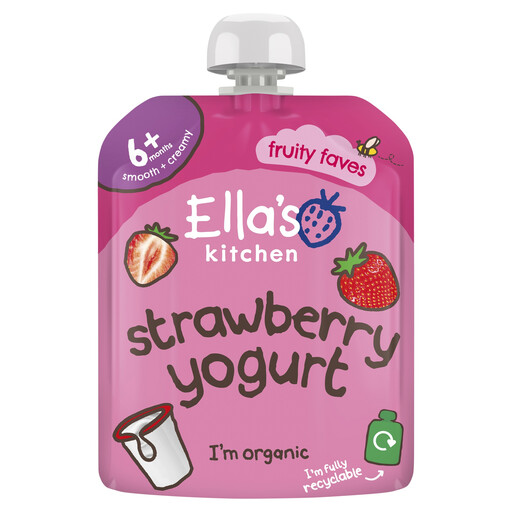 Image unavailable
This 90g strawberry yoghurt pouch suits a small fruit-flavoured serving, not a plain-yoghurt choice. For a child under 2, check the current pack for its fat level and pasteurisation information; it contains milk, so follow the child’s clinician’s advice if cow’s-milk allergy is diagnosed or suspected. Refrigerate an opened remainder and use it within 24 hours. Keep the cap away from children under 36 months.
Not as the default choice: NHS feeding guidance recommends full-fat dairy products up to age 2 and identifies pasteurised, plain or unsweetened yoghurt as a suitable starting route. For a child over 2 who can eat dairy, a lower-fat option can be considered.
No. Check the specific ingredients and sugars line: fruit, honey or sweetener-containing recipes should not be treated as plain yoghurt. For example, Sainsbury’s describes the sugars in FAGE Total 0% as naturally occurring milk sugar, while Müller describes its Light Greek Style Lemon yoghurt as containing sweetener.
Do not choose a dairy Greek yoghurt for a child with a diagnosed cow’s-milk allergy unless it is part of their clinician’s advice or allergy plan. The NHS identifies cows’ milk as a food that can trigger an allergic reaction; check the current ingredients and allergen declaration if an allergy is suspected.
Follow the instruction on the selected tub and keep it refrigerated as directed. After-opening periods can differ between products, so compare that instruction with how often your household will serve the yoghurt before choosing a large pack.