Hosts serving yoghurt with fruit
Plain yoghurt lets you add fruit separately and see what is in each serving. NHS guidance distinguishes the sugars in plain yoghurt from free sugars; a fruit-flavoured product still needs its own ingredient check.


For a children’s party, plain or natural Greek yoghurt is a starting point if you want a simple base to serve with fruit; individual pots or pouches make separate servings easier, while fruit-flavoured recipes need their own ingredient check. Neither “plain” nor “Greek-style” establishes that a child will find the yoghurt mild, so try the exact product beforehand if taste matters. Dairy Greek yoghurt contains milk: check guests’ allergy requirements and the current pack before serving it.
The useful starting point is how the yoghurt will be served and whether every guest can have a milk-containing food.
Plain yoghurt lets you add fruit separately and see what is in each serving. NHS guidance distinguishes the sugars in plain yoghurt from free sugars; a fruit-flavoured product still needs its own ingredient check.
Pots or pouches can be handed out without scooping from a shared tub. Tesco lists Greek-style plain yoghurt in 4 × 90g pots, while Sainsbury’s lists an 85g Little Yeos natural Greek-style pouch. Check a pouch’s age warning before choosing it for younger guests.
The Food Standards Agency identifies yoghurt as a food that commonly contains milk. Establish each guest’s requirements before the party, check the actual packs and keep any separately chosen alternative and its serving utensils managed according to the child’s agreed requirements.
Choose the serving format first, then compare the exact recipe and pack instructions; none of these choices guarantees a mild taste.
Choose it when: you will portion supervised bowls or add fruit separately and want a plain base.
Allow for: clean serving utensils, refrigeration and the exact tub’s instructions after opening.
Choose them when: separate servings matter more than scooping from one tub.
Check: the recipe and any cap or age warning; a small pack is not automatically suitable for every child.
Choose it when: you want a particular flavour rather than a plain base.
Check: the full ingredients, including any sweetener; a no-added-sugar claim does not mean an unflavoured recipe.
| Priority | What to check | Your needs |
|---|---|---|
| Milk and ingredients | Read the current pack’s milk-allergen declaration and full ingredients. Check each flavour and pack size separately. | I need to know what every guest can be served, with a separate arrangement for anyone who cannot have milk. |
| Recipe | Compare plain or natural yoghurt with the ingredients in a fruit-flavoured version. Check a no-added-sugar claim alongside any sweetener declaration. | If I am adding fruit myself, I want a plain base; if I choose a ready-flavoured serving, I want to know what else is in it. |
| Serving format | Compare the number and size of individual servings with a tub you will portion. For pouches, read the cap warning and serving directions. | Separate packs would simplify handing food out, but a shared tub could work if I can supervise portioning. |
| Taste and storage | Do not use “natural” as a measure of mildness: M&S describes one unsweetened Greek-style yoghurt as tangy. Follow the chosen pack’s refrigeration and after-opening instructions. | I want the child to accept the actual flavour, so I may try it beforehand rather than rely on a description. |
A natural yoghurt can taste tangy; M&S describes its unsweetened Greek-style natural yoghurt that way. The recipe alone cannot establish whether a particular child will like it.
Use the ingredients to choose between plain and flavoured recipes, then try the exact product with your child before the party if acceptance is important.
Müller lists aspartame and flavourings in its Light Greek Style Strawberry yoghurt, which also carries a 0% added sugar claim. That claim does not describe the whole recipe.
Read the ingredient list for the exact flavour. If you want a plain base, select one on its own ingredients rather than on a front-of-pack sugar claim alone.
The Food Standards Agency identifies milk as an allergen and yoghurt as a common milk-containing food. A child-oriented pack is not an exception.
Ask about guests’ requirements before buying, check each current pack and do not serve dairy Greek yoghurt to a child with a milk allergy.
Small packs can make distribution easier, but the Little Yeos natural Greek-style pouch listed by Sainsbury’s says to remove the cap before giving it to a child under 36 months.
Read the age warning, storage instructions and serving directions for the particular pouch before deciding whether it fits the guest group.
These examples show how recipes and formats differ; a brand name alone does not establish mildness or suitability for a guest.
A plain Greek yoghurt option for hosts preparing servings from a tub.
Its Little Yeos range includes an individually packed natural Greek-style yoghurt.
A reference for comparing a flavoured Greek-style recipe with a plain yoghurt.
Its listed Greek-style yoghurt range provides both individual-pot and larger-tub formats.
A retailer reference for the individual Little Yeos natural Greek-style pouch.
Its natural Greek-style and strained Greek yoghurts illustrate why the exact product description matters.
These individual Ella’s Kitchen fruit-and-Greek-style-yoghurt blends suit a different serving plan from a plain yoghurt tub: fruit is already in the pouch. Neither product name establishes a mild taste, and both require a milk-allergen check.
 No image available
The 90g pouch provides a separate fruit-and-yoghurt serving rather than a plain yoghurt base. Its product information describes a no-added-sugar recipe with mango, apple and banana, and lists milk.
It is described for children from 6 months. Follow its direction to serve on a spoon or in a bowl rather than letting a child slurp from the pouch; the cap carries a choking-hazard warning for children under 36 months. Check the current pack and guests’ allergy requirements.
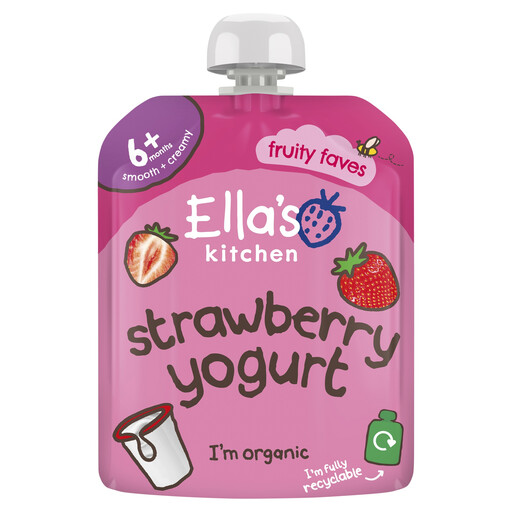 No image available
This 90g pouch is another separate-serving option, blending Greek-style yoghurt with strawberries, bananas and apples rather than offering plain yoghurt. Its product information states no added sugar and lists milk.
It is described for children from 6 months. The serving directions allow use from the pouch or a bowl under adult supervision; the cap carries a choking-hazard warning for children under 36 months. Check the temperature, current pack and guests’ allergy requirements before serving.
No. Plain describes the recipe, not how every child will perceive its flavour: M&S describes one unsweetened Greek-style natural yoghurt as tangy. If taste acceptance matters for the party, try the exact product with your child beforehand.
Do not serve dairy Greek yoghurt to a child with a milk allergy. The Food Standards Agency identifies milk as an allergen and yoghurt as a common milk-containing food; check the guest’s agreed requirements and the current labels when arranging a separate alternative.
No. Müller Light Greek Style Strawberry carries a 0% added sugar claim but lists aspartame and flavourings. Read the full ingredients of the exact flavour and pack rather than treating the claim as a description of the whole recipe.
Follow the refrigeration and after-opening directions on the exact pack. For example, M&S instructs that its Authentic Greek Yogurt be kept refrigerated at 0°C to +5°C and eaten within three days of opening; those instructions should not be assumed to apply to another yoghurt.