Families packing lunches for a day out
Choose a portion that is practical to pack, then check whether its label requires refrigeration before or after opening. Refrigerated dairy yoghurt needs a plan for keeping it chilled until it is eaten.


Neither “Greek” nor “0%” tells you whether a child will find a yoghurt mild. Plain yoghurt lets you adjust the flavour with fruit, while flavoured portions are easier to pack but call for an ingredients check. For a lunch away from home, follow the exact pack’s storage instructions: chilled tubs and unopened cupboard-stored pouches have different requirements.
Choose a portion that is practical to pack, then check whether its label requires refrigeration before or after opening. Refrigerated dairy yoghurt needs a plan for keeping it chilled until it is eaten.
A child’s response to tangy yoghurt is individual. A small serving of plain yoghurt with familiar fruit lets you adjust the combination before committing to a large tub; a flavoured portion has a fixed recipe.
Individual portions reduce the need to decant a lunch serving. Larger tubs offer flexibility for several servings, but make it important to check ingredients, milk-allergen information and instructions for use after opening.
Start with the flavour the child is willing to try, then compare the exact recipe, portion and storage instructions for the lunch you are planning.
| Priority | What to check | Your needs |
|---|---|---|
| Flavour | Check whether it is plain or fruit-flavoured. Do not assume natural, fat-free or Greek-style means mild; Marks & Spencer describes its natural Greek-style yoghurt as tangy. | I would rather try a small serving with familiar fruit than buy a large tub before knowing whether the child likes it. |
| Ingredients and nutrition | Read the ingredients alongside sugars, fat and saturates per 100g, then consider the portion. “No added sugar” does not mean sugar-free or free from sweeteners. | If I choose a flavoured yoghurt, I want to know what provides its flavour and whether it contains a sweetener. |
| Portion format | Compare the individual pot or pouch size with the serving you intend to pack. For a larger tub, check how long it can be kept after opening. | A ready-portioned pack makes a one-off lunch simpler; a tub makes more sense if we will use the remaining yoghurt within its stated period. |
| Storage | Follow the exact pack’s unopened and after-opening instructions. Refrigerated tubs need to stay chilled; some unopened fruit-and-yoghurt pouches can be stored in a cupboard but require refrigeration once opened. | For a day away from home, I need a way to meet the storage instructions until the yoghurt is eaten. |
| Milk ingredients | Check the allergen declaration on the exact pack. The Food Standards Agency identifies milk as an allergen; lactose-free does not mean milk-free. | If the child has a milk allergy, I cannot treat a dairy Greek yoghurt or a lactose-related claim as a milk-free option. |
Natural, Greek-style, fat-free and fruit-flavoured describe different aspects of a product, not how a particular child will experience its taste. Marks & Spencer describes its natural Greek-style yoghurt as tangy.
Try a small serving if acceptance is uncertain. Choose plain yoghurt when you want to control the fruit or other ingredients added to it.
Ocado lists Müller Light Greek Style Strawberry as having no added sugar, but also lists 7.4g sugars per 100g and aspartame in its recipe. Plain yoghurt can contain naturally occurring sugars too.
Compare sugars per 100g and read the ingredients and any safety wording on the exact pack.
Refrigerated yoghurt must be kept according to its label. Larger opened tubs also have a limited period for use: Ocado lists five days for Fage Total 5% and three days for Yeo Valley Organic 0% strained yoghurt.
Pack a sealed portion and arrange storage that meets its instructions until lunch. Check the date and after-opening directions before using a tub across several days.
A lactose-related claim does not establish that a dairy yoghurt contains no milk proteins. The Food Standards Agency identifies milk as a possible risk for people with an allergy or intolerance to milk or its constituents.
For a child with a milk allergy, do not select dairy Greek yoghurt on the basis of a lactose-related claim; check the exact pack’s allergen declaration.
These examples illustrate recipes and pack formats to compare; none establishes which yoghurt a particular child will find mild.
The Fage Total 5% natural strained yoghurt listed by Ocado is a plain option for serving as it comes or pairing with fruit.
Ocado lists Müller Light Greek Style Strawberry as four 115g flavoured pots, a ready-portioned alternative to a plain tub.
Ocado lists Yeo Valley Organic Greek Recipe 0% Strained Natural Yoghurt as a larger plain-tub option.
Tesco Groceries lists plain Greek-style yoghurt in both individual pots and larger tubs.
Marks & Spencer describes its Greek-style natural yoghurt as unsweetened, with a traditional tangy flavour.
These portioned fruit-and-Greek-style-yoghurt blends offer a different lunch format from a plain tub. Their fruit recipes may be worth considering for a child who prefers familiar fruit flavours, but the age marking and ingredients should be checked for the child and neither pouch comes with a promise of mild taste.
 No image available
The 90g resealable pouch combines mango, apple and banana with Greek-style yoghurt for a portioned fruit-flavour option. It is labelled 6+ months, which does not establish whether a particular school-age child will like the taste. The unopened pouch may be stored in a cupboard or fridge; refrigerate after opening and use within 24 hours, following the exact pack instructions. It contains milk.
 No image available
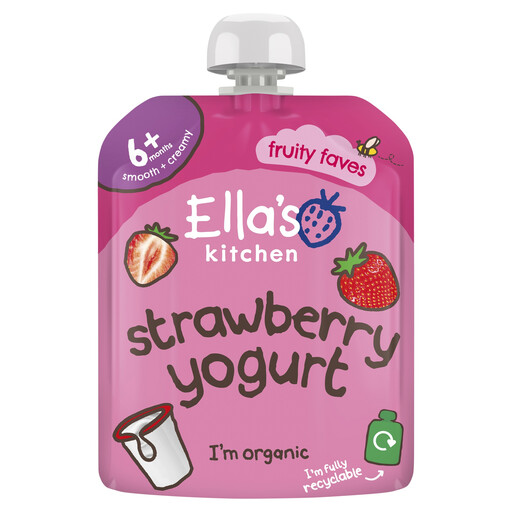
This 90g resealable pouch combines strawberry, banana and apple with Greek-style yoghurt. Its 6+ months marking does not predict a school-age child’s flavour preference. Store the unopened pouch in a cool, dry cupboard or fridge; refrigerate after opening and use within 24 hours, following the exact pack instructions. It contains milk.
No: the name does not tell you whether a child will find a particular yoghurt mild. Marks & Spencer, for example, describes its natural Greek-style yoghurt as tangy. Try a small serving if the child’s preference is uncertain.
No. Ocado lists no added sugar for Fage Total 5% and Yeo Valley Organic 0% strained natural yoghurt, alongside 3g and 3.5g sugars per 100g respectively. Read the total sugars figure and ingredients together when comparing products.
Yes, if you can follow the exact product’s storage instructions until it is eaten. Refrigerated yoghurt must stay chilled; the Joybuy fruit-and-yoghurt pouches shown here can be stored unopened in a cupboard but require refrigeration after opening.
No. Dairy Greek yoghurt contains milk, which the Food Standards Agency identifies as an allergen. Do not assume that a lactose-free dairy product is milk-free; check the allergen declaration on the exact pack.
Individual portions avoid decanting yoghurt for one lunch. A larger tub allows you to prepare several servings, provided you can keep it refrigerated and use it within the period stated after opening; check those instructions before choosing a tub size.