Carers packing chilled nursery lunches
Check whether the nursery can refrigerate a yoghurt pot until serving. A chilled pot and a pouch whose unopened label permits cupboard storage need different handling.


Choose a plain strained Greek yoghurt for a nursery lunch when the child can have milk and the nursery can keep the pot refrigerated until it is eaten. For babies from around 6 months, NHS guidance identifies pasteurised full-fat, plain or unsweetened yoghurt as a suitable choice. If refrigeration is unavailable, check the exact product’s unopened storage instructions rather than assuming that a later date makes a chilled yoghurt safe to store at room temperature.
Check whether the nursery can refrigerate a yoghurt pot until serving. A chilled pot and a pouch whose unopened label permits cupboard storage need different handling.
For a baby from around 6 months who has started complementary feeding and can have dairy, NHS guidance identifies pasteurised full-fat, plain or unsweetened yoghurt as a suitable choice.
Yoghurt contains milk. Check each current pack’s ingredients and allergen information against the child’s care plan before choosing an alternative.
Start with the child’s milk requirements and the nursery’s storage arrangements, then compare the yoghurt’s age guidance, ingredients and description.
| Priority | What to check | Your needs |
|---|---|---|
| Storage | Read the exact pack’s unopened and after-opening instructions. Confirm how the nursery will store and serve it. | I need the yoghurt to stay within its stated storage conditions until lunch. A later date on a chilled pot does not make it suitable for cupboard storage. |
| Baby’s age and formulation | Check age guidance, pasteurisation, ingredients and whether the yoghurt is plain or sweetened. NHS guidance identifies pasteurised full-fat, plain or unsweetened yoghurt as suitable from around 6 months. | For a baby starting nursery, I want a yoghurt that fits their stage of feeding; a fat-free label alone does not make it the default choice. |
| Milk allergen | Read the current ingredients and highlighted allergens. If choosing a milk-free alternative, check any precautionary allergen statement too. | If the child must avoid milk, I need an option that fits their care plan rather than Greek yoghurt. I cannot treat a ‘vegan’ label alone as an allergen check. |
| Strained or Greek-style | Look for an explicit ‘strained’ description if filtering matters. Compare the exact product’s ingredients and nutrition values per 100g rather than relying on ‘Greek-style’ in the name. | I want to know whether the yoghurt is described as strained, not assume that every Greek-style product is made the same way. |
The cited FAGE, Yeo Valley and Sainsbury’s yoghurt pots instruct shoppers to keep them refrigerated. The date does not replace those storage directions.
Read the exact pack and confirm the nursery’s refrigeration arrangements before sending a chilled pot.
The cited strained and Greek-style products have different descriptions and nutrition values; their names alone do not establish an identical process or formulation.
If straining matters, look for that word in the product description and compare the exact pack’s nutrition panel.
NHS guidance identifies pasteurised full-fat yoghurt as suitable from around 6 months and points to plain or unsweetened yoghurt as a choice without added sugars.
Consider the child’s age and feeding needs before choosing a fat-free formulation.
The Food Standards Agency identifies yoghurt as a milk-containing food. ‘Vegan’ wording on an alternative does not, by itself, address possible cross-contact.
Follow the child’s care plan and check the current ingredients, highlighted allergens and any precautionary statement.
FAGE describes its Total 5% plain yoghurt as strained; the cited Total 0% pot is also labelled strained.
The cited Greek Recipe 5% product is described as strained, while the separate Greek Style Natural Yogurt should be assessed on its own label.
Its cited own-label Greek Style Fat Free Natural Yogurt provides a fat-free Greek-style reference, not confirmation of straining.
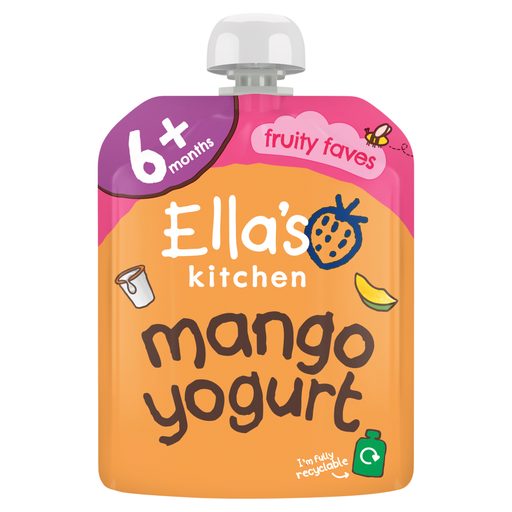
This mango Greek-style yoghurt pouch is a different option from the chilled, plain strained pots discussed above. Check its storage directions and milk ingredients for the nursery lunch; Greek-style wording alone does not confirm straining.
 No image available
For a nursery lunch, check the unopened pouch’s storage directions rather than applying the rules for chilled yoghurt pots. This 90g mango yoghurt pouch is labelled for 6+ months, contains milk and is not a plain yoghurt; its Greek-style name does not confirm straining. The supplied product guidance says to refrigerate after opening, use within 24 hours and keep the cap away from children under 36 months.
Not if its pack says to keep it refrigerated and the nursery cannot do so until serving. The cited FAGE, Yeo Valley and Sainsbury’s pots carry refrigeration instructions; check the exact pack and the nursery’s storage arrangements, or choose a different nursery-approved item.
For babies from around 6 months who can have dairy, NHS guidance identifies pasteurised full-fat yoghurt as suitable and points to plain or unsweetened yoghurt as a choice. A fat-free formulation is not automatically the appropriate substitute; consider the child’s feeding needs.
The name alone does not confirm straining. If that characteristic matters, look for an explicit ‘strained’ description on the exact product; the cited FAGE Total and Yeo Valley Greek Recipe products use that wording.
Greek yoghurt is a milk-containing food, so it does not fit a milk-free care plan. The Food Standards Agency identifies milk as an allergen and lists yoghurt among foods containing it. Check the current label and the child’s care plan when selecting an alternative.