For meals, choose plain strained Greek or plain Greek-style yoghurt if the eater already accepts its texture, or offer a small separate portion when introducing it gradually. A fruit-flavoured pot or pouch may suit a familiar snack preference, but it gives you less control over additions to a meal; check the ingredients, milk allergen declaration and storage instructions on the individual pack.
Who is this choice for?
The useful format depends on whether yoghurt is familiar, how it will be served and whether milk ingredients need checking.
Parents introducing yoghurt gradually
For parents or carers offering an unfamiliar taste or texture in small steps alongside foods a child already accepts. Berkshire Healthcare NHS Foundation Trust and Cambridge University Hospitals NHS Foundation Trust describe gradual approaches to introducing new foods.
Families looking for a plain meal ingredient
For households wanting yoghurt they can serve separately or adapt with a small familiar addition, rather than starting with fruit or dessert ingredients already mixed in.
Shoppers checking milk ingredients
For anyone who needs to distinguish a lactose-free label from a milk-free product and read the current allergen declaration before serving.
What should you check before buying?
Start with the texture and intended use, then compare the exact pack for ingredients, allergens and storage directions. A Greek, Greek-recipe or Greek-style name alone does not tell you whether two products will work the same way in a meal.
| Priority |
What to check |
Your needs |
| Familiar texture |
Check whether the yoghurt is plain, strained or blended with fruit. Consider whether it can be offered as a small separate portion without changing the rest of the meal. |
I want to introduce a texture gradually, without making a whole meal unfamiliar. A thick strained yoghurt is worth trying only if that texture is already accepted or can be offered in a small step. |
| Meal use |
Compare the ingredient lists of plain and flavoured products. Cambridge University Hospitals NHS Foundation Trust gives natural yoghurt with added savoury flavours as one example of a gradual food change; the Müller Bliss product listed by Morrisons instead contains strawberry compote and miniature biscuits. |
For a savoury dish, I would rather choose a plain base and decide what to add. If a familiar fruit flavour is the point, I am looking for a snack instead. |
| Pack details |
Read nutrition values for the exact variant and use the same per-100g basis when comparing packs. Ocado lists 3g sugars and 10.3g protein per 100g for FAGE Total 0% Fat Greek Recipe Strained Yoghurt; those figures do not describe every Greek yoghurt. |
I want to know what is already in the pot before adding it to a meal, rather than assuming plain and fruit-flavoured versions have the same ingredients or values. |
| Milk declaration |
Read the current allergen statement as well as any lactose-free wording. Ocado's listing for FAGE Total Lactose Free 0% declares milk as an allergen. |
If milk is a concern in our household, I need to check the particular product. A lactose-free label does not mean milk-free. |
| Portion and storage |
Compare the pack size with how much is likely to be served, then follow its refrigeration, use-by and after-opening directions. Marks & Spencer says its 5% Fat Authentic Greek Yogurt should be kept at 0°C to +5°C and eaten within 3 days of opening; other packs may give different instructions. |
For an initial try, a smaller pack may be easier to use. Once a yoghurt is familiar, I can consider a larger tub if the household can use it within that pack's instructions. |
Common buying mistakes
-
Expecting the product name to make a new texture acceptable
An unfamiliar taste or texture can still be rejected, regardless of what the yoghurt is called. Berkshire Healthcare NHS Foundation Trust and Cambridge University Hospitals NHS Foundation Trust describe gradual, low-pressure approaches to new foods.
Offer a small separate portion alongside accepted foods and change one characteristic at a time, rather than relying on a product claim to predict acceptance.
-
Treating every “Greek” label as the same format
Tesco lists Greek and Greek-style yoghurts separately, while the Müller Bliss Greek-style product listed by Morrisons includes compote and biscuits. Those additions matter if you need a neutral ingredient.
Compare the full product name, ingredients, nutrition panel and storage directions on the exact pack.
-
Assuming lactose-free means milk-free
Ocado's FAGE Total Lactose Free 0% listing still declares milk as an allergen.
If milk must be avoided, check the current allergen declaration rather than relying on a lactose-free statement on the front of the pack.
-
Buying a large tub for a first try
If the texture is rejected after opening, some of the yoghurt may go unused; chilled products also have pack-specific after-opening instructions.
Consider a smaller pack for an initial serving. Choose a larger tub when its texture is familiar and you can follow the stated storage period.
An opened tub that goes unused creates food waste.
Brands and formats to compare
These examples show why the exact product matters more than the brand alone: plain strained pots, Greek-style yoghurt and dessert formats have different uses.
FAGE Total
Its Greek-recipe strained range includes plain 0% products in different pack sizes.
- Ocado lists 3g sugars and 10.3g protein per 100g for the FAGE Total 0% Fat Greek Recipe Strained Yoghurt cited here.
- Those values belong to that product, not every FAGE variant. Check the selected pack's ingredients, milk declaration and refrigeration directions.
Yeo Valley
Its organic Greek Recipe 0% Strained Natural Yogurt is a plain option to compare when a neutral meal ingredient is needed.
- The product description presents it as a strained natural yoghurt.
- Check the individual pack rather than assuming its ingredients, nutrition or texture match another product labelled Greek-style.
Tesco
Tesco Groceries lists separate Greek and Greek-style yoghurt ranges, including plain formats in different pack sizes.
- The separate listings make it possible to compare the named format and pack size before choosing a meal ingredient.
- Use the current product pack to confirm ingredients, allergens and storage directions for the variant you buy.
M&S
Marks & Spencer lists authentic Greek yoghurt products, including 0% and 5% variants.
- Marks & Spencer describes its cited 0% Authentic Greek Yogurt as made in Greece from cow's milk with live cultures and strained.
- Its cited 5% product specifies storage at 0°C to +5°C and use within 3 days after opening; follow the directions for the particular pack.
Müller
Müller Bliss is a Greek-style dessert format to consider when a fruit-flavoured snack is wanted.
- The Strawberries & Cream product listed by Morrisons contains strawberry compote and miniature biscuits.
- Those additions make it a different choice from plain yoghurt for a savoury dish or a meal where you want to control additions.
Fruit-flavoured yoghurt options on Joybuy
These two fruit-flavoured yoghurt pouches are snack options for children aged 6 months and over. Consider them when the named fruit flavour is familiar; neither is a plain base for a savoury meal.
 No image available
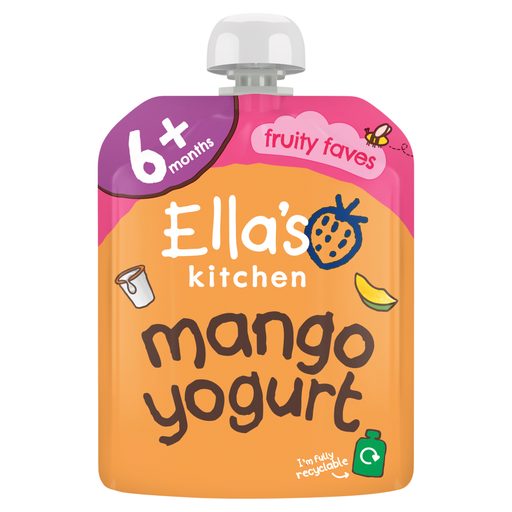
Ella's Kitchen Organic Mango Greek Style Yoghurt Pouch, 6+ Months, 90g
A mango-flavoured snack pouch to consider if that flavour is familiar, rather than a plain yoghurt for meals. The named size is 90g and the age marking is 6+ months. It contains milk; check the current allergen statement. The pouch directions say to refrigerate after opening and use within 24 hours.
Joybuy
 No image available
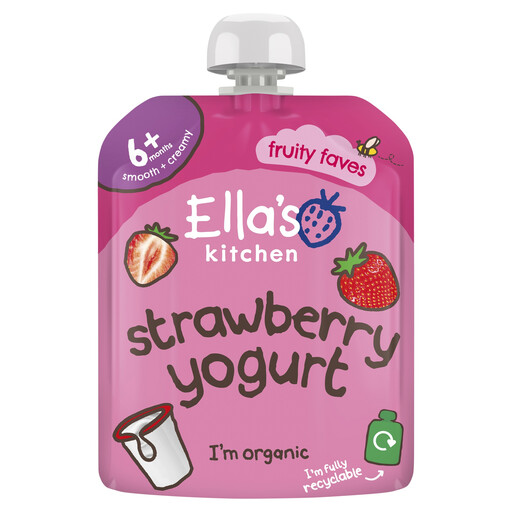
Ella's Kitchen Greek Yoghurt With Strawberry, 6+ Months, 90g
A strawberry-flavoured snack pouch to consider if that flavour is familiar, rather than a neutral ingredient for meals. The named size is 90g and the age marking is 6+ months. It contains milk; check the current allergen statement. The pouch directions say to refrigerate after opening and consume within 24 hours, and to keep the cap away from children under 36 months.
Joybuy
Questions about choosing and serving yoghurt
Should I use yoghurt to introduce a new meal to a fussy eater?
Yoghurt can be offered in a small, separate, low-pressure step alongside accepted foods, but no product guarantees acceptance. Berkshire Healthcare NHS Foundation Trust and Cambridge University Hospitals NHS Foundation Trust describe gradual approaches when unfamiliar food characteristics are a barrier.
Is plain Greek yoghurt more useful than a flavoured pot for meals?
Plain yoghurt gives you control over what, if anything, is added, so it is the more flexible choice for a savoury meal. Check the exact product: the Müller Bliss Greek-style pot listed by Morrisons contains strawberry compote and biscuits, making it a different choice from a plain ingredient.
Does lactose-free Greek yoghurt mean milk-free?
No. Ocado's listing for FAGE Total Lactose Free 0% declares milk as an allergen. Check the current allergen statement on the product you intend to serve.
How long can Greek yoghurt be kept after opening?
Follow the directions on the individual pack rather than applying one period to every yoghurt. Marks & Spencer instructs buyers of its cited 5% Fat Authentic Greek Yogurt to keep it at 0°C to +5°C and eat it within 3 days of opening.


