Weekend brunch hosts
If yoghurt is a shared base for fruit or granola, a plain pot lets everyone add their own toppings. Match its size and texture to the servings planned, and check how soon it must be eaten after opening.


For a shared weekend breakfast, choose between strained and Greek-style yoghurt by checking the exact pot, not just its name: Tesco Groceries lists 9.0g protein per 100g for Yeo Valley’s strained 5% Greek Recipe yoghurt and 4.5g per 100g for its separate Greek Style pot. A flavoured portion serves a different need from a plain pot for sharing. Straining whey from yoghurt does not establish anything about the shelf life of filtered milk or the yoghurt.
If yoghurt is a shared base for fruit or granola, a plain pot lets everyone add their own toppings. Match its size and texture to the servings planned, and check how soon it must be eaten after opening.
Compare the exact products per 100g rather than relying on “Greek” in the name. Tesco Groceries lists 9.0g protein per 100g for Yeo Valley’s strained 5% Greek Recipe yoghurt and 4.5g for its Greek Style yoghurt.
A flavoured portion may be more convenient than serving from a shared pot. Check who the product is intended for, its portion size, ingredients and storage directions before choosing it for breakfast.
Decide whether breakfast calls for a plain pot to share or individual portions, then compare labels and storage instructions on the products you are considering.
| Priority | What to check | Your needs |
|---|---|---|
| Texture and protein | Look for an explicit description of straining if that process matters to you. Compare protein per 100g on the exact pots: Tesco Groceries lists 9.0g for Yeo Valley 5% Greek Recipe and 4.5g for Yeo Valley Greek Style. | I want a plain yoghurt to spoon alongside fruit or granola, with a protein value I can compare on the label. |
| Ingredients and nutrition | Compare fat and sugars per 100g, alongside the ingredient and allergen declarations. Do not treat “Greek-style” as a statement of how the yoghurt was processed or what its nutrition values will be. | A plain base lets me choose my own toppings; for a flavoured portion, I want to know what is already in it. |
| Size and storage | Check the amount in the pack, its date mark, refrigeration directions and period after opening. Tesco Groceries says to eat its Yeo Valley Greek Style 450g pot within 3 days of opening. | For a shared pot, I need enough for the planned servings without opening more than we expect to use in the labelled period. |
The names alone do not establish the same process or nutrition values. Tesco Groceries describes whey being strained from Yeo Valley’s 5% Greek Recipe yoghurt; its separate Greek Style product has a different labelled protein value.
Read the description if straining matters to you, then compare the exact pots’ per-100g nutrition panels.
A pot intended for several breakfasts still has its own after-opening instruction. Tesco Groceries says to eat its Yeo Valley Greek Style 450g pot within 3 days of opening.
Plan the servings around the pack size and follow the tub’s refrigeration and after-opening directions.
“Plain”, “Greek-style” and “flavoured” do not replace the exact product’s ingredient and allergen declaration. The UK Department for Environment, Food & Rural Affairs and Food Standards Agency state that prepacked-food labels include ingredients and allergens.
Check the current pack when an ingredient or allergen affects your choice.
These examples illustrate formats to compare; a brand name does not tell you the nutrition or ingredients of every product in its range.
Its 5% Greek Recipe and Greek Style natural yoghurts provide two distinct shared-pot examples.
A reference when considering a flavoured or portioned yoghurt instead of a plain breakfast base.
A reference for shoppers considering portioned yoghurt.
Its Cherry Yogurt is a fruit-flavoured big-pot example for a shared breakfast.
An own-label reference when comparing Greek yoghurt formats.
These are small, fruit-flavoured yoghurt portions labelled for children aged 6 months and above. They suit a different breakfast use from a plain pot shared with fruit or granola.
 No image available
This 90g mango yoghurt pouch is labelled for children aged 6 months and above, so consider it for a child’s individual portion rather than a plain pot to share. Check the current pack’s ingredients, allergens and after-opening directions.
 No image available
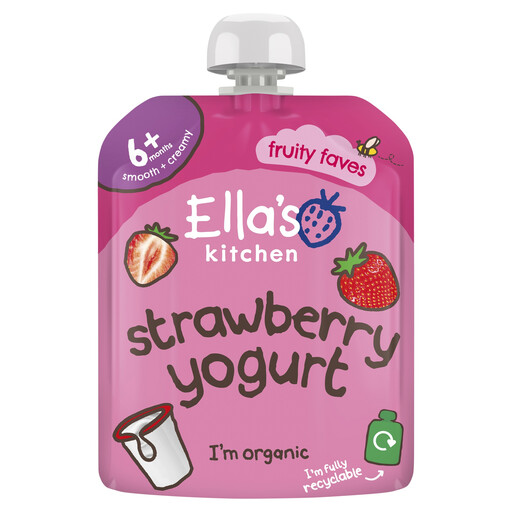
This 90g strawberry yoghurt is labelled for children aged 6 months and above. It is an individual flavoured portion, not a shared plain breakfast base; check the current pack’s ingredients, allergens and storage directions.
Not necessarily. Tesco Groceries explicitly describes whey being strained from Yeo Valley’s 5% Greek Recipe yoghurt, while its separate Greek Style product is described as Greek-style. Check the description of the exact tub if the process matters to you.
Follow the instruction on that pot. Tesco Groceries says its Yeo Valley Greek Style 450g yoghurt should be eaten within 3 days of opening; do not apply that period to a different product without checking its label.
No. GOV.UK explains that use-by dates relate to food safety, while best-before dates relate to quality. Check which date appears on the yoghurt and follow its storage instructions.
Compare the ingredient list, allergens, pack size and nutrition values on the exact products. UK guidance from the Department for Environment, Food & Rural Affairs and Food Standards Agency says prepacked-food labels include ingredients, including allergens, and a best-before or use-by date.
Check the allergen declaration on the exact product before serving it. The Food Standards Agency identifies milk as a common ingredient in yoghurt; do not assume that a different flavour or format is milk-free.