Regular leafy-green juicers
If kale, spinach or celery will feature often, check the exact model’s ingredient guidance and how its filter handles fibrous produce before prioritising the smallest appliance.


If leafy greens are your main ingredient, consider a cold-press model whose instructions cover them, provided its height and cleaning routine suit your kitchen. A compact centrifugal juicer may suit you better when space and a quicker routine take priority; check the exact model’s ingredient guidance rather than assuming either format will extract more juice.
If kale, spinach or celery will feature often, check the exact model’s ingredient guidance and how its filter handles fibrous produce before prioritising the smallest appliance.
Worktop area, cupboard height and space for removable parts all affect whether you can store the juicer and use it comfortably each day.
If preparation time is tight, chute width and cleaning access may matter more to your routine than choosing a slow-juicer format.
Consider it: When a shorter preparation routine and limited worktop space shape the choice.
Trade-off: Compactness does not establish how well a particular model processes leafy greens; check its ingredient guidance.
Consider it: When leafy greens are central to your juice and you have room for the model you choose.
Trade-off: Check the assembled height and cleaning routine; a cold-press label alone does not establish extraction results.
For green juice in a small kitchen, decide which constraint takes priority, then check the exact model against your available space and ingredients.
| Concern | What to check | Who this matters to |
|---|---|---|
| Leafy greens | Check whether the model’s instructions name your usual greens and how to access its filter for cleaning. | If kale, spinach or celery will be in most batches, I need to know the model is intended for those ingredients. Around 31% of consumers put handling greens first. |
| Kitchen fit | Compare width, depth and height with your worktop or cupboard, allowing room to use and remove accessories. | With a crowded worktop and a low cupboard shelf, I need the complete appliance to fit between uses. Roughly 25% of consumers make kitchen fit their primary concern. |
| Cleaning | Identify which removable parts are dishwasher-safe and whether the screen is easy to reach. | If I make juice frequently, a screen that takes effort to clean could disrupt the routine. About 25% of consumers prioritise cleaning effort. |
| Preparation time | Compare feed-chute width and the model’s instructions for preparing your usual ingredients. | When mornings are short, I want to spend less time cutting produce before juicing. Around 19% of consumers put quick preparation first. |
Wattage does not tell you whether a juicer fits your cupboard or how its screen handles your usual greens. Which? assesses juicing, cleaning, noise and ease of use separately.
Check the exact model’s dimensions, ingredient instructions and cleaning arrangement alongside its motor specification.
A narrow footprint can still come with substantial height. Kuvings lists its B8200S at 228 × 208 × 450 mm, so vertical clearance matters as well as counter area.
Measure where you will assemble and store the juicer, including room to remove the jug or pulp container.
Dishwasher-safe removable parts do not eliminate the need to clean a juice screen or areas where pulp collects.
Check which parts can go in the dishwasher and follow the manufacturer’s instructions for cleaning the screen after use.
Variant details can affect whether the appliance suits your kitchen and electrical supply.
Compare the full model identifier, supplied plug, voltage rating and included accessories on the product page before ordering.
These product lines illustrate different approaches to green juice, preparation and storage; compare the particular model rather than treating a brand name as a specification.
The JC151UK is a cold-press option to consider when leafy greens are a regular ingredient.
The Viva Collection HR1832/01 offers a compact centrifugal route; it is a different model from the HR1889/71 shown below.
The Juicer 800W is a centrifugal option for people weighing a wider chute against the space available.
The B8200S is a vertical slow juicer for a kitchen with sufficient overhead clearance.
The BJE430SILUK is a centrifugal option to consider when making larger batches matters more than minimising storage space.
These two juicers offer a slow-juicer route and a centrifugal route for making green juice. Check each model’s dimensions, ingredient instructions and supplied variant against your kitchen and routine.
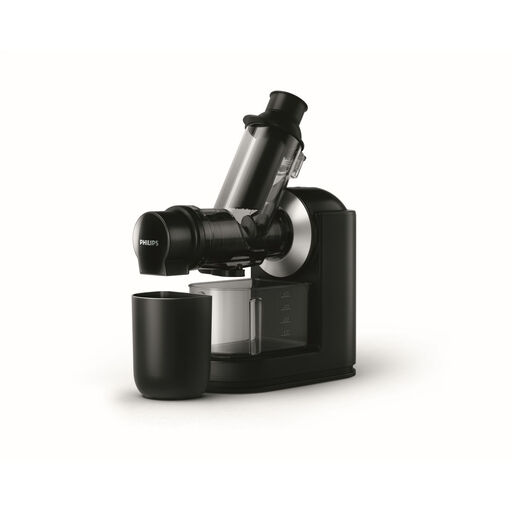 No image available
Consider this slow-juicer model if leafy greens are a regular part of your juice and you have room for a masticating appliance.
Check the HR1889/71’s assembled dimensions, ingredient instructions and cleaning requirements against your available space and routine.
 No image available
Consider this centrifugal model if you want to juice greens while prioritising a wider feed chute and a quicker preparation routine.
nutribullet UK lists a 3-inch chute and two speeds for the Juicer 800W. Check how much counter space the appliance and its pulp basin need.
Confirm the supplied unit’s UK-compatible voltage rating and plug before buying.
No. A cold-press model is worth considering when leafy greens are central to your routine, but the label does not establish how a particular juicer performs. Check its ingredient instructions, filter access, size and preparation requirements.
Measure usable width, depth and height both where you will use the juicer and where you will store it. Allow room to feed ingredients and remove the jug or pulp container; Kuvings lists the B8200S at 228 × 208 × 450 mm, while Sage lists the BJE430SILUK at 34.6 × 20.3 × 42.3 cm.
Accessible screens and removable parts make it easier to follow the model’s cleaning instructions after use. Check exactly which parts are dishwasher-safe and whether a brush is supplied; dishwasher-safe parts do not remove the need to clean areas where pulp collects.
Yes. Check current UK product-safety recall information against the exact model identifier, not just the brand. A November 2024 recall notice published by the London Borough of Bromley identified a potential metal-mesh-filter failure in an Empower Power XL Self-Cleaning Juicer.