
24/7 Customer Support

Free returns

Same-day & Next-day Delivery

Quality Guaranteed
Download the APP
Categories
Hello, I'm Joy, your Product Recommendation Officer at Joybuy. My role is to help you navigate the crowded market of 3D printing materials. Finding the right filament can be the difference between a flawless print and a frustrating failure. If you're searching for a reliable green PLA filament 1.75mm, you've likely encountered issues like inconsistent colour, tangled spools or prints that warp and fail.
This guide is designed to cut through the clutter. We'll look at the key factors you should consider before buying and highlight a few standout options that deliver on their promises, helping you get consistent, high-quality results from your FDM printer filament.
Before you add a spool to your basket, here are a few practical points to consider that will significantly impact your printing success.
The diameter of your filament is critical. A filament advertised as 1.75mm should maintain that diameter throughout the entire spool. Look for products that specify a tight dimensional accuracy, such as +/- 0.02mm or +/- 0.03mm. This precision ensures a smooth and consistent flow through your printer's extruder, dramatically reducing the risk of nozzle clogs and improving the overall quality of your prints.
A poorly wound 1kg PLA filament spool is a common source of print failures. Overlapping or tangled filament can cause the feed to snag, ruining a long print job. Many manufacturers now use automated winding systems to ensure the filament is perfectly neat. Additionally, keep an eye out for eco-friendly 3D printer filament spools. Cardboard spools are becoming more popular as they are more biodegradable than their plastic counterparts, making them a more sustainable choice.
Not all PLA is created equal. If you own a modern, high-speed printer, a standard PLA might not keep up. High speed PLA is formulated to melt and flow more efficiently at faster printing speeds, allowing you to complete projects in a fraction of the time without sacrificing layer adhesion or strength. For larger prints, look for a low warp PLA. This type of filament has reduced shrinkage as it cools, leading to better bed adhesion and minimising the frustrating corner-lifting that can ruin big models.
Based on our analysis of product specifications and features, here are some excellent options for your next project.
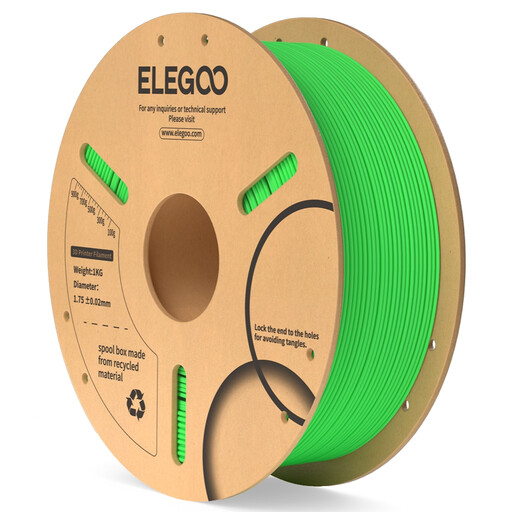
Why It Stands Out This light green PLA filament from Elegoo is a fantastic all-rounder that places a strong emphasis on reliability and sustainability. The use of a cardboard 1.75mm PLA spool is a thoughtful touch for the environmentally conscious maker. It is engineered for consistency, with rigorous manual inspection and mechanical winding to prevent tangles.
Pros
Who is it for? This filament is ideal for hobbyists, educators and makers who need a dependable, easy-to-use material for everyday printing and value sustainable packaging.
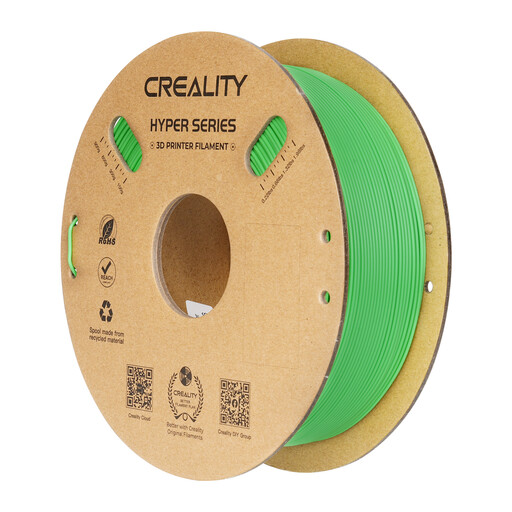
Why It Stands Out Speed is the defining feature of Creality's Hyper PLA. Designed specifically for rapid printing, it can handle speeds up to 600mm/s on compatible machines. This makes it a game-changer for rapid prototyping and producing large volumes of parts without the long wait times associated with standard PLA.
Pros
Who is it for? Users with high-speed 3D printers who need to maximise their output. It's perfect for professionals, engineers and makers focused on rapid prototyping and efficient production.
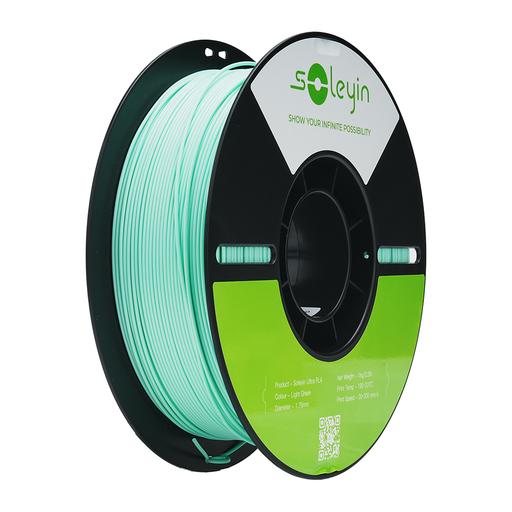
Why It Stands Out The Soleyin Ultra PLA from Creality is a premium filament that offers enhanced material properties. It provides superior toughness compared to standard PLA, making it suitable for functional parts that need to withstand some stress. The attractive matte finish gives prints a professional, high-quality appearance straight off the print bed.
Pros
Who is it for? Designers, artists and professionals who require a filament with improved mechanical properties and a superior visual finish for final products, detailed models or robust prototypes.
The world of 3D printer filament green is vast, with shades ranging from deep forest green to vibrant lime. If the options above aren't quite what you're looking for, or if you're curious about other material blends and brands, we have a wider selection available.
Explore our full range of green PLA filament here.
While there's no single "best" temperature, most PLA filaments print well within a nozzle temperature range of 190°C – 220°C. The ideal temperature can vary by brand and even by colour. Always check the manufacturer's recommendation printed on the 1.75mm PLA spool or packaging. For optimal results, it's a good practice to print a temperature tower with any new filament to dial in the perfect setting for your specific printer.
PLA (Polylactic Acid) is considered more environmentally friendly than petroleum-based plastics like ABS. It is a bioplastic derived from renewable resources such as corn starch or sugar cane. While it is biodegradable, this process requires industrial composting conditions. The growing trend of using cardboard spools, as seen with some eco-friendly 3D printer filament options, further helps to reduce the plastic waste associated with the hobby.
Warping or corner lifting is a common issue, especially on large prints. To prevent it, ensure your print bed is clean and level. Using a heated bed, typically set between 25°C – 60°C for PLA, is highly effective. You can also improve first-layer adhesion by using a brim or raft in your slicer settings. For particularly large or warp-prone models, choosing a specially formulated low warp PLA can make a significant difference.