Cream-tea hosts who prefer green tea
If green tea belongs on your table, decide whether you want a lighter cup or a blend that keeps green tea as its main ingredient while adding black tea.


If a traditional, robust cup matters more than keeping green tea in the mix, choose black tea. If you want a green-tea element, Twinings’ blend contains 70% green tea and 30% black tea, although its richer flavour is the maker’s description rather than a cream-tea pairing test. Pure green teas described by their makers as light or delicate suit a lighter contrast to the scones, jam and clotted cream.
If green tea belongs on your table, decide whether you want a lighter cup or a blend that keeps green tea as its main ingredient while adding black tea.
Check the tea composition rather than relying on the word “strong”. Twinings declares a 70% green and 30% black blend; the pure green teas described by Teapigs and Clipper are delicate or light.
Pure green and matcha-containing blends offer different ingredients and flavour descriptions. Choose by the particular product’s ingredients and preparation guidance, rather than assuming either will taste like black tea.
Decide whether the cup must remain entirely green, then check the ingredients, flavour description and brewing directions for the tea you are considering.
| Priority | What to check | Your needs |
|---|---|---|
| Cup character | Check whether the ingredients are entirely green tea or include black tea. Twinings lists 70% green tea and 30% black tea in its blend; Teapigs and Clipper describe their pure green teas as delicate or light. | I want some green tea in a fuller-tasting cup, but I would choose a pure green tea if a lighter contrast to the food appeals more. |
| Tea type | Choose between an all-green cup, a declared green-and-black blend and traditional black tea. A preference survey does not establish which one pairs with cream tea. | Keeping green tea in my cup matters more to me than following the usual black-tea route. In the UK Tea & Infusions Association’s 2025 Tea Census of over 1,000 Britons, 71% named traditional black tea their main infusion, while 13% predominantly chose green tea; those figures measure usual tea preference, not cream-tea pairing. |
| Brewing | Follow the directions for the exact tea. Teapigs recommends 80°C water and three minutes for Mao Feng; Tesco gives a three- to five-minute infusion for its own-label green tea. | I want a preparation method that fits how I make tea, without assuming a longer steep will make a light green tea taste like a traditional black brew. |
| Ingredients and claims | Read the ingredient list if pure green tea matters. Check the exact pack for organic or Fairtrade claims and for any preparation or disposal directions you intend to follow. | A single-tea product or a particular product claim may matter more to me than a description of strength. |
A declared green-and-black blend has different ingredients from a pure green tea described as light or delicate. The label “green tea” alone does not tell you which cup you will prefer with cream tea.
Read the composition first. Choose pure green tea if that is the flavour profile you want; consider a declared blend if retaining some green tea while adding black tea fits your preference.
Pukka describes Supreme Matcha Green as a smooth blend of green teas and matcha. That description does not establish how it compares in strength with a pure green tea or black tea.
Choose a matcha-containing blend for its stated ingredients and flavour direction, not as a guaranteed substitute for a robust black brew.
Teapigs specifies 80°C water and three minutes for Mao Feng, while Tesco gives a three- to five-minute infusion for its green tea.
Start with the directions for the product in your hand rather than using a longer brew to compensate for choosing a tea with a lighter stated profile.
Its blend and pure green tea give shoppers two distinct ingredient choices.
Mao Feng is a pure green-tea option with specific brewing guidance.
Its Organic Fairtrade Pure Green Tea may interest shoppers who want those claims on a pure-green product.
Its matcha-containing blends offer a different green-tea composition from a plain pure green tea.
Its own-label green tea is a straightforward pure-green choice with serving directions.
This pure-green tea-bag option is for a cup alongside cream tea when keeping to green tea matters more than recreating a traditional black brew.
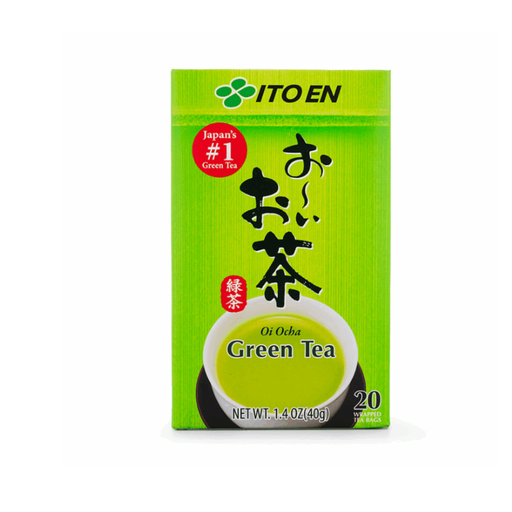 Image unavailable
Choose these green-tea bags if you want a green cup alongside cream tea rather than a traditional black brew. The stated pack size is 40g with 20 tea bags; check the pack for brewing and serving directions.
Do not assume it will: Teapigs describes its Mao Feng as delicate, Clipper calls its pure green tea light and delicate, and Twinings describes its Pure Green Tea as mellow. Choose one of those profiles if you want a lighter cup; consider a green-and-black blend if its ingredients better match what you mean by a fuller green-style tea.
Twinings Green Tea & Black Tea Blend is a compositionally clear option: Twinings lists 70% green tea and 30% black tea. Twinings describes its character as rich, but the ingredient ratio and maker’s description are not an independent test of how it tastes with cream tea.
Start with the instructions for the particular tea rather than assuming a longer steep will give you the cup you want. Teapigs specifies 80°C water and three minutes for Mao Feng, whereas Tesco gives a three- to five-minute infusion for its own-label green tea.
Follow the directions for the tea you choose: Tesco specifically says to serve its own-label green tea without milk. Do not apply that instruction to every green tea; if a familiar milk tea is central to the occasion, black tea is the more direct choice.