Green-tea drinkers looking for ginger
If you want a ginger-led drink without switching to a herbal infusion, check that green tea appears in the ingredients. Twinings lists both ginger root and green tea in its Green Tea & Ginger blend.


For a ginger-led winter cup that still contains green tea, Twinings Green Tea & Ginger lists 50% ginger root and 40% green tea. Lemon, mint and matcha blends offer different flavour directions if spice is not what you want. If avoiding caffeine matters more than keeping a green-tea base, look for an explicitly caffeine-free herbal infusion and check the ingredients and brewing directions of the exact product.
If you want a ginger-led drink without switching to a herbal infusion, check that green tea appears in the ingredients. Twinings lists both ginger root and green tea in its Green Tea & Ginger blend.
A ginger drink need not be green tea. Clipper describes its Lemon & Ginger herbal infusion as caffeine-free, while its ingredient list contains no green tea. Check the exact pack rather than relying on the flavour name.
Clipper Green Tea & Lemon, Teapigs Green Tea With Mint and Pukka Supreme Matcha Green offer citrus, mint and matcha directions respectively. Choose by the ingredients you want in the cup, not just the words “green tea” on the front.
Start with the tea base and flavour ingredients, then check caffeine information and the brewing method for the blend you choose.
| Priority | What to check | Your needs |
|---|---|---|
| Ginger and tea base | Look for both ginger and green tea in the ingredients. Twinings Green Tea & Ginger lists 50% ginger root and 40% green tea; Clipper Lemon & Ginger is a herbal infusion without green tea. | I want ginger flavour, but I still want the drink to contain green tea. |
| Other flavours | Compare the named additions: Clipper Green Tea & Lemon contains lemon peel and flavouring; Teapigs Green Tea With Mint contains peppermint leaves; Pukka describes Supreme Matcha Green as a green-tea-and-matcha blend. | A citrus, mint or matcha cup appeals to me more than a ginger-led one. |
| Caffeine information | Check the caffeine declaration on the exact pack. Clipper labels its Lemon & Ginger herbal infusion caffeine-free. Yogi Tea lists green tea in Green Tea Ginger Lemon but also calls it caffeine-free online, so seek clarification before relying on that claim. | If I am avoiding caffeine, a clearly labelled herbal infusion may suit me better than a green-tea blend. |
| Brewing method | Follow product-specific directions. Twinings specifies one Green Tea & Ginger bag in 200 ml of freshly boiled water for 3 minutes; Teapigs specifies 80°C water and at least 3 minutes for Green Tea With Mint. | I want a blend whose preparation directions work with how I make tea at home. |
Clipper Lemon & Ginger is a herbal infusion without green tea, so it will not meet a preference for a green-tea base.
Read the ingredients for green tea as well as ginger; choose a herbal infusion when that is the drink you actually want.
Yogi Tea’s Green Tea Ginger Lemon page lists 63% Sencha green tea while also describing the product as naturally caffeine-free. Those statements do not give a clear basis for a caffeine-restricted choice.
Check the current pack and ask the manufacturer to clarify the caffeine status before relying on this product for caffeine avoidance.
Ginger, lemon, mint and matcha identify different ingredients and flavour directions; the category name does not tell you which one is in the blend.
Compare the ingredient lists and choose the addition that matches the cup you want.
Twinings calls for freshly boiled water for Green Tea & Ginger, whereas Teapigs specifies 80°C water for Green Tea With Mint.
Use the directions for the product in your hand rather than carrying over another blend’s method.
Its green-tea range includes ginger, lemon, mint, pure and decaffeinated options.
Clipper offers both green tea with lemon and a separate lemon-and-ginger herbal infusion.
Pukka describes Supreme Matcha Green as a blend of green teas and matcha.
Its green-tea range includes Green Tea With Mint alongside other named tea styles.
Green Tea Ginger Lemon lists Sencha green tea, ginger, citrus ingredients, peppermint and black pepper.
Tesco lists an own-label Lemon & Ginger infusion in a 40-bag pack.
These options cover a ginger-and-matcha latte and a mint-and-matcha blend. They serve different preferences, so check the drink format and the exact tea base before choosing.
 No image available
Consider this if you want ginger and matcha in an instant latte rather than a plain green-tea infusion. The pack is labelled 10pcs, 250g.
For a caffeine-limited choice, confirm the amount per prepared drink. The product information flags milk and coconut and possible soy, nuts or gluten; check the pack if these matter to you.
 No image available
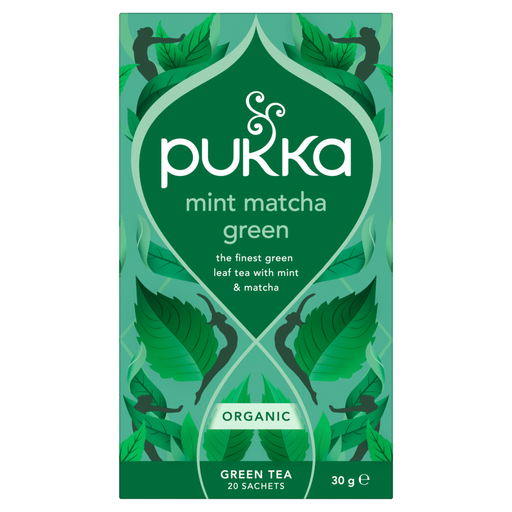
This 30g mint-and-matcha option suits a preference for mint over ginger. If a green-tea base is essential, check what type of tea the pack identifies as its roasted-tea ingredient.
Check the pack’s caffeine information if that affects your choice.
No. Twinings Green Tea & Ginger lists both green tea and ginger, while Clipper Lemon & Ginger is a caffeine-free herbal infusion without green tea. Read the ingredients if the tea base matters to you.
Check that both ginger and green tea appear in the ingredients, then compare any stated proportions. Twinings Green Tea & Ginger lists 50% ginger root and 40% green tea; Yogi Tea Green Tea Ginger Lemon lists 18% ginger and 63% Sencha green tea, alongside other ingredients.
No. Check the exact product’s caffeine information. If you need a caffeine-free drink, Clipper labels its Lemon & Ginger herbal infusion caffeine-free, but it is not green tea.
Check the current pack and seek clarification from the manufacturer before relying on it for caffeine avoidance. Yogi Tea’s Green Tea Ginger Lemon page lists Sencha green tea at 63% while also calling the product naturally caffeine-free.
No. Follow the directions for the blend you buy: Twinings specifies 200 ml of freshly boiled water and 3 minutes for Green Tea & Ginger, while Teapigs specifies 80°C water and at least 3 minutes for Green Tea With Mint.