Everyday green-tea households
If the household regularly drinks unflavoured green tea, a bagged household pack can be easier to commit to than a catering-sized supply. Check that everyone who will use it likes the same blend.


If everyone drinking it already likes unflavoured green tea, a plain bagged tea is a straightforward choice for a repeat purchase. Choose mint, lemon, jasmine or matcha-containing blends when those flavours are wanted; choose a product labelled decaffeinated when reducing caffeine is the priority. If preferences are uncertain, start with a pack the group can realistically finish before committing to a larger format.
If the household regularly drinks unflavoured green tea, a bagged household pack can be easier to commit to than a catering-sized supply. Check that everyone who will use it likes the same blend.
When several people use the supply, individually wrapped envelopes may make portions easier to distribute. Check the count, storage instructions and whether the intended drinkers want plain or flavoured tea.
Decaffeinated, mint and matcha-containing green teas answer different preferences. Read the exact product label rather than assuming that every pack described as green tea has the same ingredients or caffeine status.
Settle the blend and caffeine preference first, then choose a pack format the intended drinkers are likely to use.
| Priority | What to check | Your needs |
|---|---|---|
| Blend and ingredients | Read the full ingredient list. Clipper lists green tea as the ingredient in its Pure Green Tea; Twinings lists peppermint leaves and natural mint flavouring in its mint blend. Matcha-containing blends are another distinct choice. | I want a blend everyone sharing the pack will drink, rather than a large quantity of an unfamiliar flavour. |
| Pack format | Check the number of bags or envelopes and whether portions are individually wrapped. Twinings and Clipper list 80-bag household products; Clipper also lists a 250-envelope catering format. | For regular use at home, I can choose a pack the household will finish. For shared provision, individual portions may matter more. |
| Caffeine status | Check whether the exact product is labelled decaffeinated. Twinings says ordinary green tea contains naturally occurring caffeine and estimates around 30–40mg per 200ml cup for its green tea, varying with the tea and brewing. | If I am choosing tea to reduce caffeine intake, I need the decaffeinated variant, not just a pack labelled green tea. |
| Brewing directions | Keep the exact pack instructions. Twinings specifies freshly boiled water and three minutes for its Pure Green Tea; Teapigs specifies 80°C water and three minutes for Mao Feng. | Before ordering the same tea in quantity, I want to prepare it as directed and decide whether I like it. |
| Storage | Check the pack’s storage directions and best-before date. Clipper instructs buyers to keep its Pure Green Tea in a cool, dry place. | I need somewhere suitable to keep the supply and a pack count that fits how quickly it will be used. |
Flavoured green teas are not interchangeable with plain green tea. Twinings’ mint blend, for example, contains peppermint leaves and natural mint flavouring as well as green tea.
Check the recipe and try a smaller pack when the intended drinkers have not agreed on the flavour.
Clipper’s 250-envelope format provides individually wrapped portions, while its 80-bag format is a different way to stock the same type of tea. A larger count may also be more than the group will use.
Choose the format around how portions will be served, where the tea will be stored and how quickly it will be finished.
Ordinary green tea contains naturally occurring caffeine. Twinings estimates around 30–40mg per 200ml cup for its green tea, while noting that the tea and brewing affect the amount.
If reducing caffeine matters, check that the exact product is labelled decaffeinated.
Preparation directions differ: Twinings specifies freshly boiled water for its Pure Green Tea, while Teapigs specifies 80°C water for Mao Feng. Both give a three-minute infusion time for those products.
Keep the chosen pack’s instructions with the supply and prepare a cup as directed before deciding whether to reorder.
These brand ranges illustrate different blends and formats; check the details of the particular product you intend to buy.
Clipper lists Pure Green Tea in both an 80-bag household pack and a 250-envelope catering format.
Twinings’ UK range lists plain, lemon and jasmine green teas in 80-bag formats, alongside a decaffeinated green-tea product.
Pukka lists Supreme Matcha Green, Mint Matcha Green and Citrus Yerba Green among its UK green teas.
Teapigs lists pure Mao Feng green tea as well as mint, jasmine pearls and popcorn tea in its green-tea range.
These options cover a decaffeinated 50-bag pack and two pack sizes of Morrisons Jasmine Serenity Green Tea. The Morrisons listings describe jasmine in the name but list green tea as the sole ingredient, so check the exact recipe before choosing either as a flavoured blend.
 No image available
A 50-bag choice for a household seeking green tea labelled decaffeinated. The product description states that it is decaffeinated to 0.2%; check the exact label if a particular residual-caffeine level matters. Store it as directed on the pack.
 No image available
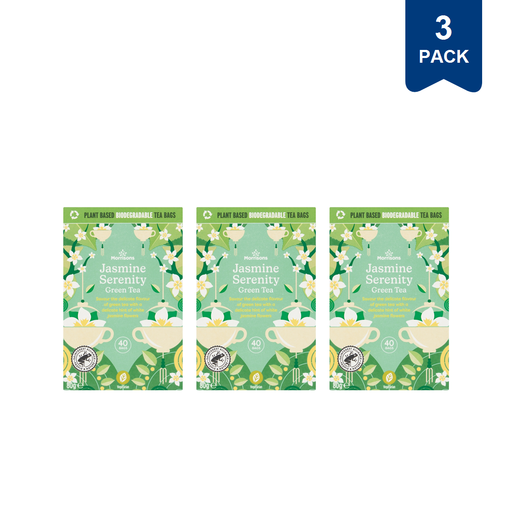
Three 40-bag boxes provide 120 bags for repeat or shared use. The listing names jasmine but gives “Green Tea (100%)” as its ingredient, so check the packaging to establish the flavour composition before committing to the bundle.
 No image available
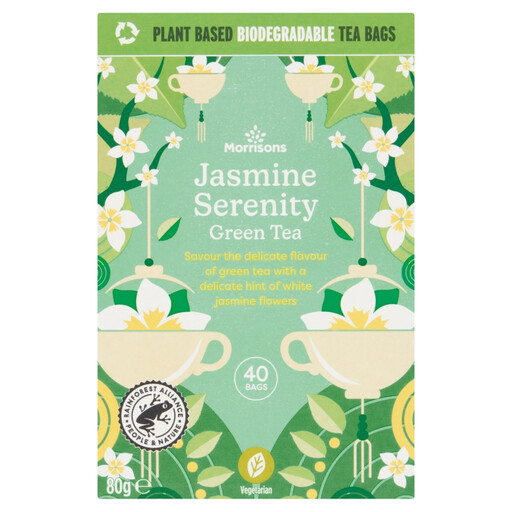
This 40-bag pack is a smaller commitment than the three-pack bundle. Its listing names jasmine but gives “Green Tea (100%)” as the ingredient; check the packaging if the jasmine flavour or a green-tea-only recipe is important to your choice.
Choose plain green tea if the intended drinkers already like it. Choose a flavoured recipe when that flavour is wanted by the people using the pack: Twinings’ mint tea, for example, contains peppermint leaves and natural mint flavouring. If preferences are uncertain, try a smaller pack first.
No. Clipper’s 250-envelope Pure Green Tea format provides individually wrapped portions for shared provision, while its 80-bag format is another option for household use. Base the count and wrapping choice on how the tea will be served, stored and finished.
Follow the exact product’s directions rather than one rule for every green tea. Twinings specifies freshly boiled water and three minutes for its Pure Green Tea; Teapigs specifies 80°C water and three minutes for Mao Feng. Prepare a cup as directed before deciding whether to repeat the purchase.
Yes. Twinings says green tea contains naturally occurring caffeine and estimates around 30–40mg per 200ml cup for its green tea, with variation according to the tea and brewing. If reducing caffeine is the reason for buying, check that the exact pack is labelled decaffeinated.
Follow the chosen pack’s storage directions and best-before date. Clipper instructs buyers to keep its Pure Green Tea in a cool, dry place; choose a pack count that fits the storage space and expected use.