Catering teams using filter machines or cafetières
Start with coffee labelled for the equipment, then use its preparation directions as a starting point for a repeatable communal-service recipe. Trial the resulting flavour with residents.


For care-home dining, choose ground coffee that states a preparation method matching the equipment in use, then trial the brewed flavour with residents rather than comparing strength numbers across brands. Filter or cafetière service calls for a product labelled for that method; an espresso or moka blend belongs in a service using that equipment. Keep regular and decaf choices aligned with residents’ preferences and individual care needs.
Start with coffee labelled for the equipment, then use its preparation directions as a starting point for a repeatable communal-service recipe. Trial the resulting flavour with residents.
Keep personal and cultural preferences in view rather than making strong caffeinated coffee the only choice. The Care Quality Commission says people’s preferences and religious and cultural backgrounds must be taken into account when providing food and drink.
Look for a ground coffee whose stated preparation method matches that equipment. An espresso or moka label alone does not establish suitability for a filter machine.
For care-home service, settle the brewing method first, then assess the cup residents will drink and the choices needed alongside it.
| Priority | What to check | Your needs |
|---|---|---|
| Brewing method | Check the exact pack for filter-machine, cafetière, espresso or moka directions. Start with its stated preparation instructions. | We use shared brewing equipment, so the coffee needs to suit the method staff actually use. |
| Flavour | Read the flavour description and use any intensity label within that brand’s range, not as a cross-brand measurement. Trial the usual serving recipe. | I would like a fuller-flavoured cup, but other residents may prefer a different taste. |
| Regular and decaf choice | Check whether a suitable decaf ground coffee can be prepared with the available equipment. Keep each resident’s preferences and care guidance in view. | Decaf should be an option when I prefer it or my individual care guidance calls for it. |
| Opened-pack storage | Follow the pack’s storage and after-opening directions. Match pack size to how quickly the home uses ground coffee. | If coffee is served less often, I want an opened pack handled in line with its storage directions. |
A larger printed number does not establish that one brand’s coffee will produce the flavour residents prefer over another’s. Lavazza describes intensity in terms of aroma and richness.
Use the label to shortlist within a brand, then taste coffee prepared at the home’s usual serving recipe.
Lavazza lists espresso and moka for Espresso Barista Intenso, while illy identifies Filter Intenso for filter coffee. Those stated methods address different service setups.
Record the home’s brewing equipment and check the exact product’s preparation directions before ordering.
A single default may not reflect residents’ individual choices. The Care Quality Commission says food and drink provision must take account of personal, religious and cultural preferences.
Offer an identifiable decaf route where appropriate, while keeping regular-versus-decaf choices aligned with individual preferences and care guidance.
Opened coffee needs the storage conditions stated on its pack; Sainsbury’s directions for Fire Up Your Morning call for an airtight container after opening.
Choose pack sizes with the home’s usage in mind, date opened packs and follow their storage directions.
These product lines illustrate different brewing and flavour choices; a brand name alone does not establish a match for the home’s equipment.
Espresso Barista Intenso is a ground coffee Lavazza labels for espresso and moka preparation.
Illy identifies its 250 g Filter Intenso ground coffee for filter preparation and Americano coffee.
Taylors describes its Rich Italian ground coffee as rich and smooth.
Rombouts Decaf is medium-ground for filter machines and cafetières.
Tesco’s Finest range includes 227 g roast-and-ground coffees, including Peruvian and Colombian Supremo variants.
Fire Up Your Morning Ground is a 227 g coffee labelled strength 6.
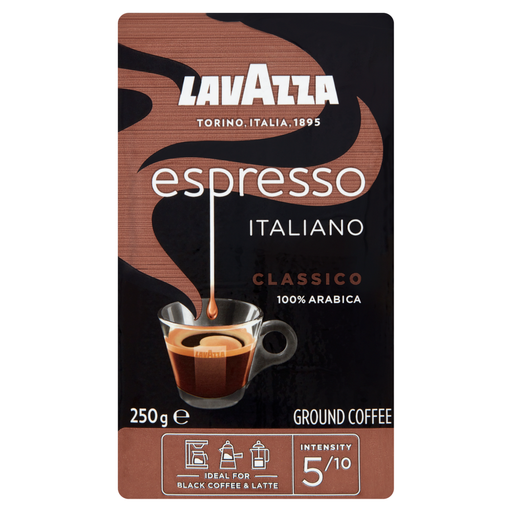
The Joybuy option below is a 250 g ground coffee to consider for care-home service. Check its pack directions against the home’s brewing equipment and trial the flavour with residents.
 No image available
For care-home service, compare the brewed flavour with residents’ preferences and check the pack’s method against the equipment used. Ground coffee in a 250 g pack.
No: numbers from different brands are not a common measure of residents’ preferences. Lavazza describes intensity in terms of aroma and richness; check the brewing method and taste the coffee at the home’s intended serving recipe.
Do not make it the only choice without considering individual preferences and care needs. The Care Quality Commission says people’s preferences and religious and cultural backgrounds must be taken into account when providing food and drink; regular and decaf choices should reflect those considerations.
Check the method used by the home’s equipment. Illy identifies Filter Intenso for filter coffee, Sainsbury’s gives filter-machine and cafetière directions for Fire Up Your Morning, and Lavazza lists espresso and moka for Espresso Barista Intenso.
Yes, if the decaf product states that method: Rombouts describes its Decaf ground coffee as medium-ground for filter machines and cafetières. Choose whether to offer it to a resident according to their preferences and individual care guidance.
Follow the exact pack directions. Sainsbury’s advises keeping Fire Up Your Morning coffee cool and dry, away from direct sunlight, and transferring it to an airtight container after opening.