Gym-goers packing a fruit-based snack
A portable smoothie may appeal if you want fruit in drink form. Compare the bottle size and sugars rather than treating “no added sugar” as a statement about the total sugar content.


A fruit smoothie can be a convenient gym-bag snack if you can follow its storage instructions and account for the amount you drink. Check the sugars and serving information rather than assuming “no added sugar” means sugar-free: the NHS advises limiting fruit juice and smoothies together to 150ml a day, with a meal. If replacing fluid after exercise is your main aim, the NHS recommends water.
A portable smoothie may appeal if you want fruit in drink form. Compare the bottle size and sugars rather than treating “no added sugar” as a statement about the total sugar content.
If vegetable ingredients or fibre matter to you, check the exact recipe and nutrition panel. A smoothie containing vegetables can still contain sugars from fruit and vegetables.
If your priority is replacing fluid after sweating, the NHS recommends water. Consider a smoothie separately as food or drink within your daily intake.
Decide whether you want a fruit-based snack or a drink for hydration, then compare the exact bottle’s portion, nutrition and storage instructions.
| Priority | What to check | Your needs |
|---|---|---|
| Sugars | Read the sugars figure and its unit, such as per 100ml. Check the ingredients as well as any “no added sugar” wording; Tesco Groceries lists 10g sugars per 100ml for its Innocent mango smoothie despite that wording. | I want to know how much sugar is in the drink, not just whether sugar has been added. |
| Portion size | Compare the bottle volume with the stated serving. The NHS advises limiting fruit juice and smoothies together to 150ml a day, with a meal; the 250ml Innocent bottle listed by Waitrose & Partners states that it contains 1⅔ servings of 150ml. | A bottle that fits in my bag may still hold more than I intend to drink at once. |
| Storage | Check whether the unopened drink needs refrigeration and follow the label after opening. The Innocent smoothies listed by Waitrose & Partners specify refrigerated storage at 0–8°C. | I need to know whether I can keep the drink at the required temperature until I have it. |
| Recipe | Compare the ingredients, vegetable content, fibre information and sugars for the exact variant. Waitrose & Partners lists 25% vegetables and 9.6g sugars per 100ml for one Innocent fruit-and-vegetable smoothie. | If I prefer vegetable ingredients or fibre, I still want to check the sugars rather than assume the recipe is sugar-free. |
| Hydration | Decide whether you primarily need a drink after exercise or a fruit-based snack. The NHS recommends water to replace fluid lost through sweating. | After a workout, I may want water even if I also choose a smoothie to have with a meal. |
| Ingredients | Read the exact product’s ingredient and allergen information, particularly for breakfast-style blends. M&S describes some smoothies made with yoghurt, dates and oats. | I want to check whether a particular recipe fits the ingredients I avoid. |
A smoothie can contain sugars from its ingredients. Tesco Groceries lists 10g sugars per 100ml for an Innocent mango smoothie labelled “no added sugar”.
Read the sugars line on the exact bottle and keep its per-100ml or per-100g unit in mind when comparing products.
The NHS advises limiting fruit juice and smoothies together to 150ml a day, with a meal. A 250ml Innocent bottle listed by Waitrose & Partners contains more than its stated 150ml serving.
Check the bottle volume before packing it and decide how much you intend to drink.
The NHS recommends water for replacing fluid after sweating. A smoothie is a different choice if you also want a fruit-based drink.
Carry water for hydration and consider the smoothie separately within your food and drink plans.
The Innocent products listed by Waitrose & Partners specify storage at 0–8°C before and after opening.
Follow the exact bottle’s instructions and plan how you will keep a chilled product at its required temperature until use.
Innocent fruit-led and fruit-and-vegetable smoothies appear in the checked 250ml and 750ml retailer listings.
Sainsbury's has listed own-label chilled fruit smoothies alongside branded products.
Tesco lists chilled smoothies and has a separate reduced-sugar juice-and-smoothies browsing category.
M&S lists smoothies in 350ml and 750ml bottles, including some breakfast-style blends.
Sainsbury's has listed Naked Blue Machine and Green Machine Super Smoothies in 750ml bottles.
This coconut milk and papaya smoothie is a bottled option to consider for a gym-bag snack. Its 180ml bottle is larger than the NHS’s 150ml daily guidance for fruit juice and smoothies combined.
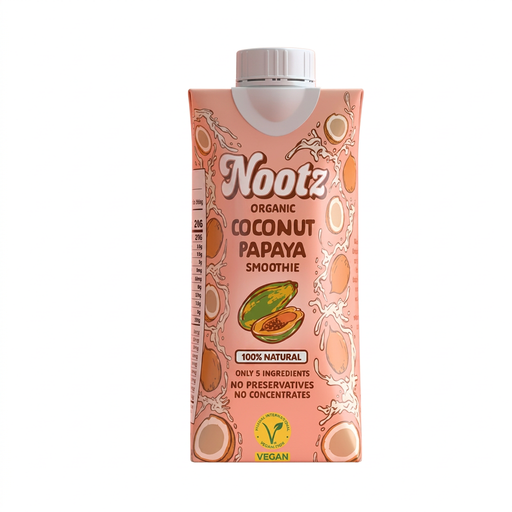 No image available
The 180ml bottle offers a portable smoothie, but check how much you plan to drink against the NHS’s 150ml daily guidance for fruit juice and smoothies combined. Its product information lists cane sugar and 7g sugars per 100g; that figure is by weight, not per 100ml or per bottle. Store it in a cool, dry place before opening, then refrigerate and consume within 24 hours.
No. Fruit ingredients can contribute sugars even when none are added. Tesco Groceries lists 10g sugars per 100ml for a checked Innocent mango smoothie labelled “no added sugar”, so compare the nutrition panel on the bottle you choose.
Not necessarily. A 250ml Innocent bottle listed by Waitrose & Partners states that 150ml is one serving and that the bottle contains 1⅔ servings. The NHS advises limiting fruit juice and smoothies together to 150ml a day, with a meal.
Choose water if replacing fluid after sweating is your main aim; that is the NHS recommendation. Treat a smoothie as a separate fruit-based choice rather than your main hydration plan.
Follow the storage instructions for the exact product. The checked Innocent smoothies listed by Waitrose & Partners require refrigeration at 0–8°C before and after opening, so plan chilled storage while carrying one.
Yes. Check the label of the particular bottle, especially when considering breakfast-style blends: M&S describes some smoothies made with yoghurt, dates and oats. Also check serving size and sugars for that recipe.