
24/7 Customer Support

Free returns

Same-day & Next-day Delivery

Quality Guaranteed

Unlock Your Welcome Offers: FREE Delivery | Up to 80% OFF | Free 30-day JoyPlus trial
Download the APP
Straining to see the road ahead on a dark, rainy night? Tired of the dim, yellowish glow from your standard halogen bulbs? You are not alone. Many UK drivers find that factory-fitted halogen bulbs lack the brightness and clarity needed for confident driving, especially in poor weather. Furthermore, their shorter lifespan means more frequent and often fiddly, replacements.
Upgrading to an H1 LED bulb is a straightforward way to enhance both the safety and style of your vehicle. This guide is designed to help you understand the key features to look for in an H1 halogen replacement. We will walk you through what matters most when choosing a bulb and present a few carefully selected options to help you make an informed decision.
Navigating the specifications for car bulbs can seem complex. Here are three key factors to consider to ensure you get a reliable and effective upgrade.
The primary reason for upgrading is better visibility. Brightness is measured in lumens, and a higher lumen count generally means a brighter light output. Equally important is the colour temperature, measured in Kelvin (K). A 6000K H1 bulb (or 6500K) produces a crisp, cool white light that closely mimics natural daylight. This colour rendering can reduce eye strain and make it easier to spot hazards on the road compared to the warm, yellow light of halogens. A bright H1 bulb is a significant safety enhancement.
For many car owners, ease of installation is a top priority. Look for a plug and play H1 LED bulb. These are designed to be a direct replacement for your old halogen bulbs without any need for complicated wiring or modifications. A 1:1 mini H1 bulb is particularly useful, as its dimensions are almost identical to the original halogen, ensuring it fits perfectly into the headlamp housing without any clearance issues.
Modern vehicles often use a Controller Area Network (CANBUS) system to monitor the vehicle's electrical components, including the headlights. Because LED bulbs draw less power than halogens, the CANBUS system can sometimes mistakenly register this as a fault, leading to a warning light on your dashboard or flickering lights. To avoid this, it is wise to choose a CANBUS H1 LED bulb. These bulbs have built-in resistors or circuitry to communicate correctly with your vehicle's computer system, ensuring seamless, error-free operation.
Based on the features that matter to UK drivers, here are some recommended H1 LED bulbs to consider for your next upgrade.
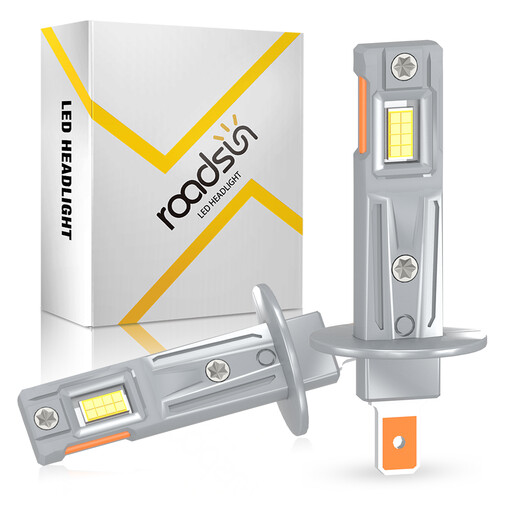
Why It Stands Out: This bulb is a versatile option, designed for use as either an H1 fog light bulb or a turn signal. Its standout feature is the strong light penetration, which is engineered to cut through fog, rain and haze effectively. The 6000K pure white light provides excellent clarity in adverse conditions.
Pros:
Who is it for?: Drivers looking for a robust, multi-functional bulb with a focus on superior performance in challenging weather conditions.
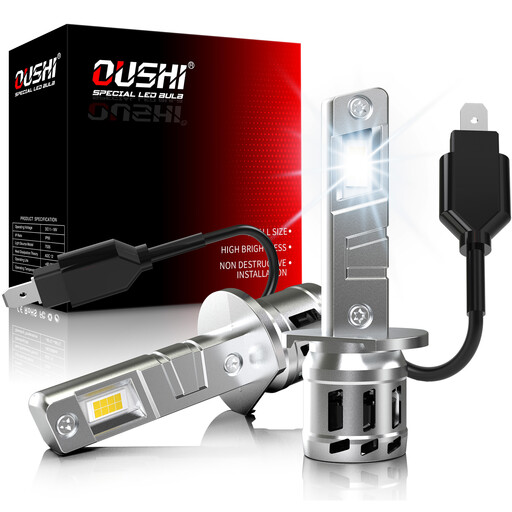
Why It Stands Out: The OUSHI H1 bulb is built for high-performance lighting and compatibility. It incorporates a high-speed turbo cooling fan to maintain optimal operating temperature and features an advanced CANBUS H1 LED system, making it suitable for a wide range of vehicles, including many European models that are sensitive to bulb changes.
Pros:
Who is it for?: Owners of modern cars, particularly European makes, who need a powerful H1 LED headlight bulb with reliable CANBUS compatibility.
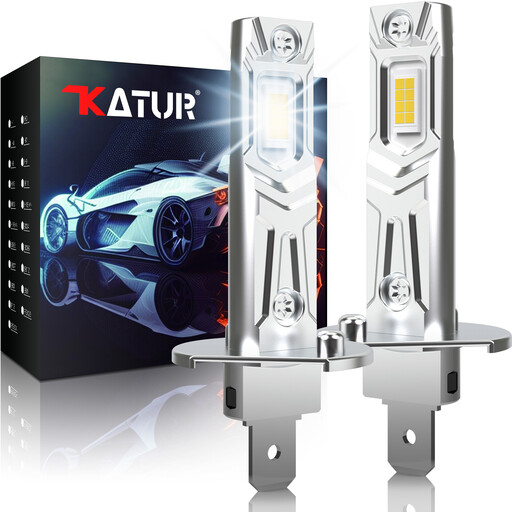
Why It Stands Out: The KATUR H1 bulb’s key feature is its fanless design. By using an aviation-grade aluminium body for passive heat dissipation, it eliminates the noise and potential failure point of a mechanical fan. This, combined with its compact, all-in-one design, makes for an incredibly straightforward installation.
Pros:
Who is it for?: The DIY enthusiast who values simplicity and reliability, or anyone with limited space in their vehicle's headlight housing.
While these recommendations cover a range of needs, every vehicle and driver is different. If you are looking for a different specification or simply want to see more choices, we have a wider selection available.
Explore our full range of H1 bulb options to find the perfect match for your vehicle's needs.
Q1: Are H1 LED bulbs a direct replacement for halogen bulbs? A: Yes, in most cases. Bulbs designed as a plug and play H1 LED with a 1:1 mini H1 bulb profile are intended to be a direct swap. However, it is always a good practice to check your vehicle's manual and the bulb's dimensions to ensure a perfect fit before purchasing.
Q2: Will I get an error on my dashboard if I install an H1 LED bulb? A: It is possible with some vehicles, especially more recent European models. Their onboard computer (CANBUS) may detect the lower power consumption of LEDs and register it as a fault. To prevent this, choose a CANBUS H1 LED bulb, which is specifically designed to work with these systems without causing errors.
Q3: How much brighter is an H1 LED bulb than a halogen? A: The difference is significant. Many LED bulbs are advertised as being several hundred percent brighter than their halogen counterparts. This translates to a much clearer, wider and longer beam of light on the road, substantially improving nighttime visibility and driving safety.