
24/7 Customer Support

Free returns

Same-day & Next-day Delivery

Quality Guaranteed

Unlock Your Welcome Offers: FREE Delivery | Up to 80% OFF | Free 30-day JoyPlus trial
Download the APP
An H13 HEPA air purifier can be a practical addition to a bedroom, home office or living room, but the filter grade alone does not tell you whether a model will suit your space. Many UK shoppers focus on phrases such as “removes 99.97%” or “covers a large room” without checking the airflow, filter availability or noise level behind the marketing.
The most common buying mistakes are surprisingly simple:
Clean Air Delivery Rate (CADR) indicates how quickly a purifier supplies filtered air. It is measured in cubic metres per hour, or m³/h. A higher CADR generally suits a larger room or a household that wants faster circulation.
For practical UK use:
Treat the manufacturer’s coverage figure as a guide rather than a guarantee. Open-plan layouts, closed doors and furniture placement can all affect circulation.
H13 is a high-efficiency particulate filter classification commonly associated with filtration at the most penetrating particle size under relevant test conditions. It is designed to capture fine airborne particles, but it does not automatically remove gases or odours.
A useful air purifier for allergies, dust or pollen should also have a pre-filter to catch larger particles. For cooking smells, smoke and some volatile organic compounds, look for an activated carbon air purifier with a carbon layer.
Do not assume that an H13 label means the complete appliance has a particular overall removal rate. Check whether the figure refers to the filter, the whole unit or a brand’s own testing conditions.
Noise is especially important for a bedroom air purifier. Sleep mode figures below 30 dB are generally worth comparing, although the highest fan setting will usually be louder.
Useful everyday features include:
Never wash a HEPA or carbon filter unless the instructions specifically allow it. Some models have washable pre-filters, while the main filter remains a replaceable cartridge.
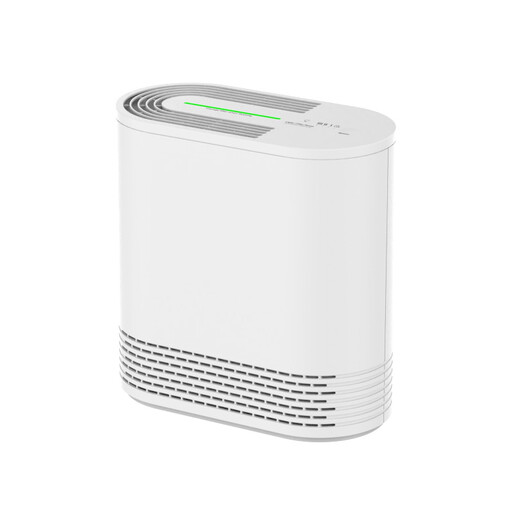
Why This Fits Their Persona: Its 85 m³/h CADR is suited to smaller UK bedrooms, offices and studies where a compact footprint matters more than high airflow.
The clearly stated CADR helps avoid buying a small unit for an oversized room, while the filter reminder supports routine maintenance.
Three fan speeds, sleep mode, night light, washable pre-filter and activated carbon layer.
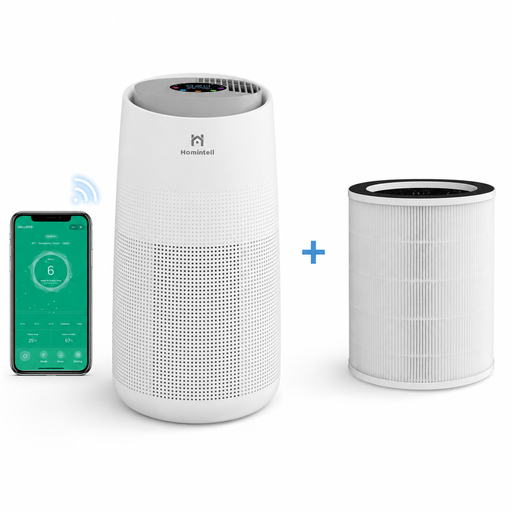
Why This Fits Their Persona: A suitable option for households wanting higher airflow, app-based control and built-in air quality feedback in a medium-sized room.
The 300 m³/h CADR is more informative than a broad coverage statement and the included extra H13 filter makes future maintenance more transparent.
Wi-Fi control, PM2.5 and air quality display, activated carbon filtration, child lock and a 26 dB listed sleep mode.
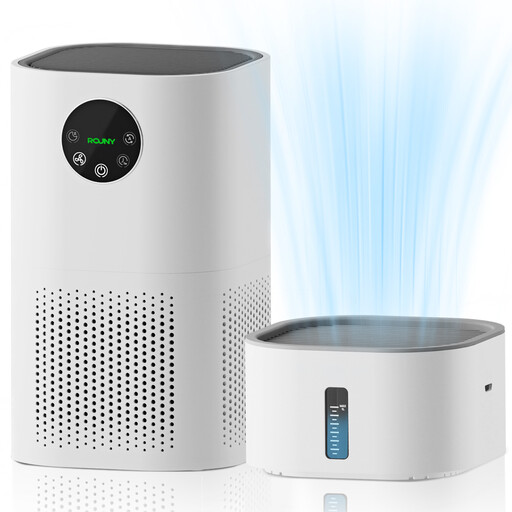
Why This Fits Their Persona: Pet owners and households using a bedroom or living room regularly may appreciate combined purification and humidification in one appliance.
Its 150 m³/h CADR and stated 20–50 m² range give a clearer basis for room matching than a generic “whole home” claim.
Four fan speeds, air quality display, 2/4/8-hour timer and a listed sleep mode of no more than 25 dB.
We have compiled a complete, real-time list of products that fully satisfy these strict selection criteria and UK safety regulations.
Running cost depends on wattage, operating hours and replacement filter pricing. A 15–25 W purifier is relatively modest in electrical demand, but continuous use still adds to household consumption. Use the product’s sleep mode or timer where appropriate, while keeping the unit running long enough to circulate the room air.
Clean washable pre-filters according to the manual, keep air inlets clear and replace the main cartridge when prompted or when airflow visibly reduces. Before buying a replacement, confirm the exact model number. For example, the TRULIVA KJ260 requires a specifically compatible replacement filter rather than a generic H13 cartridge.
It can be, provided the CADR matches the room and the noise level is acceptable. Look for a dedicated sleep mode, dimmable indicators and a timer. Place the unit away from curtains, walls and furniture so that the air inlet and outlet remain unobstructed.
There is no universal interval. Usage, indoor dust, pets and outdoor pollution all affect filter life. Some products provide a reminder after a stated number of hours, while others recommend replacement after several months. Check the manual and buy the correct air purifier replacement filter for the model.
Not by itself. HEPA filtration targets airborne particles such as dust and pollen. Odour reduction generally requires an activated carbon filter and performance depends partly on the amount and quality of carbon used. For smoke or cooking smells, compare the purifier’s carbon stage as well as its H13 filter.