
24/7 Customer Support

Free returns

Same-day & Next-day Delivery

Quality Guaranteed

Unlock Your Welcome Offers: FREE Delivery | Up to 80% OFF | Free 30-day JoyPlus trial
Download the APP
Struggling with the dim, yellowish glow of standard halogen headlights on dark British roads? You are not alone. Many drivers find that factory-fitted bulbs lack the brightness and clarity needed for confident night-time driving. Upgrading to an H4 LED headlight bulb can transform your experience, offering superior visibility, a modern aesthetic and enhanced safety.
As your Joybuy Product Recommendation Officer, my role is to help you navigate the options. This guide cuts through the technical jargon to present practical advice and highlight some excellent choices for your vehicle, focusing on what truly matters: performance, reliability and ease of installation.
Choosing the right bulb can feel overwhelming. Here are a few key factors to consider to ensure you get a compatible and effective upgrade.
The most noticeable change will be the light output. Brightness is measured in lumens (lm), and a higher number generally means more light on the road. Equally important is the colour temperature, measured in Kelvin (K). A 6000K LED car bulb produces a crisp, cool white light that closely mimics daylight. This improves contrast and makes it easier to spot road signs, pedestrians and potential hazards from a distance, creating a less strenuous driving experience at night.
For most car owners, a straightforward upgrade is essential. Look for bulbs described as plug and play H4 LED. These are designed with a 1:1 size ratio to the original halogen bulb, meaning they should fit directly into your vehicle's headlight housing and connect to the factory socket without any cutting or modification. Also, consider CANbus compatibility. Many modern cars use a CANbus system to monitor bulb function, and an incompatible LED can trigger dashboard error messages. Bulbs with built-in CANbus decoders are designed to work seamlessly with the vast majority of vehicles.
LEDs generate heat, and managing it is crucial for their longevity and performance. A bright H4 headlight needs an effective cooling system to maintain its output over time. This is typically achieved in two ways:
Both methods are effective, but fanless designs offer silent operation and have no moving parts that could potentially fail. A well-cooled bulb can last for tens of thousands of hours, far outlasting its halogen counterparts.
Based on features, user-friendliness and performance specifications, here are our standout recommendations for upgrading your vehicle's lighting this year.
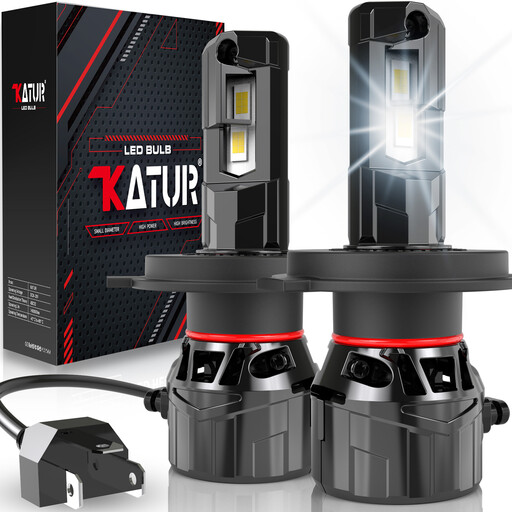
Why It Stands Out: This KATUR bulb is built for those who prioritise maximum illumination. The manufacturer specifies a high power rating of 120W and a brightness of 30000LM per pair, projecting a powerful beam of 6000K xenon white light. Its active cooling system, featuring a 16,000RPM turbo fan and a copper heat pipe, is engineered to manage the heat from its high-output chips effectively.
Pros:
Who is it for? Drivers seeking one of the brightest H4 LED options available. It's an ideal choice for those who frequently travel on unlit country roads and want a significant upgrade in light output.
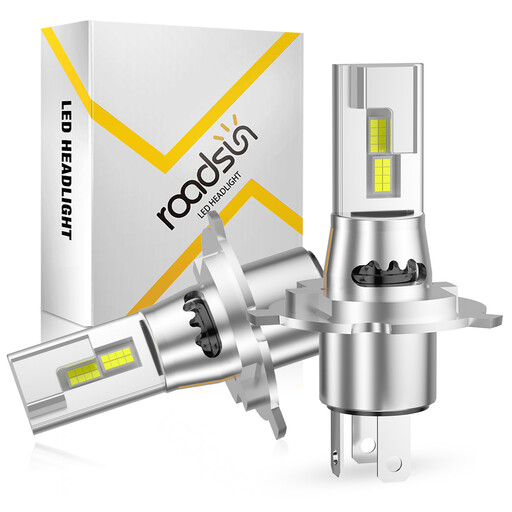
Why It Stands Out: This Roadsun bulb offers a well-rounded package of brightness, durability and simplicity. The brand states it delivers a significant brightness increase over standard halogens, with a 6500K cool white light that enhances clarity. A key feature is its IP68 waterproof rating, ensuring reliable performance in heavy rain, fog and other harsh British weather conditions.
Pros:
Who is it for? The everyday driver who wants a reliable, hassle-free upgrade. Its robust, all-weather construction and simple installation make it a practical choice for anyone looking to improve safety and visibility year-round.
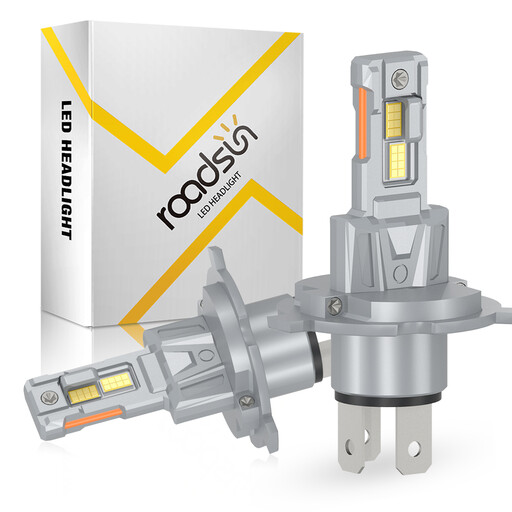
Why It Stands Out: The defining feature of this Roadsun H4 bulb is its fanless design. By using an integrated aluminium heat sink, it eliminates fan noise and the potential for mechanical failure, making it a very durable option. This design is also more compact, which is a great advantage for vehicles with tight headlight housings or restrictive dust covers. It’s also positioned as a strong choice for off-road use.
Pros:
Who is it for? Drivers who value silent operation or have vehicles where space behind the bulb is limited. It's also an excellent fit for owners of 4x4s and off-road vehicles who need a tough, reliable light source that can withstand vibration and harsh environments.
Every vehicle and driver has unique needs. If these recommendations aren't quite what you're looking for, or if you'd like to explore a wider variety of lighting solutions for your car, we invite you to browse our full collection.
? Explore our complete range of LED Light Beams
Yes, most modern H4 LED conversion kits are designed for a direct replacement. They often feature a 1:1 halogen size and a non-polarised plug that fits into the existing socket without any rewiring. The entire process can often be completed in minutes, making it an accessible DIY task for most car owners.
Quality H4 LED bulbs typically include a built-in CANbus-ready driver designed to be compatible with the computer systems of around 99% of vehicles, preventing flickering or error codes. However, some vehicles with particularly sensitive electronic systems may still require an additional external CANbus decoder to function perfectly.
These three designations—H4, 9003 and HB2—all refer to the same type of bulb. It is a dual-filament bulb that provides both high beam and low beam functions from a single unit. H4 is the original ECE (European) designation, while 9003 and HB2 are the equivalent American DOT terms. If your vehicle requires one, the others will fit.