
24/7 Customer Support

Free returns

Same-day & Next-day Delivery

Quality Guaranteed

Unlock Your Welcome Offers: FREE Delivery | Up to 80% OFF | Free 30-day JoyPlus trial
Download the APP
Upgrading your car's standard halogen headlights to a modern H4 LED headlight bulb can transform your night-time driving experience. The promise of brighter, clearer light is appealing, but the market is filled with options that can be confusing. Many drivers invest in a H4 halogen upgrade only to be disappointed by poor performance or a short lifespan.
As a Joybuy Product Recommendation Officer, my role is to help you navigate these choices. We will look past the marketing clutter and focus on the practical details. Before you spend your money, be aware of these common purchasing pitfalls:
To make a sound choice, you need to understand the features that truly matter.
When selecting a car headlight replacement bulb, focusing on a few key technical specifications will ensure you get the performance and reliability you expect.
The single most important factor for a safe LED upgrade is the beam pattern. Your vehicle's headlight housing is designed specifically for the filament position of a halogen bulb. A quality LED bulb should replicate this design precisely.
Look for bulbs described as having a 1:1 halogen size. This ensures the LED chips are positioned where the halogen filament would be, resulting in a sharp, focused beam with a clear cut-off line. This prevents glare for other road users and puts the light exactly where you need it—on the road. A poorly designed bulb will create dark spots and uncontrolled scatter.
An LED's lifespan is directly tied to its ability to manage heat. High-power LEDs can get very hot, and without effective cooling, their brightness will degrade rapidly.
Colour temperature is measured in Kelvin (K) and describes the colour of the light. Standard halogen bulbs are typically around 3200K, producing a yellowish light.
Most H4 hi/low beam LED bulbs are in the 6000K to 6500K cool white range. This crisp, white light is closer to natural daylight, which improves contrast and makes it easier to spot road signs, markings and potential hazards at night. It provides a modern look while enhancing visibility and reducing eye strain on long journeys.
Based on these critical criteria, we have identified options that align with the needs of different UK drivers.
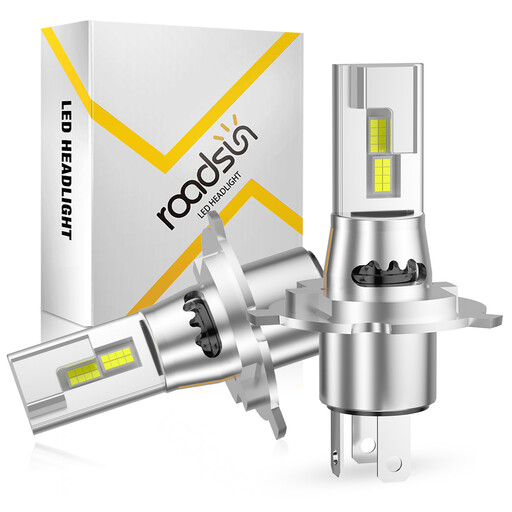
Why This Fits Their Persona: For the driver who enjoys performing their own car maintenance, a straightforward upgrade is essential. This bulb's design allows for a quick and tool-free installation, saving a trip to the garage.
It directly counters the "Plug and Play" myth. The 1:1 halogen size and simple connector mean it fits directly into the H4 housing without modification, making it a genuine plug-and-play solution.
True 3-minute installation with no extra tools or wiring needed. The integrated design is compatible with H4, 9003 and HB2 sockets.
Why This Fits Their Persona: This driver prioritises safety above all, especially during commutes on unlit B-roads or in poor weather. They need reliable, powerful lighting that enhances visibility without compromising the safety of others.
It avoids the "brighter is better" trap by combining increased light output with a precise beam pattern. The 6500K light improves clarity, while the design prevents dangerous glare for oncoming traffic.
Features an IP68 waterproof rating for all-weather reliability and a focused beam that enhances road contrast, helping to identify hazards earlier.
Why This Fits Their Persona: This user thinks about the total cost of ownership. They want a product that performs well and lasts, avoiding the hassle and expense of frequent replacements.
It tackles the overheating flaw head-on. The combination of an aviation aluminium body and a 16,000 RPM cooling fan ensures stable performance and prevents premature failure due to heat.
Engineered for a lifespan of over 50,000 hours, providing long-term reliability and reducing the need for replacements compared to standard halogen bulbs.
We have compiled a complete, real-time list of products that fully satisfy these strict selection criteria and UK safety regulations.
The legality of aftermarket LED headlight bulbs in the UK depends on whether they meet specific performance standards. The key requirement is that they must produce a correct beam pattern that does not cause glare or dazzle other road users. Bulbs that have a 1:1 design matching the original halogen are more likely to achieve this. After installation, it is always recommended to have your headlight aim checked at a garage. For the most current regulations, you should consult the latest guidance from the DVSA.
A 9003 LED bulb is the same as an H4. Many modern vehicles use a CANbus (Controller Area Network) system to monitor the vehicle's electrical components, including the headlights. Because LEDs draw less power than halogens, the system can sometimes mistakenly report a "bulb out" error. Many LED bulbs now come with "CANbus-ready" drivers built-in, which solves this issue for most vehicles. However, some sensitive European car models may still require an additional external decoder to prevent flickering or dashboard warnings.
While many manufacturers state lifespans of 50,000 hours or more, real-world longevity depends heavily on the bulb's heat management system. An H4 hi/low beam LED with a high-speed fan and quality heat sink will maintain its performance and last significantly longer than a passively cooled or poorly designed bulb. For the average UK driver, a well-engineered LED bulb can last for many years, far outlasting multiple sets of halogen bulbs.