
24/7 Customer Support

Free returns

Same-day & Next-day Delivery

Quality Guaranteed

Unlock Your Welcome Offers: FREE Delivery | Up to 80% OFF | Free 30-day JoyPlus trial
Download the APP
Struggling with dim, yellow headlights on a dark British B-road? You're not alone. Standard halogen bulbs can often feel inadequate, especially during the UK's long winter nights and frequent downpours. Upgrading to an H4 LED headlight bulb can transform your night-time driving experience, offering significantly improved visibility, a modern aesthetic and enhanced safety.
However, the market is filled with technical jargon and ambitious claims. This guide is designed to cut through the jargon, helping you understand the key features to look for and providing a straightforward selection of H4 LED bulbs for your consideration.
Before you buy, it's helpful to understand a few key specifications. This will ensure you select a bulb that not only fits your car but also performs as you expect.
When comparing bulbs, you'll see two main figures: lumens (lm) and Kelvin (K).
A key advantage of modern LED upgrades is their ease of installation. Look for a plug and play H4 LED design. These bulbs are built to the same dimensions as the original halogen bulb, allowing you to simply remove the old one and fit the new one without any modifications to the headlight housing.
Additionally, many modern vehicles use a Controller Area Network (CANbus) to monitor the car's systems. Because LEDs use less power than halogens, the system can sometimes mistakenly report a "bulb out" error. A CANbus ready H4 bulb has integrated circuitry to prevent these dashboard warnings or flickering, ensuring seamless compatibility.
An H4 bulb is a dual-filament bulb, meaning it provides both your main and dipped beams. It's crucial that your new H4 high low beam bulb replicates the original halogen's beam pattern precisely. A well-designed LED bulb will cast a focused beam with a sharp cut-off line on the dipped setting. This illuminates the road effectively without creating glare that can dazzle oncoming drivers, which is a critical safety consideration. The terms H4, 9003 and HB2 all refer to this same type of dual-beam bulb.
Here are a few H4 LED bulb options that stand out for their design, performance features and user-friendly installation.
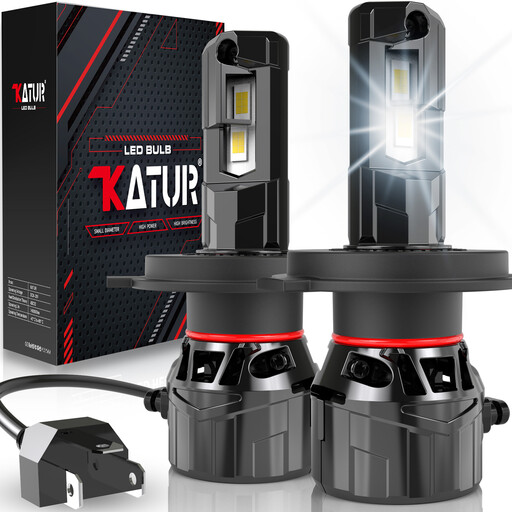

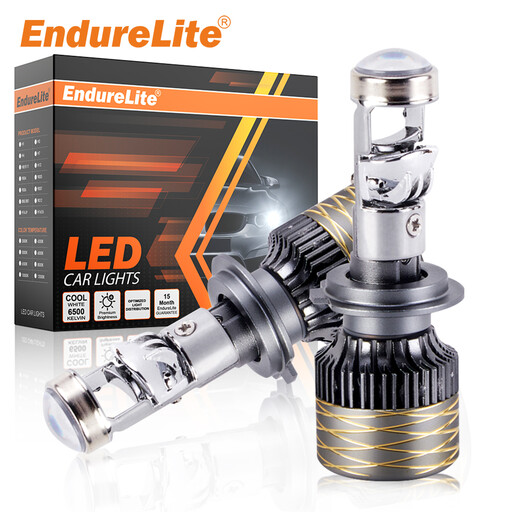
The H4 fitting is one of the most common, but every vehicle is different. If these recommendations aren't quite what you're looking for, or if you need bulbs for your fog lights or interior, there is a wider world of automotive lighting to discover.
Explore our full range of LED light projector options and other automotive bulbs to find the perfect match for your vehicle.
This is an important consideration. According to DVSA guidelines for MOT tests, retrofitting LED bulbs into a headlight unit originally designed for halogen bulbs is a test failure for vehicles first used on or after 1 April 1986. It is essential to be aware that while these bulbs provide excellent illumination, their use on public roads may not comply with current road vehicle lighting regulations. Buyers should check the latest government guidelines and consider using them for off-road purposes or be fully aware of the legal context.
This can happen on vehicles equipped with a CANbus system, which may detect the lower power consumption of an LED as a fault. To avoid this, it is best to choose a CANbus ready H4 bulb. These bulbs include built-in resistors or an intelligent driver that communicates correctly with your car's computer, preventing error codes and flickering.
There is no functional difference. H4, 9003 and HB2 are simply different regional or technical names for the same type of dual-filament bulb. This bulb contains two filaments within a single housing, allowing it to function as both the high beam and low beam from one unit. If your vehicle requires an HB2 or 9003 bulb, an H4 bulb will fit and function correctly.