
24/7 Customer Support

Free returns

Same-day & Next-day Delivery

Quality Guaranteed

Unlock Your Welcome Offers: FREE Delivery | Up to 80% OFF | Free 30-day JoyPlus trial
Download the APP
Upgrading your car's headlights can feel like a simple task, but the market for H4 LED headlight bulbs is filled with technical jargon and bold claims. Many UK drivers, hoping for a straightforward car headlight upgrade, end up with bulbs that are not only disappointing but potentially unsafe. Before you make a purchase, it's crucial to understand the common pitfalls that lead to wasted money and poor performance.
As the Joybuy Product Recommendation Officer, my role is to help you see through the marketing jargon. Here are the key issues to watch out for:
To make an informed choice, focus on the technical specifications that directly impact safety and performance. Ignore the inflated lumen figures and instead concentrate on these three non-negotiable parameters.
The single most important feature of any H4 LED headlight bulb is its ability to replicate the light source position of a standard halogen bulb. Look for models that specify a 1:1 halogen filament design or have an ultra-thin chip spacing. This ensures the light is directed correctly into your vehicle's headlight housing, producing a sharp, focused cut-off line for the low beam. A proper H4 high and low beam kit will provide excellent long-range visibility on high beam without scattering light and causing glare on low beam.
If your car was manufactured in the last 15-20 years, it almost certainly has a Canbus system. To avoid electronic issues, you need a bulb that is specifically designed to work with it. Look for terms like Canbus error free LED or "built-in Canbus decoder". This technology incorporates resistors or circuitry to communicate correctly with your car's computer, preventing flickering and false error messages on the dashboard.
An LED's lifespan is directly tied to its ability to dissipate heat. There are two main types of cooling systems:
Both systems can be effective, but the choice depends on the bulb's power output and the space available within your headlight housing. Additionally, look for a high IP rating, such as IP67 or IP68, which indicates the bulb is well-protected against dust and moisture, making them reliable waterproof car lights for UK weather. A 6000K headlight bulb colour temperature is also popular, as it produces a crisp, modern white light that closely resembles daylight.
Instead of a one-size-fits-all approach, we've matched specific H4 car bulbs to different driver profiles based on their key features.
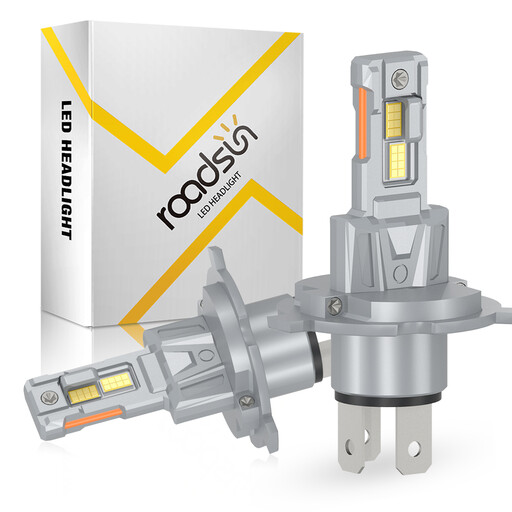
Why This Fits Their Persona: This driver values reliability and a quiet, hassle-free experience for daily driving. The fanless design means no moving parts to fail and zero operational noise, making it a dependable choice for commuting.
Its fanless construction directly addresses the longevity myth by eliminating a common point of failure, relying on a robust aluminium body for heat dissipation.
Silent operation and a compact, inline design that fits easily into tight headlight housings. The IP67 rating ensures all-weather reliability.
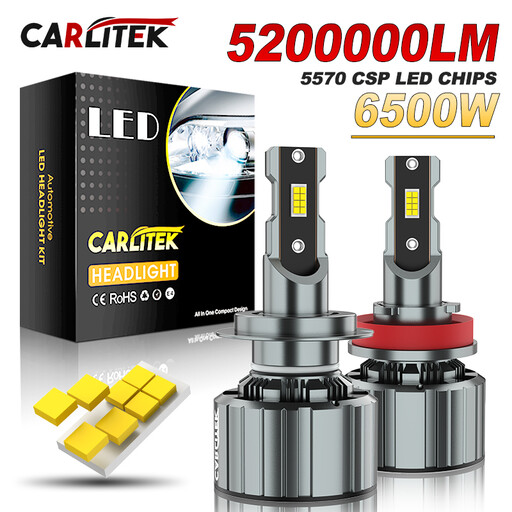
Why This Fits Their Persona: Ideal for those who frequently drive on unlit country roads or motorways at night. This user prioritises maximum brightness and a perfectly focused beam for enhanced safety and visibility.
It directly counters the glare trap with a 1:1 halogen filament position design, ensuring a super-focused beam pattern that illuminates the road without dazzling others.
Features a powerful 10,000 RPM cooling fan for sustained high performance and built-in Canbus technology for error-free operation in over 99% of vehicles.
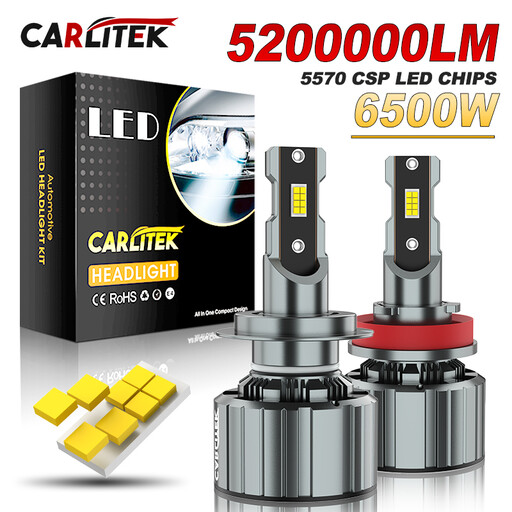
Why This Fits Their Persona: This highlights that the same technology is available for other fitments. If your car doesn't use H4 bulbs, it's vital to find the correct model (e.g., 9005/HB3, H7, H11) with the same quality features.
This approach prevents the ultimate pitfall: buying a high-quality bulb that simply doesn't fit. Always verify your car's required bulb type before purchasing.
Products like this offer the same core benefits—focused beam, Canbus compatibility and effective cooling—tailored to a different headlight housing.
We have compiled a complete, real-time list of products that fully satisfy these strict selection criteria and UK safety regulations.
The regulations surrounding aftermarket LED headlight bulbs can be complex. As of the latest guidance, fitting LED bulbs into a headlight unit designed for halogen bulbs is not strictly considered type-approved for road use. However, an MOT test will primarily assess the beam pattern. If the bulb produces a clean, correct beam pattern without causing glare, it may pass the test. It is the vehicle owner's responsibility to ensure their lights are compliant and do not dazzle other road users.
The most reliable way to confirm your bulb type is to check your vehicle's owner's manual. You can also remove one of the existing headlight bulbs; the fitment type (e.g., "H4" or "9003") is usually printed on its base. Do not rely solely on online vehicle compatibility checkers, as they can sometimes be inaccurate.
Neither is inherently better; they are different approaches to the same problem. A fanless bulb is silent and has fewer moving parts, which some users prefer for long-term reliability. A bulb with a fan can often handle higher power outputs and may cool more effectively, sustaining peak brightness for longer. The choice depends on your priorities and the space within your car's headlight assembly.