
24/7 Customer Support

Free returns

Same-day & Next-day Delivery

Quality Guaranteed

Unlock Your Welcome Offers: FREE Delivery | Up to 80% OFF | Free 30-day JoyPlus trial
Download the APP
Replacing standard halogen lamps can make sense for drivers who want a cooler light colour, quicker illumination and a modern-looking headlight. However, choosing H4 LED headlight bulbs is not simply a matter of selecting the highest lumen figure on a product page.
The correct bulb must fit the socket, maintain a controlled beam pattern and work with your vehicle’s electrical system. This guide explains the main buying pitfalls, the specifications worth checking and a selection of H4 LED bulbs for cars, SUVs, trucks and motorcycles.
Listings may quote very high output figures, but the number alone does not confirm how much useful light reaches the road. Housing design, LED chip placement, reflector compatibility and beam control all affect the result.
A poorly aligned bulb can create glare for oncoming drivers while leaving dark areas ahead. Look for details such as 1:1 halogen-size construction, ultra-thin chip spacing and a stated high and low beam design. After installation, check the beam pattern against a wall and arrange an alignment check if necessary.
H4, 9003 and HB2 generally describe the same three-pin bulb format, but vehicle housings and electrical systems vary. A bulb may fit the socket physically yet fail to fit beneath the dust cover or trigger flickering and dashboard warnings.
“CANbus-ready” usually means the bulb includes a driver intended to reduce compatibility problems; it does not guarantee compatibility with every model. Sensitive vehicles, including some European cars, may still need an additional decoder.
LEDs produce less wasted heat than halogen filaments in some areas, but their electronics and chips still require thermal management. Fan-cooled LED headlights can dissipate heat effectively, but the fan needs clearance and may introduce a small operating noise or another moving part.
Fanless bulbs use aluminium housings or heat sinks instead. They can be useful where the headlight cavity is narrow, although the actual thermal design should be checked rather than assumed from the word “fanless”.
Check your vehicle handbook, the marking on the original bulb or a reliable vehicle-fitment catalogue before ordering. H4 9003 HB2 LED bulbs are designed for the same general socket family, with one bulb providing both dipped and main beam functions.
Do not confuse an H4 replacement with H7, H11, 9005 or 9006 products. Some multi-fit listings contain several bulb codes, so confirm that the selected variant is specifically H4.
A 1:1 halogen-size LED bulb is more likely to fit the original retaining clip and dust cover without modification. Measure the available rear clearance, particularly if the product includes an external driver or fan.
Useful details include:
For regular UK use, look for an aluminium body and a stated ingress rating. IP67 or IP68 waterproof car headlight bulbs are designed with protection against dust and water ingress, but the rating applies to the product under specified test conditions. It does not compensate for a damaged headlight seal or incorrectly fitted dust cover.
A claimed operating life of 50,000 or 60,000 hours is a manufacturer specification rather than a guarantee of service in every vehicle. Heat, vibration, voltage variation and installation quality can all affect real-world durability.
6000K cool white LED bulbs provide a noticeably whiter appearance than traditional warm halogen light. Some products use 6500K, which may appear slightly cooler still. Colour temperature does not by itself establish brightness, beam quality or road legality.
Before fitting an LED retrofit, check your vehicle handbook, the bulb’s approval information and current UK requirements for road use. Correct beam alignment is important for MOT performance and for avoiding glare. A bulb that physically fits is not automatically approved for every vehicle or headlight housing.
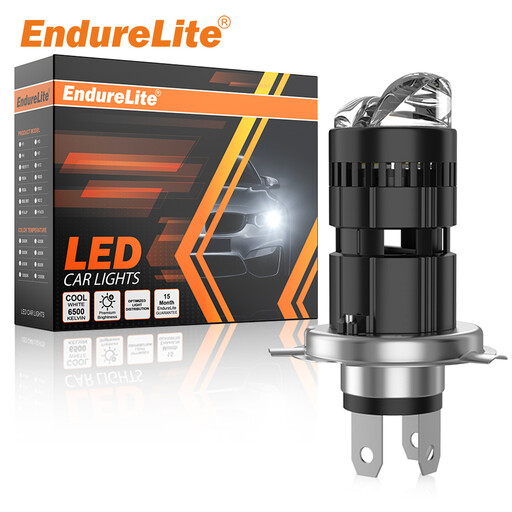
Why This Fits Their Persona: A straightforward pack-of-one option for drivers who want to replace a failed H4 bulb without paying for features they may not need.
The listing identifies H4 high and low beam operation and plug-and-play installation, helping avoid confusion with single-function bulbs.
6000K cool white colour, integrated high/low beam function and an advertised efficient cooling system.
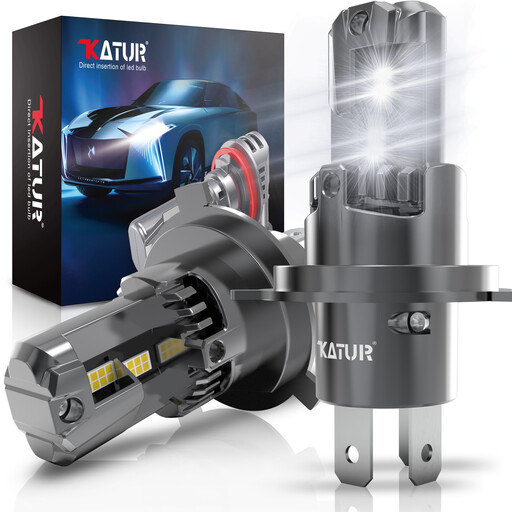
Why This Fits Their Persona: Suitable for owners seeking a compact two-bulb upgrade with active cooling and an external driver designed for broader vehicle-system compatibility.
Its stated 1:1 halogen size addresses rear-clearance concerns, while the listing identifies CANbus readiness rather than promising universal fit without qualification.
16000RPM turbo fan, aviation aluminium body, IP65 water resistance and 6000K light colour.
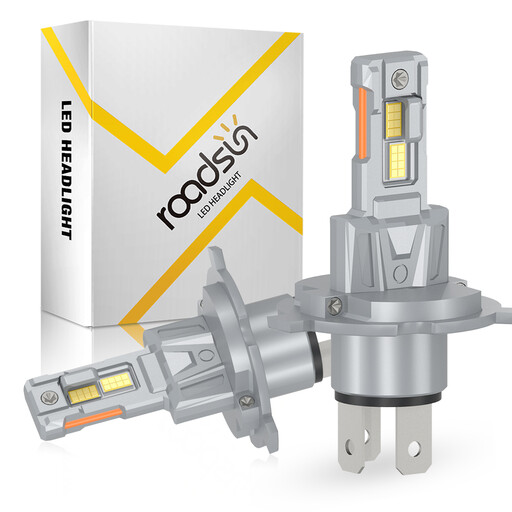
Why This Fits Their Persona: A practical match for trucks, SUVs, motorcycles or off-road vehicles where rear housing space is limited or fan noise is undesirable.
The fanless construction avoids a moving cooling component, while the product information clearly notes that sensitive vehicles may require a decoder.
Inline fanless format, IP67 water and dust protection and an integrated high/low beam function.
We have compiled a complete, real-time list of products that fully satisfy these strict selection criteria and UK safety regulations.
Before starting, switch off the lights, remove the key and allow the original bulb to cool. Wear gloves and avoid touching the LED chips or lens surface.
If a CANbus-ready H4 bulb still produces an error message, use only a compatible decoder recommended for the vehicle. Do not cut factory wiring unless the product instructions specifically require a safe, approved installation method.
They can be suitable when the vehicle uses an H4, 9003 or HB2 socket and the bulb physically fits the housing. Always confirm the vehicle application, rear clearance and road-use requirements before ordering. Cars, SUVs, trucks and motorcycles may use the same socket but have different housing or electrical-system constraints.
Many LED replacement products are marketed with lower or similar wattage than halogen lamps, but actual consumption varies by model. Check the stated voltage and wattage rather than assuming every LED bulb reduces running load. A CANbus system may also monitor the circuit and require a compatible decoder.
Product listings commonly state service-life figures ranging from 50,000 to 70,000 hours. These are manufacturer specifications, not a guaranteed lifespan for every installation. Adequate cooling, stable voltage, correct sealing and low vibration can all support more consistent operation.