
24/7 Customer Support

Free returns

Same-day & Next-day Delivery

Quality Guaranteed

Unlock Your Welcome Offers: FREE Delivery | Up to 80% OFF | Free 30-day JoyPlus trial
Download the APP
Struggling with the dim, yellowish glow of standard halogen headlights on UK roads? You're not alone. Poor visibility in rain, fog or on unlit country lanes is a common frustration and a genuine safety concern. Upgrading to an H7 LED headlight bulb can transform your nighttime driving experience, offering a brighter, whiter light that improves clarity and modernises your vehicle's appearance.
However, the market is flooded with options, making it difficult to know which bulbs are a worthwhile investment. This guide is designed to cut through the clutter. We will walk you through the key factors to consider when choosing an H7 LED conversion kit and present some carefully selected recommendations to help you make an informed decision.
Before jumping to specific products, understanding a few key technical details will ensure you find the perfect fit for your vehicle and needs.
The performance of a headlight is primarily measured by its brightness (lumens) and its colour temperature (Kelvin).
For many car owners, ease of installation is paramount. The ideal upgrade is a plug and play H7 bulb. This means the bulb is designed to be a direct replacement for your old halogen unit, with no complex wiring, external drivers or modifications needed.
Look for bulbs described as having a 1:1 mini size. This indicates the LED bulb has the same physical dimensions as the original halogen bulb, ensuring it fits perfectly within the headlight housing and allows the dust cover to be re-secured without issue.
Modern vehicles often use a Controller Area Network (CANbus) system to monitor the vehicle's functions, including the headlights. Since LED bulbs draw less power than halogens, the CANbus system can sometimes misinterpret this as a fault, leading to a dashboard warning light or flickering.
To avoid this, look for a CANbus error free H7 LED bulb. These have built-in resistors or decoders that communicate correctly with the vehicle's computer, ensuring smooth, error-free operation in the vast majority of cars.
Based on their features, design and user-focused benefits, here are some standout H7 LED headlight bulbs to consider for your vehicle.
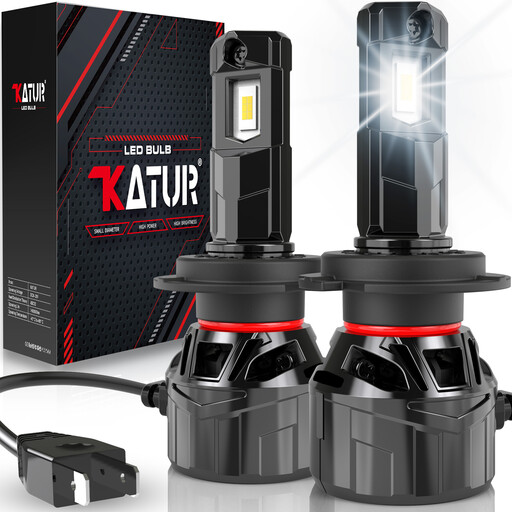
Why It Stands Out: This KATUR model is built for high performance. Its main draw is the impressive light output, specified at 120W and 30000LM per pair. To manage the heat generated by this high output, it incorporates an active cooling system with a 16,000RPM turbo fan and a copper tube, designed to maintain stable performance over its lifespan.
Pros:
Who is it for? Drivers who prioritise maximum brightness and a long-range beam, especially those who frequently travel on poorly lit rural roads or motorways at night.
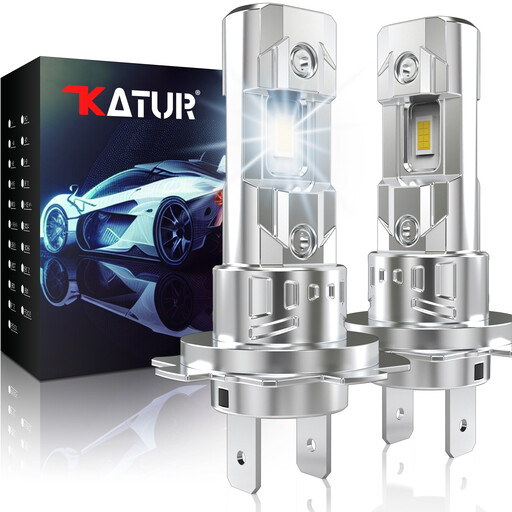
Why It Stands Out: This model offers a different approach to thermal management with its fanless design. By using an aviation-grade aluminium body for passive heat dissipation, it operates silently and eliminates the risk of fan failure. It still provides a substantial light output of 26000LM and 80W per pair, delivering a 360-degree beam without dark spots.
Pros:
Who is it for? Vehicle owners who value reliability and silent operation. The absence of a fan makes it a durable choice for those wanting a fit-and-forget upgrade.
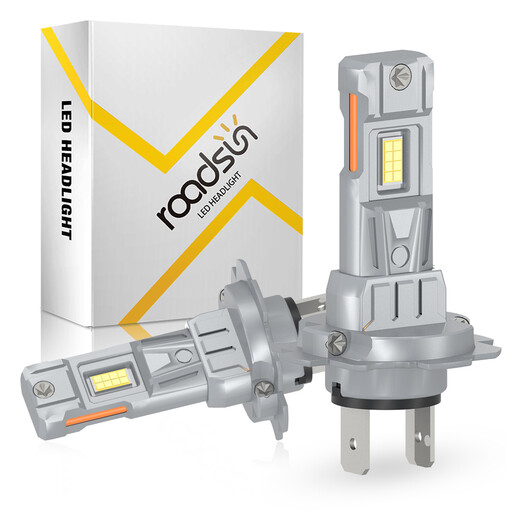
Why It Stands Out: The Roadsun H7 bulb focuses on simplicity and compatibility. Its key feature is the real 1:1 mini size, which precisely mimics the dimensions of a standard halogen bulb. This makes it one of the easiest options to install, as it requires no adapters and fits directly into the factory socket. Roadsun states its bulbs offer a significant brightness increase over halogen, paired with a 6000K cool white light.
Pros:
Who is it for? The DIY enthusiast or any driver looking for the most straightforward, hassle-free upgrade possible. Its universal fit and simple installation make it an excellent choice for beginners.
If the models above aren't the right fit for your vehicle, or if you're searching for different bulb types and specifications, there is a wider selection available.
Explore our full range of Vehicle LED lights to find the perfect lighting solution for your car, van or motorcycle.
1. Are H7 LED bulbs legal for road use in the UK? As of 2026, the regulations state that replacing halogen bulbs with LED units in an existing headlight housing is not strictly compliant for road use and may cause an MOT failure. The rules are intended to ensure that headlights produce a correct and safe beam pattern that does not dazzle other drivers. However, many high-quality LED bulbs are designed to mimic the beam pattern of halogens precisely. It is recommended to check the latest DVSA guidelines and ensure your headlights are correctly aligned after installation.
2. Will I need a CANbus decoder for my H7 LED bulbs? It depends on your vehicle. Many European cars, particularly from brands like VW, Audi, BMW and Mercedes-Benz, use sensitive CANbus systems. While many modern LED bulbs have built-in CANbus compatibility, some vehicles may still require an additional external decoder to prevent errors. It is often a good idea to choose a CANbus error free H7 LED bulb to minimise the chance of issues.
3. Can I use an H7 LED headlight bulb as an H7 fog light? Yes, in most cases. The H7 fitting is used for both headlights and fog lights in various vehicles. An H7 LED bulb can serve as an excellent H7 fog light upgrade, as the bright, white light can improve visibility in foggy or misty conditions. Just ensure the bulb's design is robust enough to handle the lower position on the vehicle, like the Roadsun model mentioned above.