
24/7 Customer Support

Free returns

Same-day & Next-day Delivery

Quality Guaranteed

Unlock Your Welcome Offers: FREE Delivery | Up to 80% OFF | Free 30-day JoyPlus trial
Download the APP
Struggling with dim, yellowy halogen headlights on dark British roads? You're not alone. Poor visibility at night is not just an inconvenience; it's a safety concern. Upgrading to modern LED bulbs can transform your nighttime driving experience, offering a brighter, clearer view of the road ahead and giving your vehicle a more contemporary look.
However, the market for H7 LED headlight bulbs is crowded with technical jargon and ambitious claims. Finding a reliable, easy-to-install bulb that works with your car can feel overwhelming. This guide is designed to cut through the jargon. As the Joybuy Product Recommendation Officer, my role is to provide clear, practical advice to help you choose a suitable H7 bulb replacement for your vehicle. We will look at key features to consider and highlight a few standout options available today.
Before you buy, it's worth understanding a few key factors that separate a great upgrade from a frustrating one. Keep these points in mind during your search.
While many focus on lumens (a measure of brightness), the most critical factor for a safe headlight upgrade is the beam pattern. A well-designed H7 LED bulb will mimic the light source position of a traditional halogen bulb. This ensures the light is projected correctly by your car's headlight housing (whether it's a reflector or projector type), illuminating the road and verges without dazzling oncoming drivers. For colour, a 6000K H7 bulb is a popular choice, producing a crisp, neutral white light that is close to daylight and can help reduce eye fatigue.
For most DIY enthusiasts, ease of installation is paramount. Look for bulbs advertised as plug and play H7 LED. These are typically designed with a 1:1 mini-size ratio, meaning they have the same dimensions as the original halogen bulb they are replacing. This avoids any need for modification to the headlight housing, dust caps or wiring. A compact, all-in-one design without a bulky external driver makes the replacement process much simpler.
Many modern cars, particularly those from European manufacturers like VW, Audi, BMW and Mercedes-Benz, use a Controller Area Network (CANbus) system to monitor the vehicle's electronics. Because LED bulbs draw less power than halogens, the CANbus system can mistakenly interpret this as a burnt-out bulb, resulting in a dashboard warning light or flickering. To avoid this, look for bulbs specified as H7 CANbus error free. These have built-in resistors to communicate correctly with the car's computer. For some sensitive vehicles, a separate, external CANbus decoder may still be required.
Here are a few H7 LED bulb options that balance performance, design and user-friendliness.
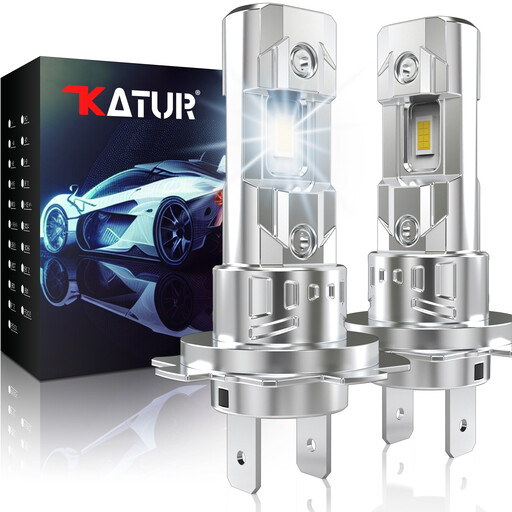
Why It Stands Out: The most notable feature of the KATUR H7 bulb is its fanless design. By using an aviation-grade aluminium body for passive heat dissipation, it operates in complete silence. This eliminates any potential noise from a cooling fan and removes a moving part that could fail over time. Its ultra-compact, 1:1 mini design makes it a true plug and play H7 LED solution, ideal for headlight housings with very limited space.
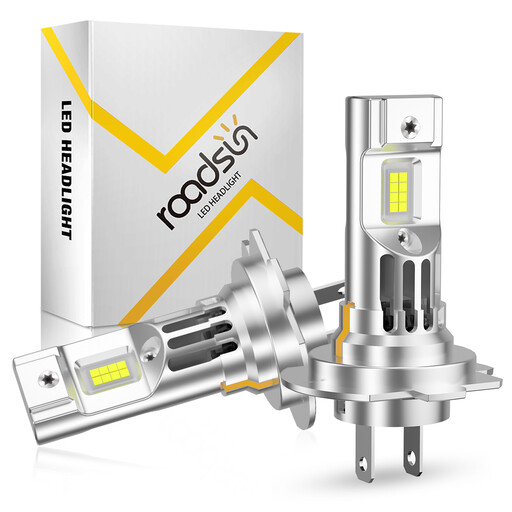
Why It Stands Out: The Roadsun H7 bulb integrates a high-speed silent cooling fan to actively manage heat. This helps maintain stable performance and brightness during long periods of use. With a slightly cooler 6500K colour temperature and an IP68 waterproof rating, it's built for reliability in all weather conditions. Its design requires no additional adapters, simplifying the H7 bulb replacement process.
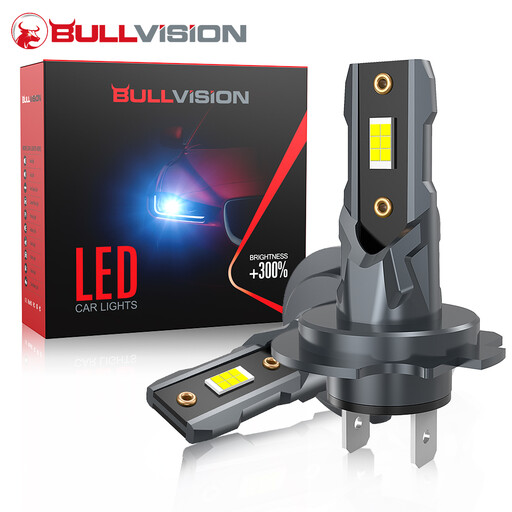
Why It Stands Out: The Bullvision H7 bulb places a strong emphasis on replicating the beam pattern of a standard halogen bulb. Its 1:1 design and ultra-thin chip spacing help to create a focused beam with a clean cut-off, which is essential for maximising road visibility without causing glare for other road users. It also features a built-in intelligent driver, making it H7 CANbus error free for a high percentage of vehicles.
While these are our top picks for H7 bulbs, we know every vehicle and driver has unique needs. If you're exploring other lighting options, such as those with different cooling technologies, you can browse our wider selection of light bulb fan products for more choices.
1. Are H7 LED bulbs a straightforward replacement for halogens? For the most part, yes. Many modern options are designed as a plug and play H7 LED replacement. The key is to choose a bulb with a 1:1 design that matches the size of the original halogen. This ensures it will fit inside the headlight housing without any modifications. Always check the product dimensions before purchasing.
2. Will I get a dashboard error after installing H7 LED bulbs? This depends on your vehicle. If your car has a CANbus system, it may detect the lower power draw of an LED and trigger a "bulb out" warning. To prevent this, select a bulb that is advertised as H7 CANbus error free. For some highly sensitive vehicle systems, a separate external decoder might still be necessary to resolve flickering or errors.
3. Is a brighter H7 LED bulb always better? Not necessarily. While bright H7 LED bulbs improve visibility, the quality of the beam pattern is far more important for safety. A poorly focused bulb, no matter how bright, will scatter light and cause dangerous glare for oncoming traffic. A well-engineered bulb directs light precisely where you need it—onto the road. A colour temperature around 6000K is generally considered optimal for clarity without being too harsh.