
24/7 Customer Support

Free returns

Same-day & Next-day Delivery

Quality Guaranteed

Unlock Your Welcome Offers: FREE Delivery | Up to 80% OFF | Free 30-day JoyPlus trial
Download the APP
Replacing standard halogen bulbs can give your car, SUV or truck a whiter appearance and different lighting performance. However, choosing H8 H9 H11 LED headlight bulbs is not simply a matter of selecting the highest lumen figure on a product page. Socket compatibility, beam control, heat management and vehicle electronics all affect whether an upgrade is suitable.
This guide explains the key checks to make before buying H8 H9 H11 LED bulbs, including options for headlights, daytime driving lights and H11 LED fog light bulbs.
Listings may advertise figures such as 20,000 lumen LED bulbs, 30,000 lumens or even higher. These figures may describe the pair, a maximum theoretical output or a marketing estimate rather than measured light on the road. A high number does not automatically mean a useful beam.
Look for supporting design details such as:
H8, H9 and H11 sockets are closely related, but your vehicle’s original bulb specification remains the deciding factor. A listing that supports all three sizes may still require checks for housing clearance, connector design, wattage and beam use.
Confirm the size in the vehicle handbook, the original bulb marking or a reliable vehicle-parts catalogue. Do not rely solely on a marketplace compatibility filter.
CANbus LED bulbs include driver electronics intended to reduce flickering, dashboard warnings and radio interference. Nevertheless, sensitive vehicles may still require an additional decoder. This is particularly relevant to some Volkswagen, Mercedes-Benz, BMW and similar vehicles.
An error-free LED headlight bulb description should therefore be treated as a compatibility feature, not a universal guarantee.
First identify whether your car uses H8, H9 or H11 for the intended position. H8 and H9 LED bulbs are commonly used for fog or auxiliary lighting, while H11 may be used for headlights or fog lights depending on the vehicle.
Also check:
A compact, fanless design can help where space is limited. A fan-assisted bulb may offer more active cooling but needs enough room behind the housing.
6000K cool white headlight bulbs produce a crisp white appearance. Some products are listed at 6500K, which may look slightly cooler or bluer. Colour temperature is not the same as brightness, and a cooler colour does not guarantee better road illumination in every condition.
For practical performance, prioritise a controlled beam. A 1:1 bulb attempts to place the LED emitters where the original halogen filament sat. Correct alignment is still important after installation, particularly in reflector housings. Check the beam on a level surface and adjust the headlamps if necessary.
LED chips generate heat, so aluminium housings, heat sinks and cooling fans are common. Product listings may state lifespans of 50,000 or 70,000 hours, but actual service life depends on operating temperature, vibration, voltage and enclosure conditions.
For UK driving conditions, useful features include:
IP ratings describe resistance to dust and water under specified test conditions; they do not mean a bulb is immune to every installation or weather problem.
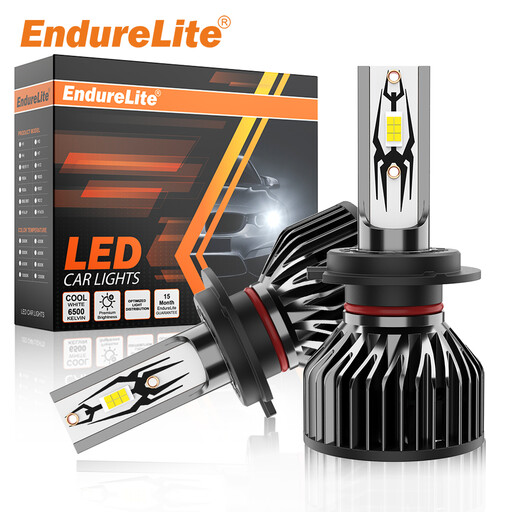
Why This Fits Their Persona: A straightforward option for UK motorists replacing standard H8, H9 or H11 bulbs at home. The 6000K colour and plug-and-play format suit drivers seeking a simple visual upgrade.
The listing identifies 1:1 sizing, beam-pattern positioning and built-in CANbus-ready electronics rather than relying only on a brightness claim.
6000K cool white output, aluminium construction, cooling fan, IP-rated waterproof design and a pair supplied together.
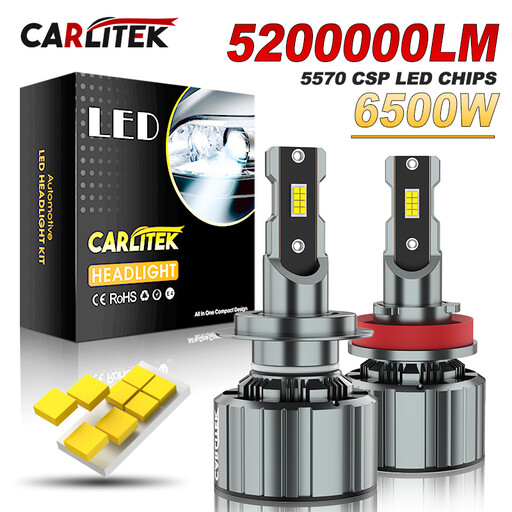
Why This Fits Their Persona: Suitable for DIY motorists who place emphasis on integrated electronics, beam control and weather resistance for regular night driving.
It uses a stated 1:1 filament-position design, 0.0074-inch chip spacing and built-in CANbus technology. The claimed lumen figure should still be compared cautiously.
IP68 rating, 6000K colour, built-in fan and no separate driver or wiring harness listed.
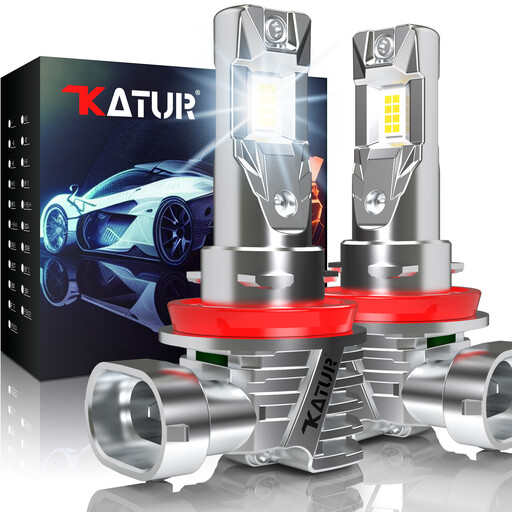
Why This Fits Their Persona: A practical match for drivers, pick-up owners and off-road users whose headlight housing has limited rear space or where a fanless design is preferred.
The integrated mini format avoids a separate driver and external fan, helping with dust-cap clearance. Its listing also specifies H8, H9 and H11 socket use.
Fanless 1:1 mini design, 6000K light, aluminium housing and IP-rated construction.
Turn off the lights, allow the halogen bulb to cool and wear gloves. Avoid touching the LED chips. Insert the replacement firmly, align the emitters correctly and confirm that the dust cap seals properly.
After installation:
Many are designed as plug-and-play LED bulbs, with a 1:1 body and factory-style connector. Fitment is not guaranteed for every vehicle, so confirm the socket, polarity, dust-cap clearance and housing type before ordering.
Not always. CANbus-ready products are designed to reduce warning lights and flicker, but some sensitive vehicles may still need a decoder. Product notes should be checked carefully, especially for premium European vehicles.
LEDs may use less electrical power for a similar application, but the actual consumption varies by bulb design and vehicle. Compare the stated wattage per bulb or pair rather than relying on a general energy-saving claim.