
24/7 全天候客户支持

免费退货

当日/次日达

品质保障

开启新人专享福利: 全场免邮 | 低至 2 折 | 免费试用 30 天 JoyPlus 会员
下载 Joybuy
Choosing between hair dryers and tumble dryers is less about buying the appliance with the longest feature list and more about matching specifications to your routine. A compact hair dryer may suit a student flat or frequent traveller, while a larger tumble dryer can make family laundry more manageable. The wrong choice, however, can lead to unnecessary energy costs, awkward installation or disappointing performance.
This guide highlights common buying traps, explains the specifications that matter and matches a selection of products to different UK household needs.
A hair dryer’s wattage indicates electrical power consumption, not a guaranteed airflow speed. A high-speed hair dryer with a brushless motor may produce strong airflow at a lower wattage than a conventional model. Look at motor speed, airflow information, heat and speed settings and nozzle design together.
For tumble dryers, a higher capacity does not automatically mean lower running costs. A partly filled 10kg drum may be less practical than a correctly sized 8kg model if your household produces smaller loads.
An ionic hair dryer may help reduce static and make hair feel smoother during styling, but ion technology cannot compensate for poor airflow, limited temperature control or an uncomfortable handle. Similarly, Wi-Fi connectivity on a tumble dryer is useful for monitoring and programme selection, but it should not take priority over drying technology, drum capacity and energy efficiency.
A condenser tumble dryer does not need an external vent hose, but its water tank and filters still require regular emptying and cleaning. A heat pump tumble dryer generally operates at lower temperatures and can use less energy, but cycles may take longer.
For hair dryers, blocked filters can restrict airflow and contribute to overheating. Attachments also become hot, so they should cool fully before storage.
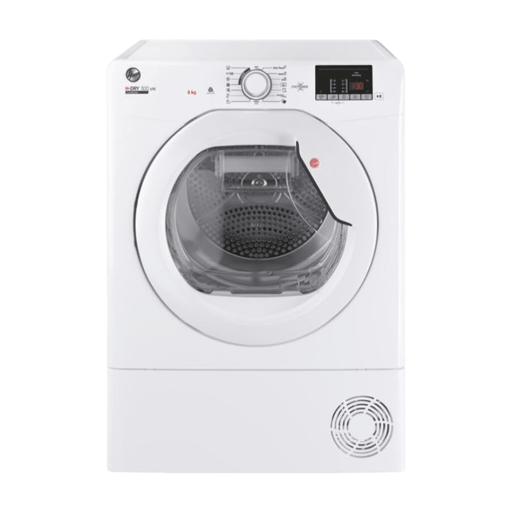
Why This Fits Their Persona: Its 8kg drum and condenser format suit couples, students and smaller households needing straightforward drying without an external vent.
The stated dimensions are 85 x 60 x 53cm, helping buyers assess narrower installation areas before ordering. It also has a front-accessible water tank and lint filter.
12 programmes, four dryness levels and a 24-hour delay timer provide practical everyday control.
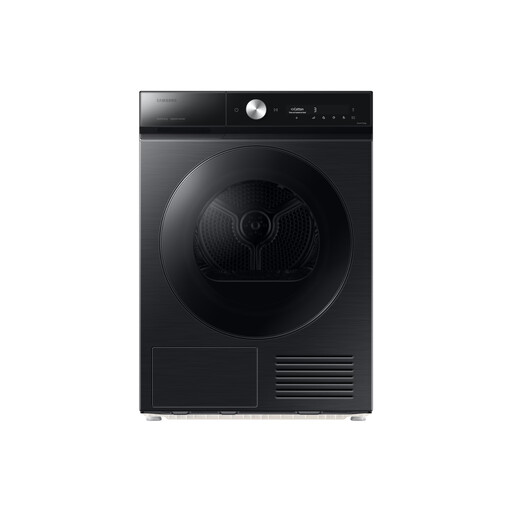
Why This Fits Their Persona: The 9kg drum, heat pump technology and app connectivity suit households wanting detailed control over frequent laundry loads.
The specification lists a 60dB noise level, four dryness levels, 23 programmes and an A+++ energy class, allowing comparison beyond app features.
SmartThings Wi-Fi, a reversible door and heat pump drying support flexible daily use.
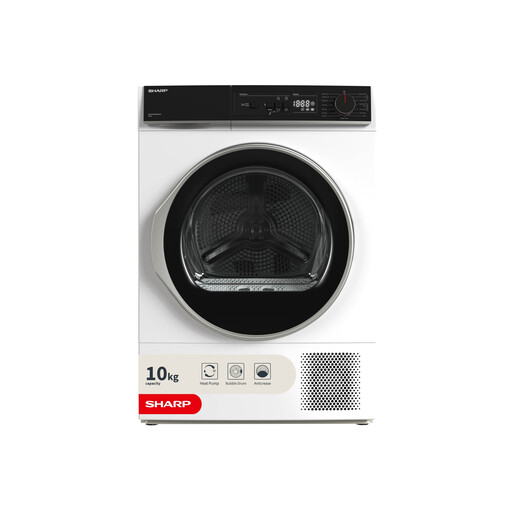
Why This Fits Their Persona: A 10kg drum is suitable for larger families, regular bedding loads and households that want to reduce the number of drying cycles.
The heat pump system is paired with sensor drying, five dryness levels and a stated annual consumption of 258kWh, giving useful efficiency information.
15 programmes, a 64dB noise level, two-way tumbling and Express 34 and Shirts 20 programmes.
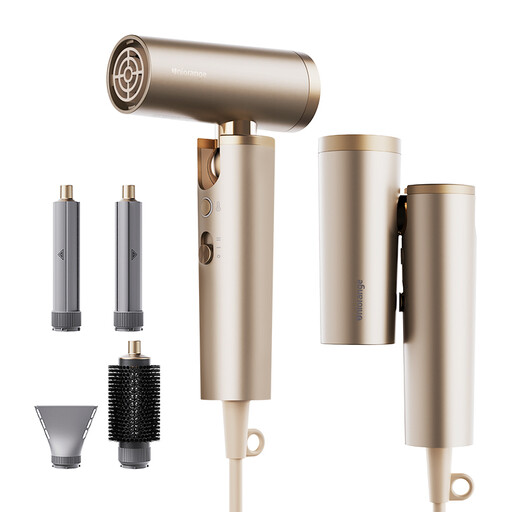
Why This Fits Their Persona: Its foldable body, dual-voltage design and four styling attachments suit travellers who want one compact tool for drying and styling.
The product specification identifies dual voltage and a detachable filter, so portability does not remove the need for voltage checks or routine cleaning.
The set includes left and right curling barrels, a concentrator and a volumising brush, plus a reverse-airflow cleaning mode.
We have compiled a complete, real-time list of products that fully satisfy these strict selection criteria and UK safety regulations.
Running cost depends on the appliance’s energy label, stated kWh consumption, load size, electricity tariff and usage frequency. Heat pump models generally operate at lower temperatures and can use less energy than conventional designs, but compare the product’s official energy information rather than assuming every model has the same cost.
A condenser or heat pump model can offer more flexible placement because it does not require an external vent hose. However, the appliance still needs a level floor, suitable ventilation, an appropriate electrical socket and enough clearance around the machine. Check the installation instructions and building rules before placing it in a bedroom or shared accommodation.
Check that the diffuser is included and compatible with the dryer, then consider adjustable heat and speed settings, weight and airflow control. A hair dryer with diffuser can distribute air more gently for textured or wavy styles, but avoid using excessive heat and follow the appliance’s safety instructions.