End-touch-up stylers with little storage space
If you mainly smooth or flick wavy ends rather than straighten all your hair, look for control over small sections and a way to keep the tool closed after it has cooled.


For shaping a few wavy ends, look for plates narrow enough to control small sections; a lock or guard helps the cooled tool fit neatly into limited storage. Adjustable temperature gives you more choice than a fixed setting, while a cordless brush may suit general smoothing without offering the same small-section precision. For a mains-operated straightener used in the UK, check for a UK 3-pin plug and fuse, and let any heated tool cool before storing it.
If you mainly smooth or flick wavy ends rather than straighten all your hair, look for control over small sections and a way to keep the tool closed after it has cooled.
If you use a straightener intermittently, variable temperature lets you start at a lower setting instead of accepting one fixed heat level.
Fringes, short layers and small sections near the ends call for careful plate placement. ghd describes its Mini as a precision styler with 15 mm plates, while Remington positions the extra-slim S5515 for short hair.
For end touch-ups in a small space, choose a shape that handles your usual sections, then consider temperature control and how the cooled tool will fit away.
| Concern | What to check | Who this matters to |
|---|---|---|
| Small-section precision | Check plate width and whether the model is intended for precise work; a compact label alone does not establish this. | When I only need to shape a few wavy ends, I want control over each small section rather than a tool chosen for broad passes. Around 44% of consumers put precise end styling first. |
| Temperature choice | Compare the stated temperature range with a fixed setting, and check how the controls work. | If I style only occasionally, I want to choose a workable setting rather than use the same fixed heat every time; for around 33% of consumers, adjustable heat is the primary concern. |
| Storage after styling | Look for a plate lock, guard or supplied pouch, and allow the tool to cool before putting it away. | A crowded drawer makes me favour a tool that closes neatly once cool. Around 23% of consumers place compact storage first. |
A lock or heat-resistant pouch helps organise the tool, but neither makes immediate storage safe. London Fire Brigade warns that straighteners can get extremely hot.
Unplug the tool and leave it to cool on a heat-resistant surface before locking and storing it.
A model’s highest setting is not a requirement for a quick end touch-up. A fixed-temperature model also gives you no option to turn the heat down.
Compare the available controls and stated range. If you choose fixed heat, make sure you are comfortable with that model’s single setting.
A conventional straightener can close neatly with a hinge lock without having the narrow plates you want for short sections.
Check plate width separately from locks, pouches and descriptions such as compact or travel-sized.
Electrical suitability matters even if you plan to use the straightener only briefly. Electrical Safety First says mains-operated straighteners used in the UK must have a UK 3-pin plug and fuse.
Confirm the plug and fuse before buying, and do not use an appliance with a damaged cable, plug or casing.
Its slim straighteners illustrate why plate shape, temperature controls and storage features need to be checked model by model.
The ghd Mini is a precision-focused option for small sections, short hair and fringes.
Check the particular K·SKIN model and tool format rather than assuming two models share the same controls.
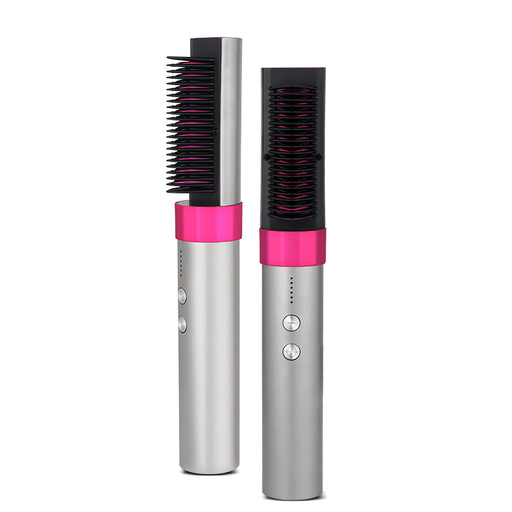
This cordless brush is a choice to consider for general smoothing and adjustable heat. If shaping individual wavy ends is your main task, check whether its brush format gives you the control you need.
 No image available
Consider this brush if cordless handling and temperature choice matter more to you than narrow-plate styling.
Its listed features include a lithium battery, six temperature settings from 130°C to 200°C and anti-scald comb teeth. If drawer space or charging arrangements are decisive, check its dimensions and supplied charging details before buying; do not assume it has a plate lock or pouch.
Yes, if it is a mains-operated straightener for use in the UK. Electrical Safety First says it must be fitted with a standard UK 3-pin plug and fuse; confirm these details for the model you intend to buy.
No. Unplug it and let it cool on a heat-resistant surface first. Electrical Safety First advises against storing straighteners in supplied heat-proof pouches until they have cooled.
No. A lock keeps the plates together, but it does not cool the tool or replace unplugging it before storage. Keep the appliance away from water and check its cable and plug before use.
Choose adjustable temperature if you want the option to start at a lower workable setting. A fixed-temperature model can be straightforward to use, but its heat cannot be reduced; compare the individual models’ stated settings before deciding.