Regular dry-hair stylers
If you style already-dry hair at a dressing table, consider the time it takes to get ready and where the hot tool will rest. Remington’s appliance instructions call for a stable, heat-resistant surface.


For a sleek style on already-dry hair, choose adjustable heat if you want to select the temperature yourself, or a fixed-temperature styler if you prefer not to choose a setting. Wider plates are worth considering for larger sections of long or thick hair; slim plates help with detailed sections, while a rounded tool allows occasional bends or waves. Whichever you choose, follow its hair-use instructions and provide a stable, heat-resistant place to rest it.
If you style already-dry hair at a dressing table, consider the time it takes to get ready and where the hot tool will rest. Remington’s appliance instructions call for a stable, heat-resistant surface.
If you prefer to choose a setting for your hair and routine, compare the selectable range on the exact model. Remington and BaByliss offer models with different numbers of settings.
If working through larger sections takes time, a wide-plate design may suit your routine. Check whether its size still works for any fringe, shorter layers or detailed styling you do.
For dry-hair styling at a dressing table, settle on the heat control and plate shape you want, then check how the tool will rest and cool safely. Plate width and temperature choice can coexist on the same model.
| Concern | What to check | Who this matters to |
|---|---|---|
| Heat control | Compare the exact model’s selectable temperatures with a fixed-temperature option; do not treat its maximum setting as the default. | If I want to choose the heat level rather than accept one fixed setting, temperature choice comes first. Around 30% of consumers put heat control first. |
| Larger sections | Compare plate width and whether the tool will also suit shorter layers or fringe work. | When long or thick hair takes many sections to style, I want a tool that can handle more hair at once. For around 20% of consumers, section coverage is the main concern. |
| Sleek-looking finish | Check the specific plate design and any ionic feature; treat claims about flyaways as manufacturer claims, not a promised result. | If visible flyaways are what I most want to address, I pay particular attention to finish-oriented features. Around 30% of consumers prioritise that concern. |
| Dressing-table routine | Check the resting-surface instructions, any shut-off feature and how the tool must cool before storage. | I need somewhere stable to put the hot tool during styling and cooling, even if it has automatic shut-off. Practical use and safe resting arrangements come first for around 20% of consumers. |
Wet-to-dry use depends on the model; heated plates alone do not establish that a conventional straightener is suitable for wet hair.
For this dry-hair routine, dry and detangle hair before using a standard straightener. If you need wet-to-dry styling, choose a model expressly designed for it and follow its instructions.
A wider plate addresses larger sections, while a slimmer tool can be easier to position for detailed work. A high maximum temperature does not tell you which setting suits your routine.
Compare plate shape alongside the available temperature settings, especially if you style both long lengths and shorter sections.
A shut-off feature does not replace attention while a tool is connected. Remington’s appliance instructions call for a heat-resistant, stable, flat resting surface.
Follow your model’s manual, keep the dressing table dry, unplug after use and let the tool cool before storage.
Safety alerts and recalls identify affected products; a brand name alone may not tell you whether your model is involved.
Keep the model number and purchase record so you can check the Office for Product Safety and Standards alerts and recalls for the precise tool.
The Platinum+ is a fixed-temperature option for dry-hair straightening, with a rounded barrel for occasional waves.
The models considered here cover slim plates with basic heat selection and wider plates with more settings.
The ST620U combines selectable heat with features aimed at a sleek-looking style.
These choices include plate straighteners and straightening combs to consider for a sleek-style dressing-table routine. Check each model’s hair-use instructions and resting requirements before choosing it for your setup.
 No image available
Consider the wide-plate shape if covering larger sections is your priority; check how comfortably it handles shorter sections too.
Confirm the intended hair-use mode, a heat-resistant resting arrangement and power compatibility for your setup.
 No image available
A brush-style choice if you want selectable heat for already-dry hair; its title specifies six settings from 130°C to 200°C and a cordless battery design.
Follow its instructions on hair condition and check the charging arrangement and where the hot brush can safely rest.
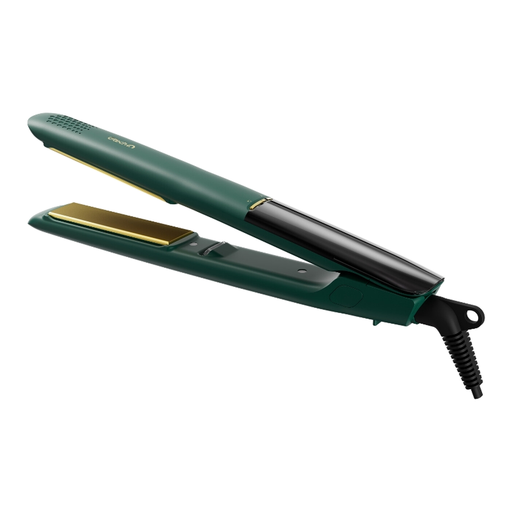 No image available
Consider this compact plate design if you want temperature choice without moving to a wide-plate tool. The title specifies ten settings and tourmaline-ceramic plates.
Check the instructions for dry-hair use, safe resting and the power connection before choosing it for your dressing table.
 No image available
A comb-style option if you prefer straightening while combing already-dry hair; the title identifies steam and PTC heating features.
Its routine includes filling and emptying a water tank. Follow the instructions on hair condition, and check its temperature controls and safe resting arrangement if those matter to you.
Do not assume a standard straightener is suitable for wet hair. Choose a model expressly designed for wet-to-dry use if that is what you need, and follow its mode-specific instructions; otherwise, dry your hair before straightening it.
Use a stable, heat-resistant surface and follow the instructions for your exact model. Remington’s appliance instructions also say not to leave the tool unattended while it is connected; let it cool before putting it away.
Search the Office for Product Safety and Standards product alerts and recalls using the brand and exact model number. Keep that number with your purchase record so you can identify whether an alert concerns your tool.
Contact the seller about the fault or discrepancy. GOV.UK guidance says sellers must offer a full refund when goods are faulty, not as described or do not do what they are supposed to; change-of-mind cancellations are a separate matter with their own rules and exceptions.