Dry-hair morning touch-up users
If your fringe and face-framing pieces are already dry, a conventional straightener with a manageable plate format is a useful starting point for smoothing or shaping just those sections.


For dry face-framing touch-ups before work, start with a straightener you can control around small sections, then decide whether selectable heat and quick heat-up matter to you. A wet-to-dry air tool is a different choice for mornings that begin with damp hair; conventional hot-plate straighteners are for dry hair only.
If your fringe and face-framing pieces are already dry, a conventional straightener with a manageable plate format is a useful starting point for smoothing or shaping just those sections.
If choosing the temperature matters to you, compare models with selectable settings rather than assuming every straightener offers them. BaByliss and Remington both describe adjustable settings on the models discussed below.
If your morning routine starts with damp hair, consider a tool specifically designed to dry and straighten it. Dyson describes the Airstrait as an airflow-based option; it serves a different routine from a quick dry-hair touch-up.
Decide whether you are styling a few dry front pieces or starting with damp hair; for a dry touch-up, weigh control, readiness and temperature choice against your own routine.
| Concern | What to check | Who this matters to |
|---|---|---|
| Control around the hairline | Compare plate width and body shape, particularly if you want to make a small bend as well as straighten. | If I style only a fringe or short pieces beside my face, I want to handle those sections without choosing a tool primarily intended for larger lengths. Around 40% of consumers put this targeted control first. |
| Morning readiness | Check the stated heat-up time, the controls and whether the tool has automatic shut-off. | When I have only a brief window before leaving, I want the tool ready without adding steps to a small dry-hair touch-up. Quick readiness comes first for around 30% of consumers. |
| Temperature choice | Check the selectable range and settings; a stated maximum is not a setting you have to use. | If my front pieces are fine, coloured or resistant to styling, I want to choose a setting for my own hair rather than rely on one fixed temperature. Around 20% of consumers prioritise that choice. |
| Styling from damp hair | Confirm that the tool is designed for wet-to-dry use and check which mode is intended for dry refreshes. | If I usually begin with damp hair, combining drying and straightening matters more to me than a quick touch-up of already dry sections. That is the primary need for around 10% of consumers. |
Cloud Nine positions its wide-plate iron for longer, thicker hair. That format addresses larger sections, which may not be the task if you style only a fringe and a few face-framing pieces.
Compare standard-width tools for a front-section-only routine; consider wide plates if you also regularly style substantial lengths.
Adjustable settings give you a choice, not a reason to use the highest one. Remington distinguishes cooler settings for fine or coloured hair from higher settings for thicker hair on its S3500.
Start with the lowest available setting that achieves the finish you want, following the instructions for your tool and hair.
Wet-to-dry styling is a feature of tools designed for it. Electrical Safety First advises against using a conventional straightener on wet hair or with wet hands.
Let hair dry before using a conventional hot-plate straightener. If you need to style from damp, follow the instructions for a purpose-designed wet-to-dry tool.
Electrical Safety First advises that mains-operated straighteners have a UK three-pin plug and fuse. London Fire Brigade warns that straighteners can remain very hot after use.
Check the plug when buying a mains tool, then switch it off, unplug it and leave it to cool on a heat-resistant surface before storage.
These brands illustrate different tool formats and controls; the features below refer to the named models, not every product each brand makes.
The Chronos is a conventional straightener with 26 mm plates and a rounded body for shaping dry front sections.
The Smooth Pro 235 is a conventional dry-hair option for buyers who want selectable heat.
The S3500 combines variable heat with a stated short heat-up time for a dry-hair routine.
The Wide Iron is positioned for longer or thicker hair styled in larger sections.
The Airstrait is an airflow-based route for people who want to dry and straighten damp hair in one routine.
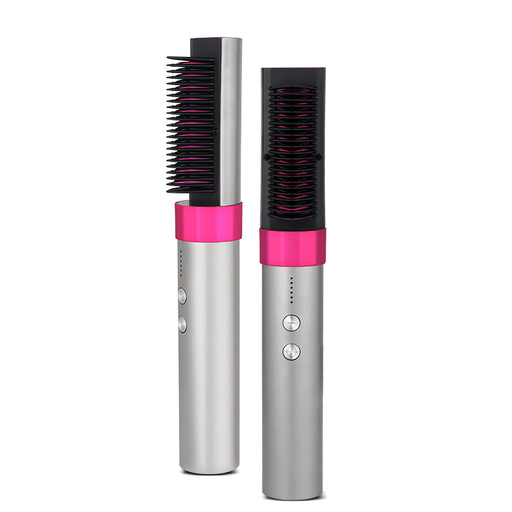
This cordless straightening brush is a choice for dry-hair touch-ups when selectable heat matters. If you mainly style short pieces close to the hairline, check its brush-head dimensions before deciding whether the format suits you.
 No image available
For dry-hair touch-ups when you prefer a cordless brush with selectable heat; check the brush-head size if you need to work on small face-framing sections.
The product name lists six settings from 130°C to 200°C, PTC heating, a lithium battery and an anti-scald comb-tooth design.
No. Electrical Safety First advises against using a conventional straightener on wet hair or with wet hands. To style from damp hair, choose a tool specifically designed for wet-to-dry use and follow its instructions.
For a mains-operated straightener in the UK, Electrical Safety First advises checking for a UK three-pin plug and fuse. Confirm the supplied plug rather than assuming that a product name or listing establishes it.
No. Automatic shut-off is a back-up feature, not a replacement for switching off and unplugging the straightener. London Fire Brigade advises leaving it to cool on a heat-resistant surface before storage.
Wide plates are worth considering if you also style longer or thicker hair in larger sections; Cloud Nine positions its Wide Iron for that use. If your main task is a fringe or short front pieces, compare standard-width tools for the control you need instead.