Choose custard creams if the vanilla-flavoured filling is what you want; choose plain digestives if you would rather have a biscuit without a cream filling. If gluten avoidance matters, look for an explicitly labelled gluten-free product instead of relying on either biscuit name, and check the exact pack’s ingredients, allergens and nutrition information.
Who is choosing these biscuits?
Half-term family snack buyers
If biscuits will be eaten at home over several days, decide whether the household wants a filled custard cream or a plain digestive. Pack format and how the biscuits will be stored after opening may also affect that choice.
Households managing food allergies
Biscuit type alone cannot settle an allergen question. Check the ingredients and precautionary statements on the exact pack; an explicitly labelled gluten-free custard cream is a separate option from the conventional examples discussed here.
What should you compare?
Start with the biscuit format you want, then compare the exact packs for nutrition, dietary suitability and storage.
| Priority |
What to check |
Your needs |
| Biscuit type |
Check whether the pack describes a vanilla-flavoured cream filling or a plain digestive. Crawford’s custard creams and McVitie’s Original Digestives illustrate these distinct formats. |
I would choose a filled biscuit for the cream filling, or a plain digestive when I do not want one. |
| Sugar and servings |
Compare sugars per 100g on the exact packs, then check the stated serving or biscuit weight rather than assuming one biscuit is the same size across products. A digestive’s name does not describe its sugar content. |
For snacks served during half term, I want to know what is in the portion I am putting out. |
| Allergens and gluten |
Read current ingredients and ‘may contain’ statements. The conventional Crawford’s and McVitie’s examples contain wheat; the cited Schär custard creams are labelled gluten-free. |
If someone needs to avoid an ingredient, I need the information for the exact product and pack, not just the biscuit category. |
| Pack format |
Check the number of biscuits or individual packs and the after-opening storage instructions. The cited Schär 125g product has five two-biscuit packs; Sainsbury’s advises airtight storage for its opened custard creams. |
Individual packs may suit separate snack occasions; for an opened larger pack, I would follow its storage instructions. |
What is easy to overlook?
-
Treating ‘digestive’ as another name for custard cream
A plain digestive has no cream filling, but its name does not establish a particular nutrition profile. The cited custard cream and digestive have different recipes.
Choose the filled or plain format first. If nutrition affects your choice, compare the exact labels using the same per-100g basis.
-
Relying on an earlier online allergen description
Ingredients and warnings differ between these products, and M&S notes that product information can change.
For an allergy or intolerance, read the ingredients and precautionary statements on the current pack before serving.
-
Applying school-food rules to a snack at home
The Department for Education’s school-food guidance concerns food provided in state-funded schools in England. It does not make an ordinary half-term snack at home a school meal.
Keep the setting clear when considering a rule. The further school-standard changes described for September 2027 are subject to Parliamentary approval, not current requirements.
Which brands illustrate the options?
Crawford’s
Its 300g custard creams illustrate the conventional vanilla-flavoured cream sandwich biscuit.
- Tesco Groceries provides ingredients, per-biscuit nutrition and storage information for this product.
- The cited product contains wheat and milk and may contain sesame; check the current pack if these matter.
McVitie’s
Original Digestives illustrate the plain-digestive side of the choice, rather than a filled custard cream.
- McVitie’s publishes ingredients and nutrition information for Original Digestives.
- The Original contains wheat and may contain milk. Its details should not be applied to coated or filled variants.
Sainsbury’s
Its 200g own-label custard creams provide another conventional filled-biscuit example.
- The listing gives ingredients and nutrition per biscuit and per 100g.
- The pack’s after-opening advice calls for an airtight container; use the current label for product details.
M&S
Extra Cream Custard Creams are a variation for shoppers specifically looking for the brand’s extra-cream format.
- M&S describes the product as having extra vanilla cream and supplies its nutrition information.
- ‘Extra cream’ is the brand’s description, not an independent comparison with other custard creams. M&S advises checking the pack because ingredients can change.
Schär
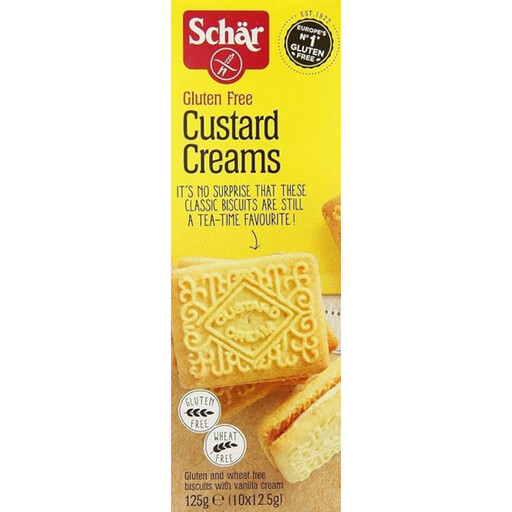
The cited 125g gluten-free custard creams offer a different recipe and pack format from the conventional examples.
- The Sainsbury’s listing describes five individual packs of two biscuits.
- Check the exact product label for dietary requirements; the gluten-free description of this product does not describe every Schär biscuit.
Joybuy biscuit options
These options cover a gluten-free custard cream and a plain, sugar-free digestive. Compare their own packs rather than transferring details from the conventional Crawford’s or McVitie’s examples.
 No image available
Schär Gluten Free Custard Creams 125g
A filled-biscuit option when an explicitly labelled gluten-free product is needed. The cited product is packed as five pairs of biscuits; check the current pack’s ingredients and allergen information against individual requirements.
View on Joybuy
 No image available
Gullon Zero Sugar Free Original Digestives 400g
A plain digestive option for someone who does not want a cream filling. This is the named sugar-free variant, not McVitie’s Original; check its own nutrition panel, ingredients, allergens and any sweetener advice before choosing it.
View on Joybuy
Questions about half-term biscuits
What if a child has a wheat or milk allergy?
Check the ingredients and precautionary allergen information on the exact pack before serving. Tesco Groceries lists wheat and milk in the cited Crawford’s custard creams, while McVitie’s says its Original Digestives contain wheat and may contain milk; an earlier online description should not replace the current label.
How should an opened pack be stored?
Follow that pack’s instructions. Tesco Groceries says the cited Crawford’s custard creams should be kept in a cool, dry place and put in an airtight container after opening; the cited Sainsbury’s custard creams also advise airtight storage after opening.
Do school-food rules apply to biscuits eaten at home during half term?
No. The Department for Education’s school-food guidance addresses food provided in state-funded schools in England, not an ordinary snack eaten at home. Its described changes for September 2027 are subject to Parliamentary approval and should not be treated as current rules.
Do rules on less-healthy food ban buying custard creams?
No general ban on buying biscuits follows from the cited rules. The Department of Health and Social Care describes restrictions on specified advertising and, in England, certain promotions of qualifying products; whether a particular biscuit falls within a restriction depends on the applicable product and legal criteria, not its name alone.


