Hosts comparing sugar figures
If you want an orange-flavoured party drink with less sugar shown on the label, compare the nutrition information and ingredients rather than relying on the words “no added sugar”.


Choose 100% orange juice if guests want an orange-only drink and you can serve small glasses; no added sugar does not mean sugar-free. If reducing the sugars shown on the label is the main aim, consider a no-added-sugar orange juice drink or diluted squash, but check its juice content, sweeteners, allergens and preparation directions. A lighter juice blend is another option, though it is not pure orange juice and still contains sugars.
If you want an orange-flavoured party drink with less sugar shown on the label, compare the nutrition information and ingredients rather than relying on the words “no added sugar”.
For someone who wants an orange-only ingredient list, 100% juice is distinct from a juice drink or squash. It still contains naturally occurring sugars, so the size of the glass matters.
Check the exact pack for sweeteners, allergens and age warnings before putting drinks out for guests. The NHS advises that children avoid squash and juice drinks; water is a straightforward alternative to offer.
Decide whether the drink needs to be pure juice, ready to serve or suitable for dilution, then compare labels on the same serving basis.
| Priority | What to check | Your needs |
|---|---|---|
| Sugars | Read “of which sugars” per 100ml and for the amount you plan to serve. Check it even when the pack says “no added sugar”: Tropicana UK lists 13g sugars per 150ml for Original Orange. | I want to compare the drink in the glass, not assume its front-of-pack wording tells me how much sugar it contains. |
| Drink type | Check whether the label says 100% juice, juice blend, juice drink or squash, and read the juice percentage. Tesco lists 12% orange juice in its cited no-added-sugar drink; Sainsbury’s lists 8% in Fruit Slurps. | Some guests may expect orange juice made only from oranges. If I choose a juice drink instead, I want its description to be clear. |
| Serving size | For fruit juice, the NHS advises no more than one small 150ml glass a day, with a meal. Check the volume of cups or individual packs rather than assuming one container equals that serving. | I would rather offer a small glass of pure juice than make a large pour the default at the party. |
| Ingredients | Read the sweetener and allergen declarations on the current pack. The cited Tesco and Sainsbury’s juice drinks list sweeteners; M&S Mediterranean Orange High Juice lists sucralose and sulphites. | Guests may avoid particular ingredients, so I need to know what is in the drink before serving it. |
| Preparation | Check whether the drink is ready to serve or needs diluting. For squash or high juice, follow the bottle’s directions and compare nutrition figures only on a clearly stated basis. | A shared jug could work for the party, provided I can prepare it as directed and identify it clearly for guests. |
Orange juice can contain sugars even when none has been added. Tropicana UK lists 13g sugars per 150ml for Original Orange.
Compare the sugars line per 100ml and for your planned serving before choosing between juice and a juice drink.
A drink with a lower sugar figure may also contain much less orange juice. The cited Tesco and Sainsbury’s juice drinks list 12% and 8% orange juice respectively.
Choose the drink type first, then compare products within that choice using their ingredients and nutrition labels.
The cited lower-sugar juice drinks contain sweeteners, while M&S Mediterranean Orange High Juice declares sulphites.
Keep the current pack available so guests can read its ingredients, and offer water as an alternative.
Ingredients, nutrition and preparation instructions need to match the drink you actually serve.
Check the purchased pack’s label, best-before date and dilution directions before the party.
These examples show how differently orange drinks can be formulated; a brand reference does not mean every product in its range has the same ingredients.
Tropicana UK lists Original Orange as 100% pressed juice, while Fresh & Light Morning Orange is a fruit-and-water blend.
innocent includes orange juice among its drinks. Check the particular carton if you are choosing between smooth juice and juice with bits.
Tesco’s cited No Added Sugar Orange Drink Pouches are juice drinks in individual 200ml packs, not 100% orange juice.
Sainsbury’s cited No Added Sugar Fruit Slurps Orange Juice Drink comes in individual 250ml packs.
M&S Mediterranean Orange High Juice is a different format from ready-to-drink orange juice: check its preparation directions before serving.
These options cover individually bottled orange juice drink and orange squash for dilution at a party. Neither should be mistaken for 100% orange juice.
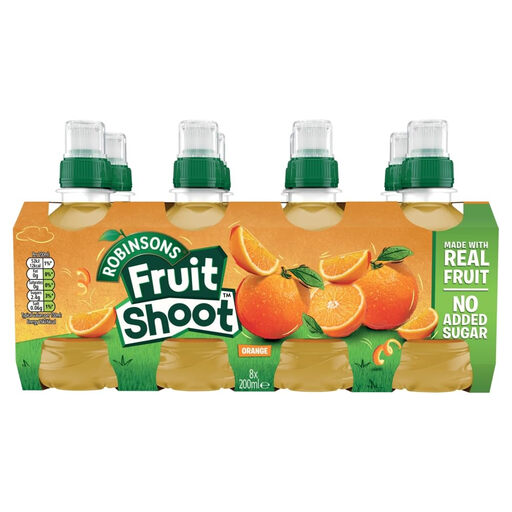 No image available
Individual bottles offer a ready-to-serve orange juice drink for party guests. This is not 100% orange juice; the product information identifies sucralose and acesulfame K. Check the pack’s warning about small caps and its restriction for children under 36 months.
 No image available
This squash can be prepared for shared serving, but must be diluted according to the bottle directions; do not serve it undiluted. The product information identifies acesulfame K, sucralose and sulphites, and says it is unsuitable for children under 36 months.
No. A drink can contain naturally occurring sugars without having sugar added. Tropicana UK, for example, lists 13g sugars per 150ml for Original Orange, so check the nutrition label for the serving you intend to pour.
The NHS advises limiting fruit juice and smoothies to one small 150ml glass a day, taken with a meal. Small glasses make that serving easier to judge at a party; offer water as well.
Some do. The cited Tesco drink lists sucralose, while Sainsbury’s Fruit Slurps lists acesulfame K and sucralose. Read the ingredients on the exact pack if guests avoid particular sweeteners.
Check the current pack’s ingredient and allergen information before serving. For example, M&S Mediterranean Orange High Juice declares sulphites, which may matter to guests who need to avoid them.
No. Squash needs diluting according to its bottle directions, so prepare it before filling a shared jug. Check whether any nutrition figure refers to the product as sold or to the diluted drink before comparing servings.