
24/7 Customer Support

Free returns

Same-day & Next-day Delivery

Quality Guaranteed

Unlock Your Welcome Offers: FREE Delivery | Up to 80% OFF | Free 30-day JoyPlus trial
Download the APP
A hand blender can simplify soups, smoothies, sauces, purées and baking preparation, but choosing one based only on wattage or the number of attachments can lead to disappointment. The right hand blender should match your cooking habits, available storage and cleaning routine.
A 1000W hand blender may offer more motor power than a 450W model, but wattage alone does not determine texture, control or convenience. Blade design, speed adjustment, working time and the shape of the blending guard also affect how an appliance handles ingredients.
For occasional smoothies and sauces, a compact 450W electric hand blender may be sufficient. Larger batches, dense vegetables, frozen ingredients or frequent food preparation may justify a higher-powered model with variable-speed control.
A hand blender with chopper, whisk, masher and extra blades can replace several small kitchen appliances, but only if you will use those accessories. Check the capacities and included components carefully. A 350ml or 500ml chopper is useful for herbs, nuts and small portions, while a whisk attachment suits eggs, cream and lighter batters.
If your main requirement is blending soup directly in a saucepan, a basic immersion blender may be more practical than a large multi-purpose hand blender set.
Most models require the motor housing, power cord and plug to be wiped with a damp cloth rather than placed in water. Dishwasher-safe claims generally apply only to detachable accessories, and some parts may have temperature limits. Always check the instruction manual before cleaning.
Blades are also sharp, so unplug the appliance before removing attachments and avoid placing loose blades where children can reach them.
For light blending, a 450W hand blender can handle many everyday tasks, including sauces, desserts and soft-fruit smoothies. Models rated at 1000W or with a stated maximum output of 1200W are more suitable for frequent preparation and tougher mixtures, provided the manufacturer’s operating guidance is followed.
Continuous operating limits matter just as much as power. Some appliances recommend short bursts or no more than one minute of operation, followed by a rest period. This helps reduce overheating and should be considered when preparing thick soups, nut mixtures or large quantities.
A one-speed stick blender is straightforward and can be convenient for quick recipes. A variable-speed hand blender gives more control: start slowly to reduce splashing, then increase the speed for finer blending. Trigger controls, dials, turbo settings and separate normal/turbo buttons all offer different handling styles.
Blade and guard design should suit your recipes. Stainless-steel blades are widely used for food contact and everyday durability. Anti-splash guards can help keep worktops cleaner, while an ice-crushing or larger cutting area may be useful for frozen drinks and harder ingredients. Do not assume any hand blender can process large ice cubes, bones or completely frozen foods unless the instructions specifically allow it.
Look at the size of the supplied beaker and chopper rather than relying on the word “multi-purpose”. A 600ml or 800ml beaker is practical for individual portions or family-sized preparation, but deep containers may be preferable for hot soup to reduce splashing.
Useful accessories can include:
For easier maintenance, choose detachable parts that are clearly identified as dishwasher-safe. Keep the motor body out of water and dry all components thoroughly before storage.

Why This Fits Their Persona: A simple option for students, smaller households and occasional cooks making smoothies, sauces or desserts.
Its specification focuses on a 450W motor, one-touch operation and a compact accessory set rather than unused extras.
Includes a 600ml BPA-free beaker and chopper; detachable parts are listed as dishwasher-safe according to the manual.
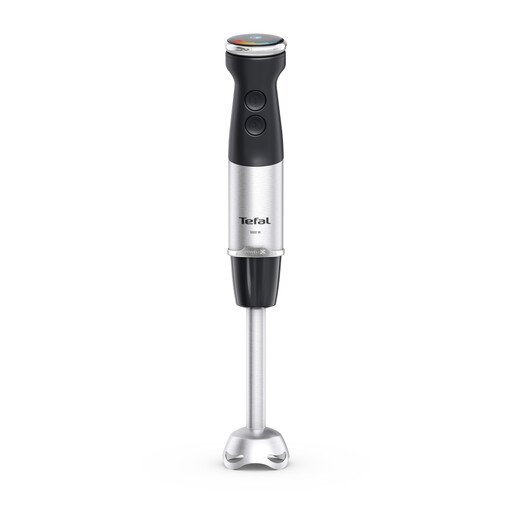
Why This Fits Their Persona: Suits regular home cooks who want speed adjustment, a metal housing and a larger beaker for soups, purées and smoothies.
The 20-speed dial and Turbo mode provide more control than a one-speed appliance, while the anti-splash guard addresses mess during blending.
1000W motor, 800ml beaker, four stainless-steel blades and dishwasher-safe removable parts are specified.
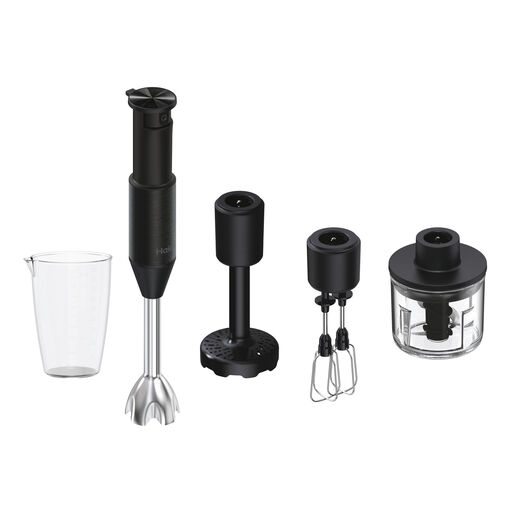
Why This Fits Their Persona: Designed for households regularly blending, whisking, chopping and mashing across everyday cooking and baking tasks.
The trigger-style variable control avoids the limits of fixed-speed blending, while the specified accessory range gives each task a suitable attachment.
Includes a whisk, double whisk, chopper, masher and stirrer; listed attachments are dishwasher-safe.
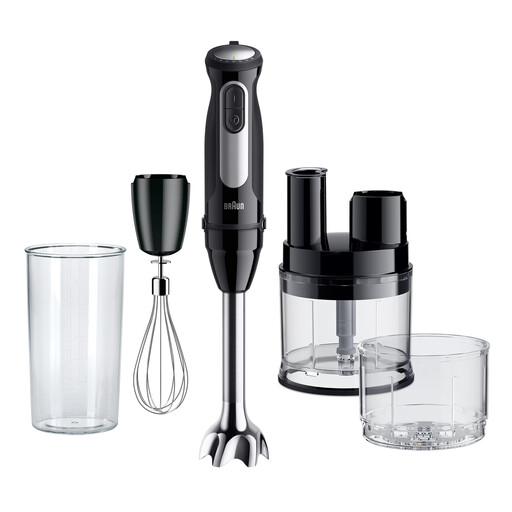
Why This Fits Their Persona: A flexible food-preparation system for families and baking enthusiasts who want blending, chopping, whisking, slicing and grating in one appliance.
Its 25-speed wheel and Turbo function offer adjustable control, reducing reliance on a single high-speed setting.
The set includes a metal shaft, whisk, mini food processor, slicing/grating disc, ice-crush knife and 500ml beaker.
We have compiled a complete, real-time list of products that fully satisfy these strict selection criteria and UK safety regulations.
Yes. A soup blender can purée cooked vegetables and stock directly in a saucepan, provided the container is deep enough and the appliance instructions permit hot-liquid use. Keep the blender upright, avoid lifting it while running and follow any stated temperature limit.
Lifespan depends on frequency of use, ingredient hardness, cleaning and adherence to operating limits. Avoid running the motor empty, exceeding continuous-use guidance or forcing the blade through dense food. Detachable, washable accessories and a wipe-clean motor body can also make regular maintenance easier.
A corded electric hand blender generally runs for short periods, so its total electricity use depends on power rating and preparation time. A 450W model uses less power while operating than a 1000W model, but a higher-powered appliance may complete demanding tasks more quickly. For a realistic comparison, check the wattage, typical running time and your household’s electricity tariff.