
24/7 Customer Support

Free returns

Same-day & Next-day Delivery

Quality Guaranteed

Unlock Your Welcome Offers: FREE Delivery | Up to 80% OFF | Free 30-day JoyPlus trial
Download the APP
A hand blender can save space and preparation time, but choosing one based only on wattage or the number of accessories can lead to disappointment. A low-cost model may handle smoothies well but struggle with dense vegetables, while a large attachment set may take up cupboard space without matching your cooking habits.
As the Joybuy Product Recommendation Officer, my aim is to filter out unclear marketing language and focus on practical details that matter in a UK kitchen.
A 1000W hand blender may offer useful power for soups, sauces and heavier mixtures, but wattage alone does not explain blade design, motor protection or recommended operating time. Some models also advertise a maximum wattage rather than their rated power.
Look for the full specification, including:
For example, the ROUNY model lists 1000W rated power and 1200W maximum power, while also specifying one minute of operation followed by one minute of rest. That information is more useful than a power figure on its own.
“Dishwasher-safe parts” normally refers to removable accessories, not the motor housing, electrical connector or every component of a whisk gearbox. The motor unit should never be immersed in water.
Before buying a hand blender with attachments, check which parts can go into the dishwasher and whether a maximum temperature is stated. The ROUNY accessories, for example, should be washed below 60°C. For other products, consult the instruction manual before using a dishwasher programme.
An immersion blender is useful as a soup blender, but blending hot food requires care. Steam and splashes can cause burns, particularly in shallow pans. A blending guard may reduce splashing, but it does not remove the need for safe handling.
Use a deep container, keep the blending head fully submerged and remove the pan from direct heat before blending. Some product instructions specify allowing soup to cool below 80°C. Never use a small beaker or chopper bowl for liquids beyond its stated capacity.
For light tasks such as sauces, soft fruit and small portions of baby food, a 450W to 600W electric hand blender may be sufficient. A higher-rated motor can be more suitable for thicker purées, larger batches and frequent preparation, provided the design has suitable cooling and operating instructions.
Do not run a stick blender continuously beyond the manufacturer’s stated limit. Pulse operation—brief presses followed by pauses—can help reduce heat build-up when processing dense ingredients.
A single-speed model is straightforward for occasional blending. A variable speed hand blender gives more control when moving from a gentle start to a finer finish. This can also help limit splashing.
The Braun MultiQuick 5 Pro MQ55236M lists intelligent variable speed control, a 1000W motor and an anti-splash blending design. The Braun MQ55755M provides a 25-speed control wheel plus Turbo mode. Tefal’s Quickchef+ HB6718G0 offers 20 speeds and Turbo mode.
Blade shape also matters. Stainless steel blades are widely used for food preparation, but compare the number of blades, guard design and intended ingredients rather than relying on a “powerful” label.
A 4-in-1 hand blender can replace several small kitchen tools, but only if you will use the attachments. Common options include:
Check the included bowl and beaker capacities. A 500ml chopper suits smaller portions, while a 700ml beaker may be more convenient for smoothies or sauces. A dishwasher-safe hand blender can reduce cleaning time, but detachable parts must still be rinsed promptly so thick food does not dry around the blade guard.

Why This Fits Their Persona: A practical choice for students, smaller households and occasional cooks who want a compact food mixer for sauces, smoothies and chopping.
Its specification clearly states a 450W motor and one-speed operation, so buyers are not paying for unused controls.
Includes a 600ml beaker and chopper, with a lightweight design and dishwasher-safe removable parts.
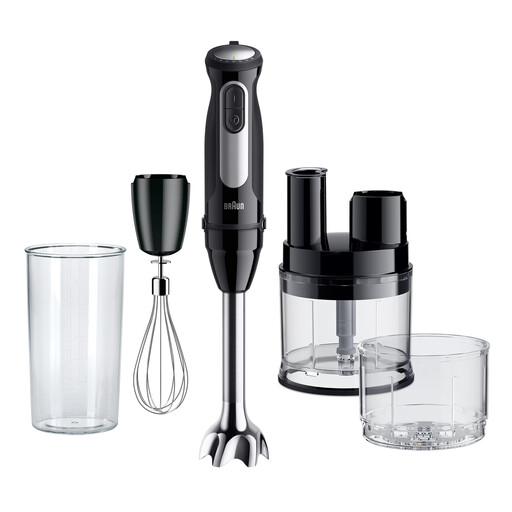
Why This Fits Their Persona: Suitable for regular home cooks and baking enthusiasts wanting adjustable control and several food-preparation functions in one system.
The set specifies its 1000W motor, 25-speed wheel, Turbo function and attachment list instead of relying on a generic multifunction claim.
Includes a mini food processor, whisk, slicing and grating disc, ice-crush knife and 500ml beaker.
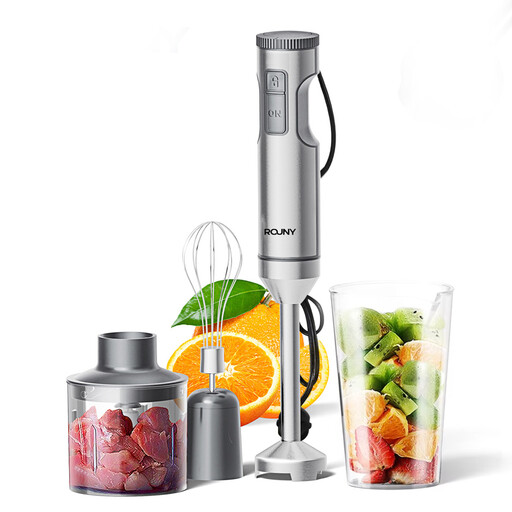
Why This Fits Their Persona: Designed for households preparing soups, sauces, smoothies and chopped ingredients regularly, with separate tools for different jobs.
It states both rated and maximum power, a one-minute operating limit, overheating protection and the cleaning temperature limit.
Offers a 700ml beaker, 500ml chopper, whisk, stainless steel shaft and stepless speed control.
We have compiled a complete, real-time list of products that fully satisfy these strict selection criteria and UK safety regulations.
Yes, many are designed for soup, but follow the specific manual. Use a deep pan, remove it from direct heat, keep the head submerged and avoid filling the container too highly. A provided beaker may not be suitable for hot liquids.
Lifespan depends on build quality, frequency of use, cleaning and whether the motor is overloaded. Following the stated pulse intervals, avoiding unsuitable ingredients and keeping the motor housing dry can help reduce unnecessary wear.
A corded model rated at 1000W uses 1 kilowatt-hour if operated continuously for one hour. Since blending usually takes seconds or short cycles, actual electricity use is generally much lower. The appliance’s operating time matters more than its headline wattage when considering running cost.