
24/7 Customer Support

Free returns

Same-day & Next-day Delivery

Quality Guaranteed

Unlock Your Welcome Offers: FREE Delivery | Up to 80% OFF | Free 30-day JoyPlus trial
Download the APP
A hand blender and food processor can reduce worktop clutter while helping with soups, smoothies, sauces, chopped vegetables, whisked eggs and meal preparation. However, buying a multifunctional appliance based only on wattage or the number of attachments can lead to disappointing results.
The right choice depends on how you cook, how much food you prepare and whether you prioritise compact storage, batch capacity or attachment versatility.
A higher wattage figure does not automatically mean smoother blending or faster chopping. Motor design, blade shape, speed control and the type of ingredients all affect performance.
For example, a compact appliance may suit soft fruit and small portions but struggle with thick mixtures. A food processor with a larger bowl may be more suitable for batch chopping, slicing and shredding, even if its wattage is not the highest available.
A 4-in-1 hand blender may include a whisk, beaker and chopper, but each accessory has a specific purpose and capacity. A whisk is designed for eggs, cream and light batters rather than dense dough. A blending shaft needs enough liquid to circulate ingredients, while a chopper bowl is more appropriate for onions, herbs and nuts.
Check the included accessories and their stated capacities rather than relying on a general “all-in-one” label.
Attachments that are difficult to remove or wash can make daily use inconvenient. Look for detachable parts and clear dishwasher guidance. The motor housing should generally be wiped with a damp cloth and never immersed in water.
Also check the recommended operating cycle. Several hand blenders in this category specify short bursts, often around one minute, followed by a cooling period. Ignoring this guidance may place unnecessary strain on the motor.
An immersion blender, also called a stick blender, is convenient for blending soup directly in a saucepan and usually takes less storage space. It is suitable for sauces, purées and smaller quantities, particularly when paired with a hand blender with beaker.
A worktop food processor and blender normally offers greater capacity and is more practical for slicing, grating, shredding, dough mixing and family-sized preparation. It needs more cupboard or worktop space, but may replace several separate appliances.
Capacity should match your cooking routine:
Do not confuse total bowl capacity with the usable working capacity. Ingredients need room to circulate, and hot liquids require particular care. Always follow the maximum-fill mark and the manufacturer’s instructions.
Variable speed can help you start gently to reduce splashing before increasing power. A pulse function is useful for controlling texture when chopping vegetables, herbs or nuts.
If you want a stick blender with whisk, check how the whisk connects to the motor unit and whether the gearbox is washable. For a dishwasher-safe blender, verify which detachable parts can go in the dishwasher and whether a specific temperature or rack position is required.
Blade guards, pan-protection features and splash-control designs may make blending more comfortable, but they do not remove the need to submerge the shaft before switching on. Keep hands and utensils away from moving blades, unplug the appliance before changing attachments and allow blades to stop fully before removal.
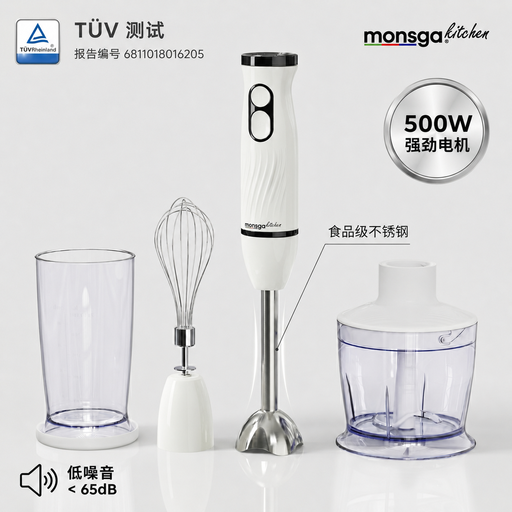
Why This Fits Their Persona: A compact option for UK flats, first kitchens and cooks who need blending, whisking and small-batch chopping without a full-size processor.
The set lists a 500ml chopper, 500ml beaker, blending shaft and whisk, while the normal and turbo controls provide more flexibility than a single-speed starter model.
The blending arm and whisk head are listed as dishwasher safe; its 36.5cm body can reach deeper pans.
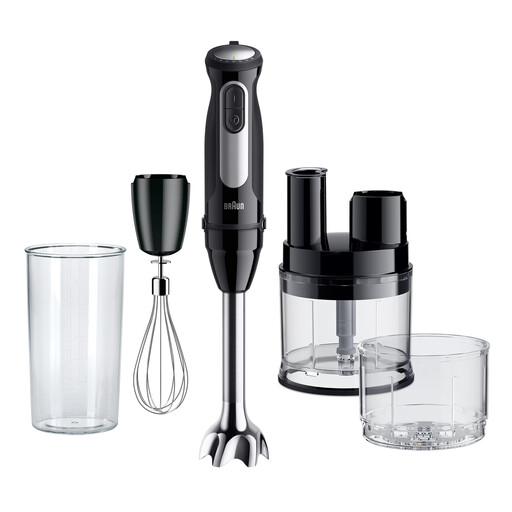
Why This Fits Their Persona: Appropriate for regular cooks and baking enthusiasts wanting detailed speed adjustment, a whisk and a mini food processor in one handheld system.
Its 25-speed wheel and turbo setting avoid the limitations of a basic one-speed control, while the EasyClick Plus system is designed for attachment changes.
Includes a metal blending shaft, whisk, 500ml beaker and mini processor with slicing and grating disc.
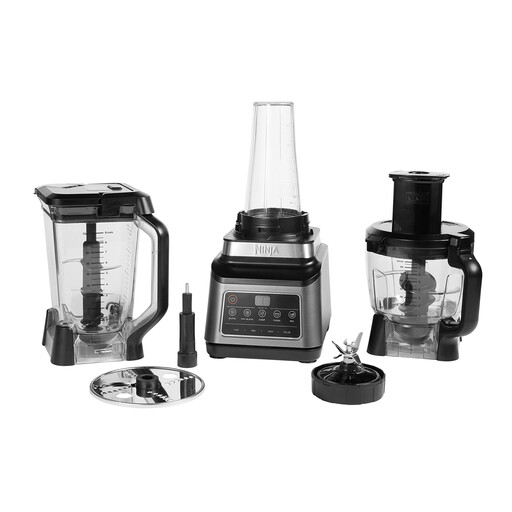
Why This Fits Their Persona: Suits families, meal-prep users and households that need substantial bowl and jug capacity for dough, salads, smoothies and shared recipes.
The system separates tasks across a 1.8L processor bowl, 2.1L jug and 700ml cup, rather than expecting one small container to handle every recipe.
It has a 1200W motor, five automatic programmes and dishwasher-safe parts listed for the included accessories.
We have compiled a complete, real-time list of products that fully satisfy these strict selection criteria and UK safety regulations.
Yes. A hand blender is suitable for smooth soups, sauces and many smoothies when used with enough liquid and an appropriate container. For large batches, a worktop jug with a stated capacity may be more convenient. Follow the product instructions for hot liquids.
Running cost depends on motor power and operating time. A hand blender often uses less electricity for short tasks because it is used for brief blending cycles. A larger food processor may use more power but complete batch preparation in fewer cycles. The difference in household electricity cost is usually influenced more by frequency and duration than by the appliance category alone.
Lifespan depends on construction, cleaning, storage and whether the recommended operating cycle is followed. Avoid overfilling, hard objects outside the stated instructions and continuous operation beyond the specified limit. Keep your receipt and check the manufacturer’s warranty and spare-part information before purchasing.