Occasional smoothie hosts
If friends visit only now and then, focus on a manageable blending setup rather than a large attachment kit. Check how you will control the speed, clean the food-contact parts and blend the quantity you plan to serve.


For occasional kiwi smoothies, start with a straightforward hand blender and a deep enough jug for the amount you intend to serve. Check the shaft material, speed controls and cleaning instructions; consider an XL wand if you regularly make larger batches, and pay for extra attachments only if you will use them for other food preparation.
If friends visit only now and then, focus on a manageable blending setup rather than a large attachment kit. Check how you will control the speed, clean the food-contact parts and blend the quantity you plan to serve.
If you often make several servings or prepare soups and purées, consider whether a longer wand suits your usual jug. Kenwood describes its Triblade XL wand as intended for larger batches; the blending vessel still needs to suit your planned quantity.
If you also expect to chop, whisk or process food, compare the attachments supplied with each exact model. Braun Household GB lists a chopper, whisk, purée tool and food processor with the MQ 9187XLI, but those tools add little to a smoothie-only routine.
For a hand blender used to make kiwi smoothies when friends visit, work out the amount you intend to serve before deciding how much you value easier cleaning or additional tools.
| Concern | What to check | Who this matters to |
|---|---|---|
| Batch size | Check the jug’s usable fill limit against your planned servings. If larger batches are routine, consider the wand length and whether the design is intended for a deeper vessel. | If I am serving several friends, I want to blend the planned quantity without repeatedly making small batches; roughly 50% of consumers put batch capacity first. |
| Cleaning and guest needs | Check which food-contact parts detach and which the exact model’s instructions allow in a dishwasher. Ask guests about ingredients that matter to them. | When I prepare drinks for guests, I want manageable cleanup and care over ingredient carry-over; around 30% of consumers place cleaning and guest needs first. |
| Useful attachments | Compare the included chopper, whisk or processor with tasks you actually do. Treat a chopper bowl’s capacity separately from the vessel used to blend drinks. | I would use extra tools for other meals, but do not want to store and wash attachments bought only for smoothies; roughly 20% of consumers prioritise useful versatility. |
Chopping, whisking and processing attachments serve separate preparation tasks; they are not needed simply to blend a kiwi smoothie.
List the other tasks you regularly do before choosing a bundle. If you only expect to make drinks, compare simpler hand blenders first.
A chopper bowl and a blending jug have different jobs. A listed chopper volume does not tell you how much smoothie you can blend for guests.
Plan your servings, then check the usable fill limit of the vessel you intend to blend in.
Cleaning instructions can differ between the blending wand, other detachable tools and the motor unit.
Consult the manual for the exact model and check the care instructions for each food-contact part.
Kenwood’s Triblade XL models are worth comparing if you regularly blend in a deeper jug or prepare larger batches.
Braun’s MultiQuick range includes bundles for consumers who want one hand-blender system to cover tasks beyond drinks.
Bosch’s ErgoMaster MSM4B624GB is an option to examine if detachable metal blending parts and variable speed matter to you.
These hand blenders offer different levels of speed control and included accessories for a smoothie-making setup. Before choosing one for visiting friends, check the usable fill limit of the vessel you plan to blend in.
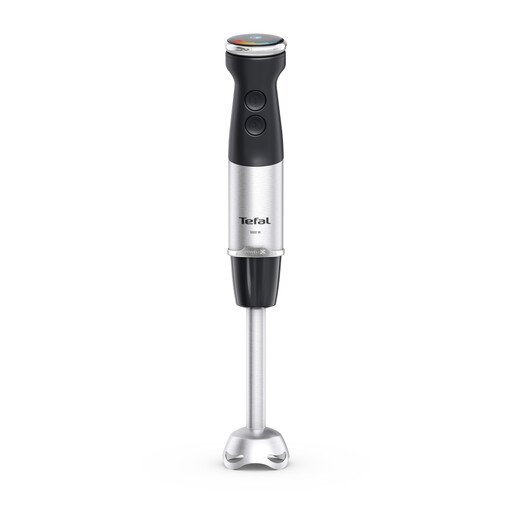 No image available
Consider this model if adjustable speed is important for your smoothie-making setup.
Its listed controls include 20 speeds. Check the usable fill limit of your blending vessel against the servings you intend to make.
 No image available
Consider this bundle if you expect to chop or whisk food as well as make smoothies.
A beaker, chopper and whisk are named in the product title. Check the beaker’s usable fill limit for your planned servings.
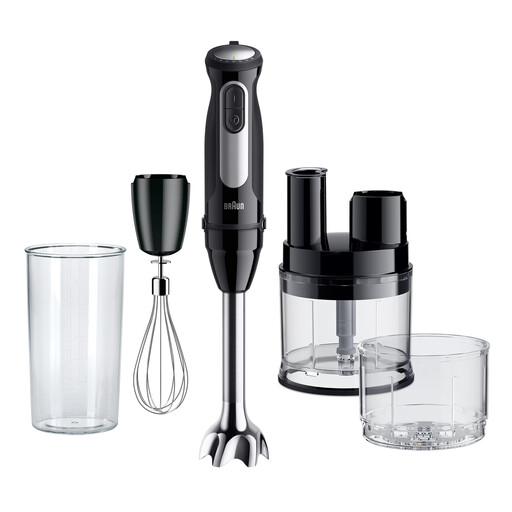 No image available
This bundle makes more sense if you will use a mini food processor and whisk for other preparation tasks.
The product title specifies 1,000 W and includes a beaker. The additional attachments may be unnecessary for smoothies alone; check the beaker’s usable fill limit before planning a group batch.
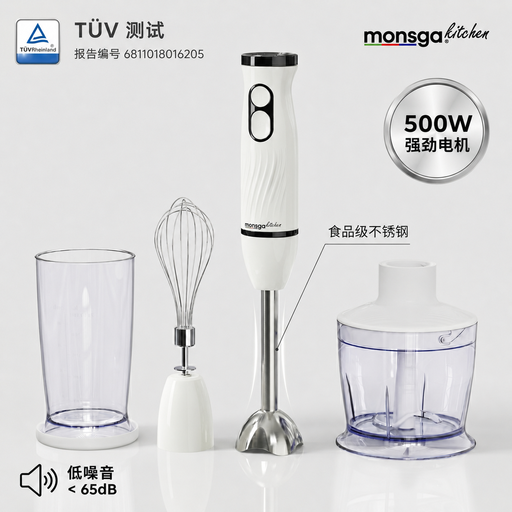 No image available
Consider this option if normal and turbo controls suit you and you would also use a whisk.
The title lists a 500 ml beaker and a separate 500 ml chopper. Neither figure establishes the beaker’s usable blending fill limit, so check it against your planned servings; also confirm the shaft material if a metal shaft matters to you.
 No image available
Consider this simpler control setup if occasional smoothies are your main task and you do not need to vary the speed.
The product title specifies 450 W and one speed. If a metal shaft is a requirement, check the shaft material before choosing it; confirm that your blending vessel will accommodate the planned servings.
Start with the quantity you intend to serve and a blending vessel suited to it. Then compare shaft material, speed control and cleaning instructions; a longer XL wand is more relevant if larger batches are a regular task.
Wattage alone is not a reliable way to judge the result of a kiwi smoothie. Compare the exact model’s controls, blending setup and attachments with the other foods you plan to prepare rather than choosing by motor rating alone.
Disconnect it and follow the exact model’s cleaning instructions. Kenwood GB describes the HBM40.004WH wand as dishwasher-safe, while Bosch GB lists a detachable metal foot for the MSM4B624GB; neither detail means every component of either appliance can go in a dishwasher.
Ask about ingredients before making the smoothie and clean food-contact parts carefully to reduce avoidable carry-over from earlier preparation. Keep the ingredients available so you can check what goes into each drink.