Single-portion soup makers
If you make one bowl or glass at a time, check whether you can keep the blending head submerged in your usual vessel. Speed control and an anti-splash design may matter more to you than a collection of preparation tools.


For one serving of cold tomato soup, choose a hand blender you can control in a vessel deep enough to keep the blending head submerged. A simple one-speed model can suit occasional use with soft ingredients; adjustable speed is worth considering if you often blend raw tomatoes and herbs. Buy a set with chopping or whisking attachments only if you will use those tools beyond soup, since they add parts to store and clean.
If you make one bowl or glass at a time, check whether you can keep the blending head submerged in your usual vessel. Speed control and an anti-splash design may matter more to you than a collection of preparation tools.
If you blend raw tomatoes, herbs or other additions, compare the exact model’s blade design and speed settings. A manufacturer’s finer-blending claim for another recipe does not establish how smooth your tomato soup will be.
If you also chop, whisk or mash food, attachments may earn their cupboard space. Check which parts you would use regularly and how each one must be cleaned.
For one cold serving, start with the vessel and the way you want to control blending; then decide whether texture adjustments or extra preparation tools justify a more involved set.
| Concern | What to check | Who this matters to |
|---|---|---|
| Control in a small serving | Check the exact model’s speed settings and whether its head fits a vessel that keeps it submerged. | With only one serving in the vessel, I want to start gently rather than send soup over the rim. Around 42% of consumers put blending control first. |
| Texture from raw ingredients | Compare model-specific blade information and adjustable speed; do not treat wattage alone as a texture guarantee. | If tomato skins, seeds and herbs affect the result I want, I would prioritise the ability to adjust blending as I go. Smoother texture is the primary concern for around 33% of consumers. |
| Storage and cleaning | Check the attachments in the exact bundle and the cleaning instructions for each part. | When soup is my main task, I would rather avoid storing and washing tools I rarely use. Keeping the kit simple comes first for around 25% of consumers. |
Motor wattage does not establish how smooth one serving of tomato soup will be. Braun Household GB’s MQ55755M page also gives different wattage figures in its promotional wording and technical specifications.
Compare the exact model’s speed control, blade and shaft design, supplied parts and instructions instead of relying on one number.
Choppers, whisks and mashers expand the tasks a set can handle, but blending one serving of soup does not itself call for all of them.
Choose the bundle around preparation jobs you expect to do regularly.
Unused attachments still take up cupboard space and add parts to wash.
Kenwood’s guidance for its Triblade XL Pro distinguishes dishwasher-safe hand-blender tools from the motor unit, gearboxes and chopper lid, which are not suitable for dishwashing.
Follow the cleaning instructions for the exact model and each individual component.
A listed capacity does not tell you whether a single serving will cover the blender head while leaving room to blend without splashing.
Compare the beaker or your usual bowl with the head dimensions, and check the model’s fill and operating instructions.
Braun’s MultiQuick range includes simple one-speed hand blenders and models with adjustable speed and additional tools.
Kenwood’s Triblade range includes hand blenders with tools for tasks beyond blending soup.
Bosch’s hand-blender range spans basic models and ErgoMaster models with adjustable speed.
These hand blenders offer different ways to approach one serving of cold tomato soup: consider the vessel and speed control first, then whether the included preparation tools suit other jobs you do.
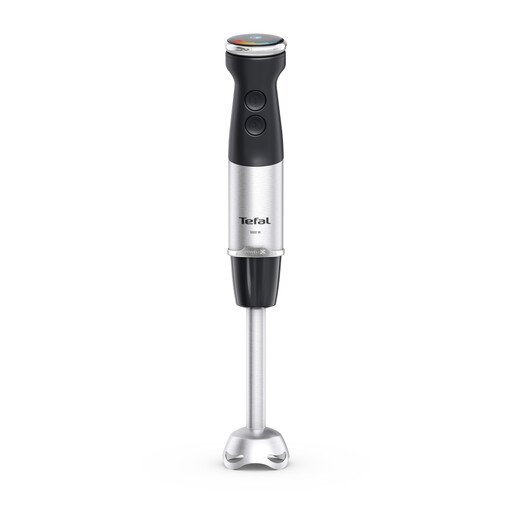 No image available
Consider this model if adjusting speed matters when blending a small serving. Its name identifies Powelix blade technology and 20 speeds; check that your chosen vessel suits the blending head before buying.
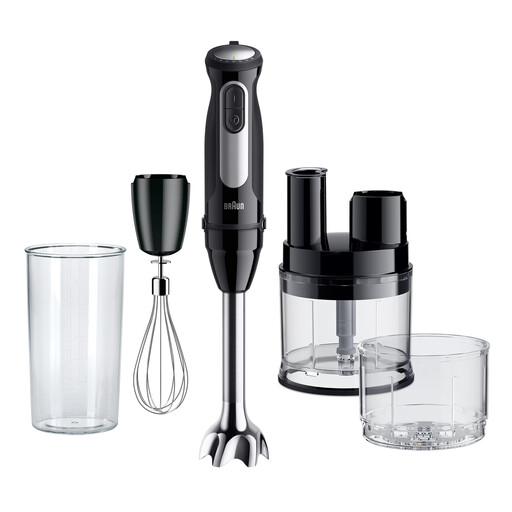 No image available
Consider this set if you will use its preparation tools as well as blend soup. Braun Household GB lists 25 speeds and a metal shaft for MQ55755M. Check the beaker’s suitability for your portion; the model’s conflicting published wattage figures should not determine your choice.
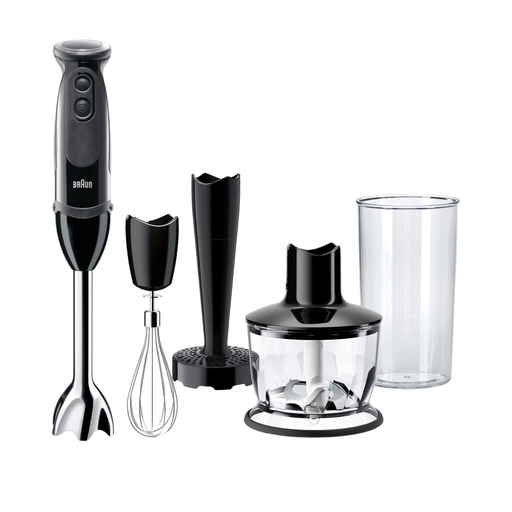 No image available
This bundle makes more sense if chopping, whisking or mashing are regular tasks alongside soup. Check whether its beaker accommodates your usual serving and how the individual attachments must be cleaned.
 No image available
Consider this bundle if you want chopping and whisking tools without choosing solely for the soup task. Compare the beaker with your serving size and follow the exact model’s instructions for cleaning each part.
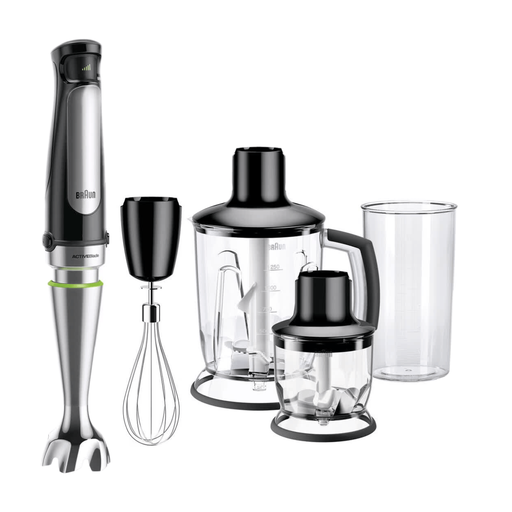 No image available
Consider this model if adjustable blending control and additional food-preparation tools suit your routine. Check that the blending shaft works with your own vessel and review the space and cleaning needs of any attachments you plan to use.
Yes, if the vessel suits the hand blender and lets you keep its head submerged while leaving room to blend. Braun Household GB describes blending in containers other than a supplied beaker; check your exact model’s instructions for vessel and fill requirements.
Do not choose a wattage threshold as a substitute for assessing your ingredients and the model’s controls. Bosch GB lists 1000 W for MSM4B624GB, while Braun Household GB’s MQ55755M page gives conflicting promotional and technical wattage figures; neither figure establishes the texture of one serving of tomato soup.
No; cleaning instructions apply to individual parts. Kenwood’s Triblade XL Pro guidance allows its main hand-blender tools in the dishwasher but excludes the motor unit, certain gearboxes and the chopper lid. Check the manual for your exact model before washing it.
Refrigerate leftovers promptly rather than leaving the soup at room temperature. Food Standards Agency material recommends putting leftovers in the refrigerator within two hours; follow appropriate food-handling guidance as well as the blender’s operating instructions.