Occasional family bakers
You make banana bread or cake batter now and then and want a compact mixer that works with a bowl you already own.


For an occasional family-size banana bread batter, a conventional hand mixer with beaters and adjustable speeds is a sensible choice if the manufacturer’s guidance covers your recipe quantity and consistency. It works with a bowl you already own, but you must hold it throughout mixing; for repeated batches or regularly tougher mixtures, consider a supported-bowl mixer or stand mixer and allow for the extra storage space.
You make banana bread or cake batter now and then and want a compact mixer that works with a bowl you already own.
You expect to prepare several batters for gatherings and would rather have the mixer supported by a bowl than hold it through every batch.
You want to bring flour, wet ingredients and mix-ins together gradually, with enough speed control to avoid starting a thick batter too fast.
Choose the mixer format for the number of batches you plan to make, then check the exact model’s beaters, controls and recipe guidance. A bowl’s capacity or a motor’s wattage alone cannot establish how much banana bread batter a mixer can handle.
Choose it when: You make one or a few batters and want to mix in your own bowl.
Bear in mind: You must hold and guide it throughout mixing.
Choose it when: Several batches make continuous hand-holding less appealing.
Bear in mind: The bowl arrangement takes more space, and its stated capacity is not a maximum batter-load rating.
Choose it when: Larger quantities or tougher mixtures are a regular task, not just an occasional gathering recipe.
Bear in mind: It is heavier and bulkier than a hand mixer.
| Concern | What to check | Who this matters to |
|---|---|---|
| Batch size and arm effort | Decide whether you will make one loaf or several batches. For a supported bowl, check the manufacturer’s recipe or load guidance as well as its capacity. | If I am preparing several batters for a gathering, I would rather not hold the mixer through every batch. Around 31% of consumers put reduced holding effort and batch capacity first. |
| Thicker batter | Confirm that the exact model has beaters intended for batter and that its guidance covers your recipe quantity and consistency. | A batter with mashed banana and chunky additions makes me want to check that the mixer suits the mixture I plan to make. For around 31% of consumers, handling thicker batter is the primary concern. |
| Mixing control | Look for a low starting speed and adjustable settings; check which attachments come with the exact variant. | When adding dry ingredients, I want to begin slowly rather than scatter them across the worktop. Controlled incorporation comes first for around 23% of consumers. |
| Storage and cleaning | Check the mixer’s size, detachable beaters and the manual’s cleaning instructions. | If I bake only occasionally, I want an appliance I can put away easily and clean as directed afterwards. Around 15% of consumers prioritise compact storage and straightforward upkeep. |
A conventional hand mixer has its motor in the handle, so repeated batches still mean holding and guiding it. Electrical Safety First distinguishes this portable format from a supported mixer.
If several batches are likely, compare a supported-bowl hand mixer or stand mixer before settling on the hand-held format.
A stated motor wattage does not establish how a mixer will handle your batter. Beaters, speed control, comfort and recipe quantity also affect the choice; Which? identifies mixing and handling as useful dimensions in its hand-mixer testing.
Check the exact model’s supplied attachments and permitted uses, then compare how its controls suit the stages of your recipe.
An imported or marketplace listing needs a closer look at the exact model and its electrical fittings. Electrical Safety First advises buying from a reputable retailer and checking for a standard UK three-pin plug and fuse.
Confirm the plug, retailer identity, warranty information and applicable product details before ordering.
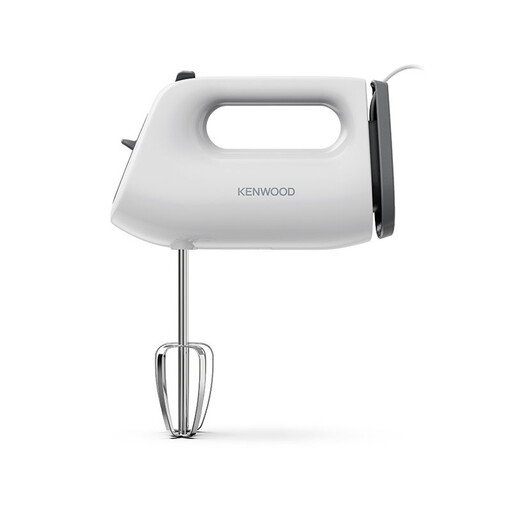
Kenwood’s white HMP30.A0WH and the silver HMP30.A0SI listing have different model identifiers. A familiar range name is not enough to establish identical specifications or current availability.
Check the precise model and colour variant, along with stock and delivery information, immediately before ordering.
Kenwood’s UK hand-mixer range includes compact QuickMix models and the Chefette supported-bowl format.
The Bosch MFQ4020GB is a hand-mixer option for buyers considering adjustable speeds and a soft-touch grip.
KitchenAid’s 5KHM9212 is aimed at bakers who want several mixing settings and a set of attachments.
The Philips HR3740/00 is a 450 W hand-mixer model presented by Philips for cake and bread preparation.
This conventional hand mixer is a choice for occasional batter mixing with your own bowl. Check the manufacturer’s guidance for your banana bread recipe before choosing it for a particularly thick or large batch.
 No image available
Consider this hand-held model for occasional banana bread batter if Kenwood’s guidance covers your recipe quantity and consistency.
Yes, a hand mixer can be a choice for banana bread batter when the exact model’s guidance covers the recipe quantity and consistency. For regularly larger batches or tougher mixtures, compare a supported-bowl mixer or stand mixer instead.
Use beaters intended for cake batter and start at a low setting when bringing dry and wet ingredients together, increasing speed only as the model’s instructions allow. KitchenAid places slow stirring at speed 1 on its nine-speed 5KHM9212, but speed numbers do not transfer between models.
Unplug it before cleaning and do not immerse the motor housing in water. Check the exact model’s manual before putting any removable attachment in a dishwasher, then dry the parts as directed.
Check the exact model’s plug and fuse and buy from a reputable retailer, as Electrical Safety First advises. For relevant products in Great Britain, GOV.UK guidance recognises CE marking alongside or in place of UKCA marking under the applicable framework; that Great Britain guidance does not by itself establish the requirements for Northern Ireland.