One-bowl birthday cake baker
If you are creaming butter and sugar, mixing coconut cake batter and perhaps whipping a topping in your own bowl, focus on beaters, graduated speed control and a grip you are comfortable holding through each stage.


For a birthday coconut cake mixed in your own bowl, start with a conventional hand mixer that has beaters, a manageable grip and enough speed control to begin gently when adding dry ingredients. Consider a mixer with a rotating bowl if you expect several batches and would value less hands-on mixing; its bowl and stand need more storage space.
If you are creaming butter and sugar, mixing coconut cake batter and perhaps whipping a topping in your own bowl, focus on beaters, graduated speed control and a grip you are comfortable holding through each stage.
If the party calls for several cake layers, cupcakes or separate mixtures, a rotating-bowl model may let you prepare the next ingredients while mixing continues. Check that its stated bowl capacity suits your recipe.
If you also plan to make heavier mixtures or do light kneading, supplied dough hooks may be useful. They are optional for ordinary coconut cake batter, so check the attachments against what you will actually make.
Choose the mixing format for the amount you plan to make, then check speed control, supplied attachments and how the mixer will feel to hold or store.
| Concern | What to check | Who this matters to |
|---|---|---|
| Controlled batter mixing | Check the exact model’s speed settings and supplied beaters, including whether you can start gently when adding dry ingredients. | When mixing one cake, I want control as ingredients go in rather than starting every stage at full speed. Around 50% of consumers put controlled batter mixing first. |
| Comfort and storage | Consider the grip, published weight where available, attachment-eject control and space needed to put the mixer away. | If I bake occasionally, I want a mixer I can hold through the recipe and store afterwards. Comfortable handling is the primary concern for around 30% of consumers. |
| Repeated batches | For a rotating-bowl model, compare its stated bowl capacity with your recipe and check the supplied attachments. | Several layers or a separate topping make it useful to keep mixing while I prepare the next ingredient. Around 20% of consumers prioritise batch handling and less hands-on work. |
A rotating bowl can help with repeated mixtures, but the bowl-and-stand arrangement takes more storage space than a conventional hand mixer.
Choose that format when larger or repeated batches, or reduced hands-on mixing, matter to your birthday bake.
Coconut cake batter calls for beating and mixing; dough hooks address a different task.
Prioritise suitable beaters and speed control unless you also intend to use the mixer for heavier mixtures or light kneading.
For an electrical mixer, the seller, instructions and product details matter as well as the advertised features. GOV.UK advises checking appropriate marking and manufacturer details.
Compare the exact model with its manufacturer information, and check the seller, UK plug and fuse, instructions and appropriate marking before buying.
Kenwood GB lists the QuickMix HMP30.A0SI at 450 W, while a Joybuy listing for that model states 300 W. The difference matters if motor wattage is part of your decision.
Ask the seller to clarify conflicting core specifications against the manufacturer’s documentation before choosing that listing.
Kenwood’s UK range includes portable QuickMix hand mixers and the Chefette bowl-combi format.
The Bosch MFQ4020GB is a conventional hand mixer for buyers who want several speeds and supplied dough hooks.
The KitchenAid 5KHM5110 is a hand-held option for routine batter and whipping tasks.
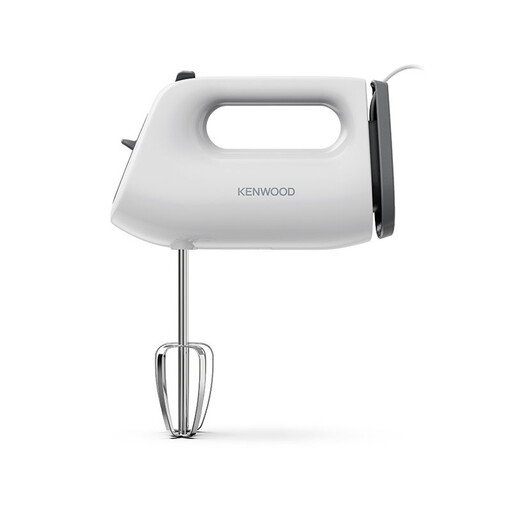
For mixing birthday coconut cake batter in your own bowl, this portable hand mixer offers a three-speed option with twin beaters. Check its size and features against the number of batches you plan to make.
 No image available
A hand-held option for mixing cake batter in your own bowl.
The listing states three speeds, a slow start and twin beaters. This is not a rotating-bowl mixer.
Before use in the UK, check the plug and fuse, appropriate marking, manufacturer details and cleaning instructions for the exact product. The listing gives conflicting information about which parts can go in a dishwasher.
No: a conventional hand mixer can mix cake batter in your own bowl. A rotating-bowl model is worth considering for repeated or larger batches when you value less hands-on mixing. Kenwood states that its Chefette HMP54.000SI has a 3.5 L rotating bowl and can handle batter for up to 24 cupcakes; compare that stated capacity with your recipe.
Beaters are the main attachment to look for when creaming butter and sugar and mixing the batter. A whisk is useful if you also plan to whip a topping, while dough hooks matter mainly if you intend to use the mixer for heavier mixtures or light kneading.
Check the exact model, seller, plug, instructions, appropriate marking and manufacturer details before buying. Electrical Safety First advises that electric mixers have a UK three-pin plug and fuse; GOV.UK advises checking appropriate product marking and the manufacturer’s name and address.
Unplug the mixer before cleaning and follow its manufacturer’s instructions for the body and each attachment. Do not assume that beaters or other parts are dishwasher-safe from a general product description: check the instructions for the exact model.