Occasional family-cake bakers
If you mainly make a cake or two at a time, straightforward speed controls, beaters and storage may matter more than attachments for other baking tasks.


For an occasional family marble cake, a hand mixer with twin beaters and a controllable low setting is a sensible starting point for mixing the batter and incorporating its cocoa portion. A five-speed model may cover straightforward baking; consider soft start or more speed settings if avoiding splashes and handling other baking tasks matter more to you. Check the exact model’s attachments, cleaning instructions and grip rather than treating motor wattage alone as a performance ranking.
If you mainly make a cake or two at a time, straightforward speed controls, beaters and storage may matter more than attachments for other baking tasks.
If you often add flour, cocoa or icing sugar to a bowl, you may value a low starting speed or soft start to help keep dry ingredients in the bowl.
If the same mixer will also whisk cream or egg whites, or handle light dough, check which whisk and dough-hook attachments come with the exact model.
Start with control when adding flour and cocoa, then consider how the mixer feels to hold and whether you will use its other attachments. More settings are worth considering when they address a task you actually do.
| Concern | What to check | Who this matters to |
|---|---|---|
| Controlled incorporation | Check the lowest speed and whether the exact model has soft start; turbo does not replace a gentle starting setting. | When adding flour or cocoa, I want to start gently rather than send dry ingredients over the bowl; around 42% of consumers would put low-splash control first. |
| Comfort while holding the mixer | Check the handle, stated weight and how readily you can move the mixer around your chosen bowl. | Making several components for a family cake means holding and guiding the mixer throughout; roughly 33% of consumers would prioritise comfortable handling. |
| Other tasks and storage | Check the included whisk or dough hooks and whether the appliance has a storage bag or stands upright. | If I also whip cream or egg whites, I want useful attachments without creating a storage problem; about 25% of consumers would make versatility and storage their main concern. |
Motor ratings do not by themselves tell you how controllable a mixer will feel in cake batter. Bosch lists 450 W for the MFQ4020GB, while KitchenAid states an 85 W DC motor for the 5KHM9212; those different motor specifications are not a direct performance comparison.
Compare the exact models’ speed controls, supplied beaters and grip alongside their motor ratings.
Turbo is a separate function from the gentle mixing needed when flour or cocoa first goes into the bowl. KitchenAid and Smeg describe soft-start features on the cited nine-speed models.
Check how the mixer starts and increase speed only after the dry ingredients have begun to combine.
Cleaning instructions vary by model. Russell Hobbs states that parts of its Desire 24672 are not dishwasher-safe.
Read the instructions for the exact model and each attachment if quick cleaning after the gathering matters to you.
Electrical Safety First advises checking for a standard UK three-pin plug and fuse and following the manufacturer’s instructions.
Before ordering, check the exact appliance’s plug, supplier details and applicable product marking for where it will be used.
Kenwood GB lists QuickMix hand mixers across several configurations, including the QuickMix Lite, HMP30 models and portable QuickMix Go models.
Bosch GB describes the MFQ4020GB as a five-stage hand mixer with turbo, whisks, dough hooks and a soft-touch handle.
KitchenAid UK lists nine speeds, soft start, beaters, a whisk and dough hooks for the 5KHM9212.
Russell Hobbs describes the Desire 24672 as a five-speed hand mixer with turbo, detachable attachments and upright storage.
Smeg UK lists nine speeds, turbo, Smooth Start and three stainless-steel accessory types for the HMF01.
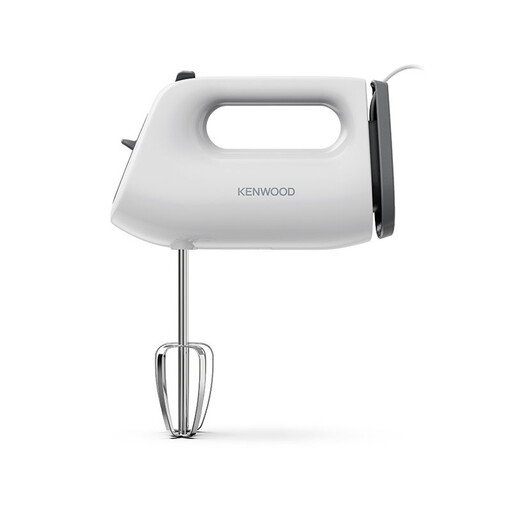
This handheld option has twin beaters for mixing cake batter. If incorporating cocoa gently is a priority, check how its lowest speed starts before choosing it.
 No image available
Its twin beaters suit mixing the cake batter and its cocoa portion.
Choose by usable speed control and the beaters supplied, not wattage alone. Bosch’s MFQ4020GB is rated at 450 W and KitchenAid’s 5KHM9212 has a stated 85 W DC motor; those figures alone do not establish which will suit your batter better.
Begin at the mixer’s lowest suitable setting and increase speed as the ingredients combine. Follow the instructions for your exact model rather than applying another mixer’s numbered setting to yours.
A hand mixer is an option for cake batter and tasks such as whipping cream or egg whites, provided you are comfortable holding and guiding it around the bowl. If thick dough or hands-free mixing will be a regular task, consider whether a stand mixer better fits those needs; Electrical Safety First describes hand mixers as suited to thinner, softer dough and batter.
Unplug it before cleaning and follow the manufacturer’s instructions for the body and each attachment. Do not assume removable beaters are dishwasher-safe: Russell Hobbs states that parts of the Desire 24672 are not.
Check that the exact appliance has a suitable UK three-pin plug and fuse, as Electrical Safety First advises. Also check the supplier’s details and the product marking applicable to where you will use it.