Occasional marble-cake bakers
If you make a single cake at home, look for beaters and speed control that let you start combining ingredients gently. A bowl-and-stand setup may be more equipment than you want to store for occasional use.


For one marble cake, choose a hand mixer with beaters and a speed you can start slowly, rather than treating wattage alone as a measure of mixing performance. A compact model suits occasional baking and limited storage; a bowl-and-stand model makes more sense if you regularly prepare larger batches or want to hold the mixer less. The picnic changes how you handle the food: fillings or toppings that normally need refrigeration must stay cool until serving.
If you make a single cake at home, look for beaters and speed control that let you start combining ingredients gently. A bowl-and-stand setup may be more equipment than you want to store for occasional use.
If the mixer comes out only for occasional bakes, consider where its tools and cable will go afterwards. Kenwood GB lists a clip-on case that holds these together for its QuickMix Go model.
If you regularly prepare larger quantities or several batter components, a rotating bowl may reduce the time you spend holding the mixer. Kenwood GB lists a 3.5 L rotating bowl for its Chefette hand-mixer combination.
Start with control for the base batter and cocoa portion, then decide how much storage space and hands-on mixing time you can accommodate.
| Concern | What to check | Who this matters to |
|---|---|---|
| Batter control | Check the selectable speeds, whether the mixer starts slowly, and which beaters are supplied. Reserve turbo or pulse for tasks that call for a brief boost. | When I combine the base batter and then mix the cocoa portion, I want to control the start rather than send dry ingredients out of the bowl. Around 45% of consumers put batter control first. |
| Storage and handling | Check the stated weight and how the tools and cable are stored. If you plan to mix away from home, check for a suitable power supply. | For an occasional bake, I want to put the mixer away neatly and carry it between kitchens if needed. Storage and handling come first for around 33% of consumers. |
| Batch convenience | Check bowl capacity, whether the bowl rotates, and whether you can use the mixer separately from its stand. | When I prepare several cakes or batter components, I would rather hold the mixer less, even if the bowl needs more cupboard space. Around 22% of consumers prioritise batch convenience. |
A motor rating does not, by itself, show how well different hand mixers will handle marble cake batter. The manufacturer specifications also differ in speed settings, attachments and design.
Check whether you can start mixing gently, which beaters come with the model and whether its handling suits your usual batch size.
A stand and rotating bowl can reduce the need to hold the mixer, but they take up more space. Kenwood GB states weights of 2.612 kg for the Chefette HMP54.000SI and 1.03 kg for the QuickMix Go HMP40.000GY.
Choose the bowl arrangement when repeated or larger batches justify the extra equipment; otherwise, consider a handheld model you can store easily.
A finished cake with a filling or topping that you normally refrigerate needs different transport planning from a plain baked cake. The UK Food Standards Agency says foods normally kept in the fridge at home also need to be kept cool at a picnic.
Carry foods that need chilling in a cool bag or cool box with ice or frozen gel packs, and keep the container out of direct sunlight.
For the Kenwood HMP30.A0SI, Kenwood GB states 450 W, while a Joybuy listing has stated 300 W. That difference matters if you are comparing the precise model and its features.
Confirm the full model code, supplied attachments and specifications with the manufacturer and on the current product page before ordering.
Kenwood GB lists conventional QuickMix hand mixers, the case-equipped QuickMix Go and the Chefette mixer with a rotating bowl.
Bosch UK lists the MFQ4020GB as a handheld option with a soft-touch handle.
KitchenAid UK identifies cake batter as a task for its five-speed 5KHM5110 hand mixer.
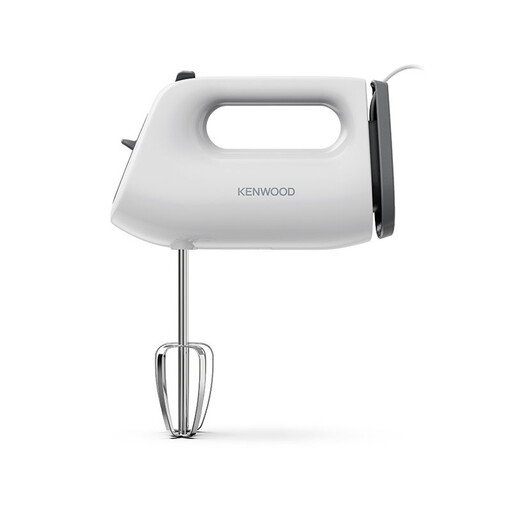
This compact handheld option is relevant if you make cake batter at home and want a controllable start without storing a separate bowl and stand.
 No image available
For an occasional marble cake, its slow-speed start and twin beaters let you begin combining the batter without starting at a higher setting.
It has three speeds, a turbo pulse and a 1.2 m mains cord. Three settings offer fewer speed choices than the five-speed models discussed above.
Wipe the main body rather than immersing it, and confirm which removable parts can be washed before cleaning.
No particular wattage is established as necessary for one marble cake. Look first for beaters and speed control that suit a gentle start; manufacturer wattage figures alone do not establish which model will mix your batter better.
Use the supplied beaters for ordinary cake batter unless your recipe calls for a different attachment. A whisk is useful when a recipe calls for separately whisked ingredients, while dough hooks are for kneading rather than routine cake-batter mixing.
You can use a corded hand mixer there only if you have a safe, suitable power supply and a clean food-preparation area. The Joybuy-listed Quickmix Lite has a 1.2 m mains cord; baking at home avoids arranging powered mixing outdoors.
No: the need to keep a cake cool depends on its ingredients and how it would normally be stored. The UK Food Standards Agency advises keeping foods cool at a picnic if they would usually be kept in the fridge at home, which may include a cake with a chilled filling or topping.