Occasional lunchbox cake bakers
If you make modest batches and do not want to give counter space to a stand mixer, a hand mixer is worth considering. Which? identifies cake-batter mixing, comfort and control as useful ways to assess hand mixers.


For occasional small batches of coconut cake batter, start with a hand mixer that has standard beaters and a low speed you can control; extra attachments and headline wattage need not drive the choice. More speed steps or soft start may matter if you often mix loose ingredients, while a bowl-and-stand format makes more sense when frequent baking justifies the extra storage space.
If you make modest batches and do not want to give counter space to a stand mixer, a hand mixer is worth considering. Which? identifies cake-batter mixing, comfort and control as useful ways to assess hand mixers.
If loose flour or coconut tends to scatter when you begin mixing, look closely at the lowest speed and how gradually the mixer starts. KitchenAid specifies soft start on its 5KHM9212, but that feature is not a reason to assume every model starts the same way.
If you also whisk or make light doughs, check the supplied tools, grip and space needed to store them. KitchenAid and Bosch list different attachment sets for their 5KHM9212 and MFQ4020GB models.
For small coconut cake batches, consider starting speed first, then how the mixer fits your storage space and whether you will use tools beyond ordinary beaters.
| Concern | What to check | Who this matters to |
|---|---|---|
| Controlled mixing | Check the lowest setting and whether the exact model has soft start; confirm that beaters are supplied. | When I add flour and coconut, I want to begin gently rather than scatter dry ingredients; around 50% of consumers put mixing control first. |
| Compact, occasional use | Check the body weight, handle shape, storage dimensions and cleaning instructions for the exact model. | If I bake lunchbox cakes only occasionally and cupboard space is tight, I want an appliance that is easy to put away; about 33% of consumers prioritise compact, occasional use. |
| Other baking tasks | Check the exact in-box attachment list if you also expect to whisk or use dough hooks. | I make mixtures beyond cake batter, so I want tools for those tasks as well; roughly 17% of consumers put versatility first. |
Kenwood lists 450 W for the HMP30.A0SI, while KitchenAid lists an 85 W DC motor for the 5KHM9212. Those stated ratings alone do not establish which mixer will handle your batter better.
Compare speed control, supplied beaters, grip and intended tasks for the exact models instead.
Kenwood lists beaters and kneaders for the HMP30.A0SI; KitchenAid lists beaters, a whisk, dough hooks and a mixing rod for the 5KHM9212.
Check the model code and in-box list if you expect to whisk or knead as well as mix cake batter.
A Joybuy listing for the Kenwood HMP30.A0SI describes it as no longer available and states 300 W, while Kenwood GB lists 450 W for that model code.
Check current availability with the seller and resolve a material specification difference against current manufacturer documentation before buying.
Kenwood lists a rotating 3.5 L bowl with its Chefette HMP54 format. The bowl and stand take more storage space than a conventional hand mixer.
Consider that format if you bake often enough to value hands-free mixing, rather than for an occasional small batch alone.
Kenwood GB lists conventional hand mixers as well as a Chefette mixer-and-bowl format.
KitchenAid’s 5KHM9212 is an option to examine if gradual speed selection and several attachments matter to you.
Bosch’s MFQ4020GB offers a five-speed model to compare if handle comfort and supplied dough hooks matter.
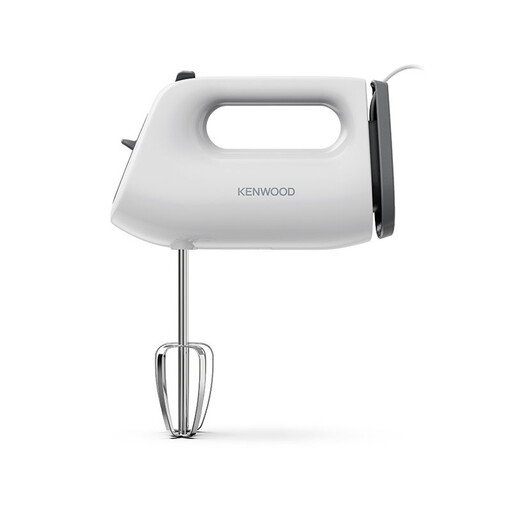
This hand mixer is relevant to occasional cake-batter mixing if three speeds provide enough control for the way you add ingredients.
 No image available
For an occasional small cake batch, consider this model if three speeds give you enough control when adding dry ingredients.
The product name specifies 300 W and twin beaters. Check which parts the dishwasher-safe description covers, and confirm the exact model and plug information with the seller.
Not necessarily: controllable speeds, supplied beaters and comfortable handling are useful starting points for this task. Kenwood’s 450 W rating for the HMP30.A0SI and KitchenAid’s 85 W DC rating for the 5KHM9212 do not, by themselves, establish a mixing-performance winner.
Use the supplied standard beaters unless your recipe or mixer manual directs you otherwise. Check the exact model’s attachment list if you also plan to whisk egg whites or use dough hooks for kneading tasks.
A conventional hand mixer is the more compact choice for an occasional small batch if you are happy to hold and guide it. A bowl-and-stand model may be worth the storage space if you bake frequently and value hands-free mixing; Kenwood specifies a rotating 3.5 L bowl for its Chefette HMP54 format.
Check that the listing identifies the exact model and seller, and confirm the plug and product information for your intended use. GOV.UK explains that the Electrical Equipment (Safety) Regulations 2016 set requirements for electrical equipment placed on the Great Britain market; do not infer that a different version of a mixer has the same conformity status.