Occasional lunchbox sponge baker
You make small cakes now and then and want beaters and manageable speeds for creaming and cake mixture, without choosing a mixer around dough-making.


For a small sponge cake, choose a hand mixer with beaters and speeds you can control while creaming butter and sugar; extra motor power is not a reason to keep mixing every ingredient. If your recipe calls for folding in flour, switch to a spatula and stop once the batter is smooth. An occasional baker may need little beyond the basic controls, while frequent use makes handling and cleaning more important.
You make small cakes now and then and want beaters and manageable speeds for creaming and cake mixture, without choosing a mixer around dough-making.
You make cakes regularly and want to compare speed control, supplied tools and cleaning instructions on the exact model you buy.
Holding a mixer through a longer creaming stage can be tiring, so grip, balance and control matter alongside the mixing features. Which? identifies comfort and control as differences between models.
Start with control for creaming, then decide how much storage, cleaning convenience and handling comfort matter for the cakes you make.
| Concern | What to check | Who this matters to |
|---|---|---|
| Sponge-batter control | Check for beaters and several usable speeds. Follow your recipe's method once flour is added. | If I want a light sponge, I need to cream the butter and sugar but avoid working the flour for too long; around 50% of consumers put batter control first. |
| Occasional-use convenience | Compare the exact model's storage needs, beater release and cleaning instructions. | When I bake only occasionally, I want a mixer that is straightforward to put away and clean; that is the primary need for around 30% of consumers. |
| Handling comfort | Consider grip, balance and speed control, particularly for longer mixing sessions. | If holding and guiding a mixer tires my hand, comfortable handling matters more to me than an extra attachment; around 20% of consumers prioritise reduced mixing effort. |
Rated power does not tell you how comfortable a mixer is to hold or how well you can control the creaming stage. Which? also identifies mixing time, noise and control as differences between hand mixers.
Compare beaters and usable speeds as well as wattage, then follow the recipe when adding flour. Waitrose & Partners' Victoria sponge method folds the flour in with a spatula and stops mixing once smooth.
Care instructions differ by model: Kenwood lists the HMP30.A0WH as dishwasher safe, while Russell Hobbs says the Food Collection 14451 parts are not dishwasher safe.
Check which parts the exact model's instructions allow you to put in the dishwasher.
Otherwise, detachable tools may add hand-washing to your baking routine.
Braun describes the MultiMix 3 HM 3100 WH as directing weight into the bowl. Its effort-reduction figure comes from Braun's own cake-batter comparison, not a guarantee of how the mixer will feel in your hand.
Compare the grip and balance features with independent comfort testing for the same model where available.
The Kenwood QuickMix HMP30.A0WH is an option to examine if you also want kneaders for occasional tasks beyond sponge batter.
The Food Collection 14451 is described by Russell Hobbs for cake mixture and batter, making it relevant to an occasional sponge bake.
The MultiMix 3 HM 3100 WH is worth examining when grip and balance are priorities during repeated cake preparation.
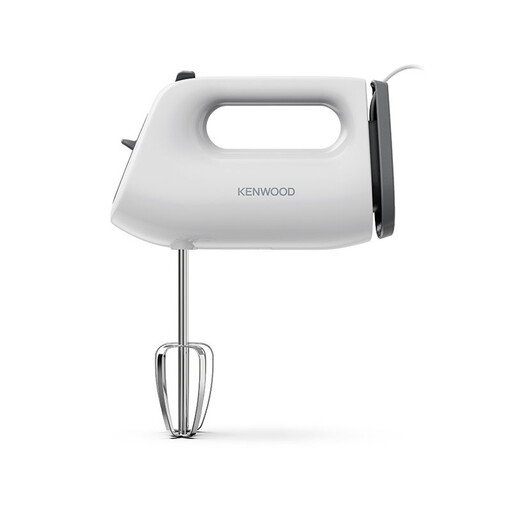
This Quickmix Lite model is a hand-mixer option to consider for creaming and mixing a small sponge; check its exact care and electrical details before ordering.
 No image available
For a small sponge, the listed twin beaters and three speeds give you features to consider for the creaming and mixing stages.
Rated power: 300W. Confirm the care instructions for the body and beaters, along with the electrical version and plug, on the product page before ordering.
Choose by the beaters and speed control you need for your recipe rather than wattage alone. After the creaming stage, Waitrose & Partners' Victoria sponge method calls for folding in the flour and stopping when the mixture is smooth.
Switch from the mixer when your recipe calls for flour to be folded in. In Waitrose & Partners' Victoria sponge method, a spatula folds the flour through and mixing stops as soon as the batter is smooth.
Switch it off, unplug it and follow the exact model's instructions before removing and washing its tools. Kenwood's HMP30 instructions say not to immerse the mixer body or wet its cord or plug; whether detachable parts are dishwasher safe varies by model.