Small-batch home doughnut bakers
If you mix modest quantities in a bowl you already own, a handheld format lets you choose a bowl that fits the batch without finding storage space for a stand and rotating bowl.


For occasional small batches of doughnut batter, start by considering a compact hand mixer with controllable speeds and beaters that suit your recipe. Choose more gradual speed control and extra attachments if you will use them; choose a rotating-bowl model when mixing without holding the appliance matters more than keeping equipment small. Declared wattage alone does not establish how different models will handle your batter.
If you mix modest quantities in a bowl you already own, a handheld format lets you choose a bowl that fits the batch without finding storage space for a stand and rotating bowl.
If flour and liquid tend to scatter when mixing begins, look closely at the starting speed. KitchenAid UK lists soft start on the 5KHM9212, while Kenwood GB lists a slow-speed start on the Chefette HMP54.000SI.
If you would rather prepare ingredients while the mixer works, a rotating-bowl format may justify its larger footprint. Kenwood GB lists a detachable hand mixer and rotating bowl for the Chefette HMP54.000SI.
Decide whether you want to guide a mixer through a bowl you own or give cupboard space to a bowl-and-stand setup. Then compare starting-speed control and the attachments you will actually use.
Choose it when: You mainly mix small batches in your own bowl and want equipment that is easier to store.
Trade-off: You hold and guide the mixer throughout mixing.
Choose it when: Gradual speed changes and tools for other mixing tasks matter alongside doughnut batter.
Trade-off: Extra settings and attachments may see little use if you only make a simple batter.
Choose it when: You want to prepare ingredients while the mixer runs without holding it continuously.
Trade-off: The bowl and stand need more storage space than a handheld unit.
| Concern | What to check | Who this matters to |
|---|---|---|
| Control at the start | Check the lowest selectable speed and whether the exact model has a documented soft or slow start. | When I first combine flour and liquid in a small bowl, I want to begin gently before increasing speed. Around 42% of consumers put that initial control first. |
| Handling and cleaning | Check how the beaters release and follow the manual for cleaning the motor body and detachable parts. | For an occasional batch, I want a mixer I can put away easily and clean without guesswork; roughly 33% of consumers make handling and cleanup their primary concern. |
| Mixing without holding the mixer | Check whether the mixer detaches from its stand, how its bowl rotates and whether the setup fits your storage space. | I would like to measure the next ingredients while the batter mixes, even if the appliance takes more room. For about 25% of consumers, that hands-free setup is the main priority. |
Kenwood GB states a 450W motor for the HMP30.A0SI, Bosch GB states a 450W connection rating for the MFQ4020GB, and KitchenAid UK states an 85W DC motor for the 5KHM9212. Those descriptions are not results from a shared doughnut-batter test.
Compare speed control, supplied tools and handling for the exact models instead of choosing by the wattage figure alone.
Kenwood GB lists a rotating 3.5L bowl for the Chefette HMP54.000SI. Its larger setup may be unnecessary when you usually mix a very small batch.
Choose the bowl-and-stand format if mixing without holding the appliance solves a problem for you; otherwise, consider a handheld mixer with a bowl you already own.
Using the appliance for a food business brings responsibilities beyond choosing mixing equipment, including controls for contamination and allergens.
The Food Standards Agency says a new food business must register with its local authority at least 28 days before trading or before food operations start. Plan cleaning and allergen controls for the operation as well.
Kenwood GB lists both a conventional QuickMix hand mixer and a Chefette model with a rotating bowl, giving you two distinct equipment setups to consider.
Bosch GB lists the MFQ4020GB as a conventional hand mixer for buyers who want speed adjustment and supplied mixing tools without a stand.
KitchenAid UK lists the 5KHM9212 for buyers who want more speed settings and several tools in a handheld appliance.
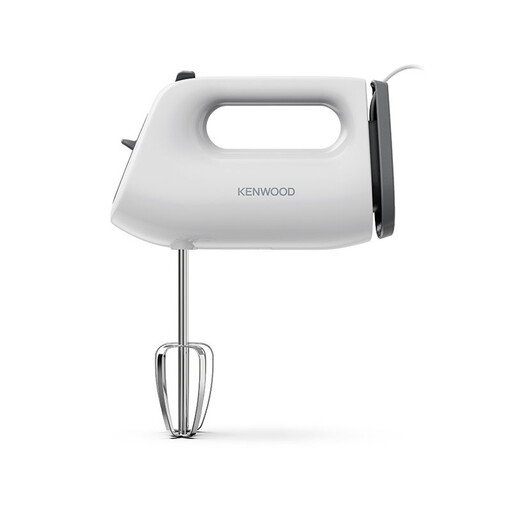
This handheld option is for mixing a small batch in a bowl you already own, rather than using a bowl-and-stand setup.
 No image available
For small batches mixed in your own bowl, this handheld model has three speeds and twin beaters. Its stated rating is 300W. Check the model manual before cleaning to establish which detachable parts, if any, can go in the dishwasher; do not immerse the motor body.
Wattage alone is not a sound way to choose one. Kenwood GB, Bosch GB and KitchenAid UK describe the motor figures for their listed models differently, so compare the exact mixer's speeds, beaters and handling for the recipe rather than treating those figures as a shared performance test.
It is worth considering if you want to prepare ingredients while mixing without holding the appliance. Kenwood GB lists a rotating 3.5L bowl for the Chefette HMP54.000SI, but a conventional hand mixer lets you use your own bowl and takes less storage space.
Follow the exact model manual for releasing and washing its detachable tools, and do not wash the motor body as though it were a beater. If you use the mixer in a food business, cleaning arrangements must also address contamination and allergens, as described in Food Standards Agency guidance.
The appliance choice does not replace food-business requirements. The Food Standards Agency says that anyone starting a food business must register with their local authority at least 28 days before trading or before food operations start; cleaning and allergen controls also need to suit the operation.