
24/7 Customer Support

Free returns

Same-day & Next-day Delivery

Quality Guaranteed

Unlock Your Welcome Offers: FREE Delivery | Up to 80% OFF | Free 30-day JoyPlus trial
Download the APP
A hand staple gun can make furniture repairs, fabric work and home decoration considerably easier. However, choosing the wrong model may lead to misfired staples, frequent jams or unnecessary hand strain. For UK households, the key is to match the stapler to the material, staple type and frequency of use rather than relying on labels such as “heavy duty” or “multi-purpose”.
This guide explains the main buying pitfalls, the specifications worth checking and suitable options for different DIY users.
Staples are not universal. A Type 53 staple gun generally cannot use Type 140, Type 28 or Type 8 staples unless the manufacturer specifically states compatibility. Even staples with a similar appearance can have different crown widths, wire thicknesses and leg lengths.
Before buying, check:
A staple gun supplied with staples may be convenient, but confirm that the included size suits your planned project.
A heavy-duty staple gun is not automatically suitable for hardwood, thick timber or continuous commercial work. Manual models still depend on the user applying sufficient downward pressure, and some are designed only for softwood, fabric or light household jobs.
Look for practical specifications instead:
For example, one ValueMax model specifies use on softwoods such as pine or spruce and advises against hardwood. That limitation is more useful than a broad marketing description.
A stapler can become frustrating if a bent staple cannot be removed without dismantling the entire tool. A removable metal channel, anti-jam mechanism or quick-release magazine can save time during furniture repair and craft projects.
A locking handle is also useful when storing a DIY stapler in a drawer or toolbox. Always keep the tool pointed away from people, secure the workpiece and keep fingers away from the staple exit area.
For light upholstery, fabric projects and home decoration, Type 53 staples in 6 mm, 8 mm or 10 mm lengths are commonly used. Shorter staples are generally suitable for thinner materials, while longer staples may provide additional hold in suitable substrates.
A multi-format tool may support Type 140 staples, Type 28 and Type 8 staples. These formats can be useful for users working across furniture, decoration, cable fixing or light carpentry, but compatibility should always be confirmed in the product specifications.
Do not select a staple length simply because it is longer. Excessively long legs may pass through thin fabric or board and create a safety hazard.
An adjustable staple gun gives more control when moving between fabric, cardboard, softwood and denser materials. A lower setting can help reduce over-penetration in thin materials, while a higher setting may be useful for suitable wood projects.
Power adjustment does not turn a manual staple gun into a tool for every material. Keep the manufacturer’s restrictions in mind and test on a concealed section first.
A reinforced PC+ABS body can provide a balance between low weight and everyday durability for light-duty work. Alloy steel construction is generally more appropriate for users who expect more frequent use or want a sturdier furniture repair stapler.
Also check for:
A staple gun with staples and a staple remover may offer a more practical starting point than buying the tool alone.
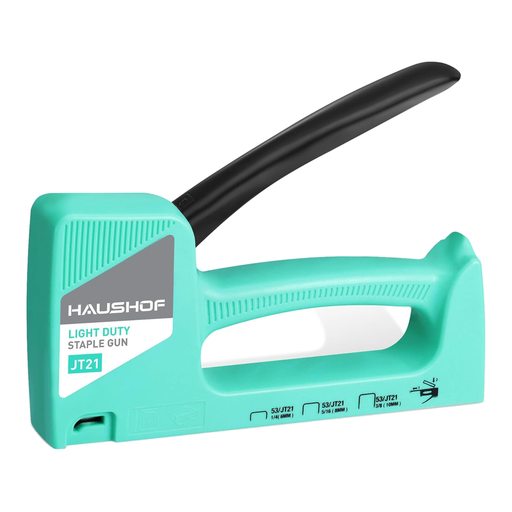
Why This Fits Their Persona: A practical starting point for occasional upholstery, crafting and home decoration jobs, including refreshing a dining chair or securing fabric to a small frame.
The staple format and sizes are clearly specified, while the anti-jam mechanism and quick-release magazine address common frustrations with entry-level tools.
Compatible with Type 53 staples in 6 mm, 8 mm and 10 mm sizes; supplied with 800 8 mm staples and a staple remover.
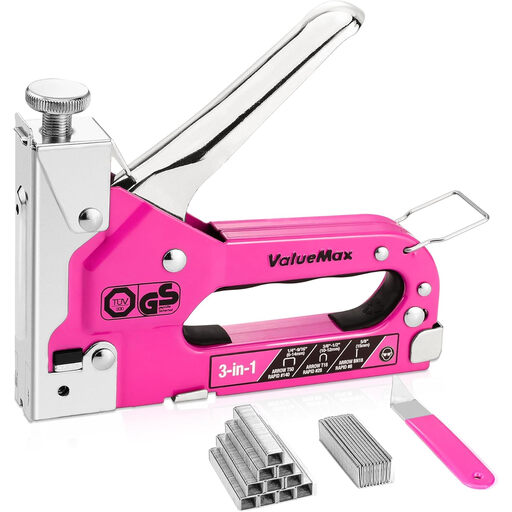
Why This Fits Their Persona: Suits DIY users who want a metal-bodied tool with more control for upholstery, decoration and light carpentry around the home.
Its depth adjustment and removable metal channel provide practical control and a defined method for clearing jams instead of relying on vague “powerful” claims.
Supports Type 140, Type 28 and Type 8 staples from 6–15 mm; includes 2,000 staples and a staple remover.
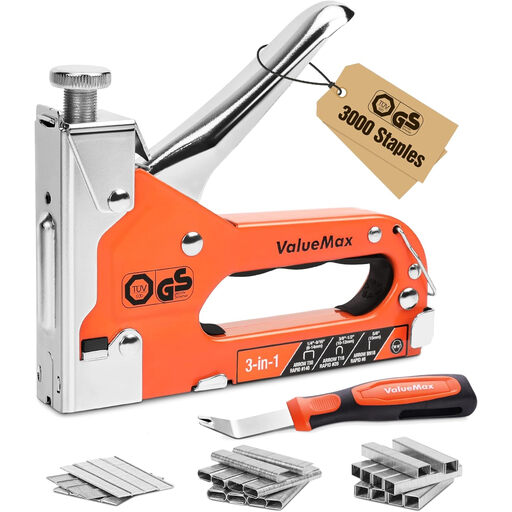
Why This Fits Their Persona: Designed for frequent upholstery, furniture repair, decoration and light carpentry on suitable softwood surfaces.
The listing states the suitable softwood use and hardwood restriction, helping buyers avoid applying a manual tool beyond its intended material range.
Includes 3,000 staples across three formats; features adjustable force and a hinged magazine for loading and jam clearance.
Place the stapler perpendicular to a stable workpiece and keep both hands clear of the firing area. Wear safety glasses when working with wood or hard surfaces, and consider protective gloves for upholstery and furniture repair.
To help preserve the mechanism:
We have compiled a complete, real-time list of products that fully satisfy these strict selection criteria and UK safety regulations.
Yes, a manual staple gun can be used on suitable softwood, thin boards and some home decoration projects. Check the product instructions first. Hardwood, dense composite boards and thick timber may require a different fastening tool.
For many light upholstery jobs, Type 53 staples in 6 mm, 8 mm or 10 mm sizes are suitable when specified by the tool. Measure the combined material thickness and choose a length that will not protrude through the workpiece.
Service life depends on construction, workload, storage and staple quality. Keeping the mechanism clean, avoiding mismatched staples and not forcing the handle against unsuitable materials can reduce wear and jamming.