
24/7 Customer Support

Free returns

Same-day & Next-day Delivery

Quality Guaranteed

Unlock Your Welcome Offers: FREE Delivery | Up to 80% OFF | Free 30-day JoyPlus trial
Download the APP
Choosing among hand tool sets can seem straightforward until a wrench slips, a pair of pliers damages a hose or a supposedly versatile kit lacks the sizes you use most. For DIY enthusiasts, mechanics, plumbers, electricians and maintenance professionals, the right selection depends less on the number of pieces and more on fit, access, material and storage.
A high piece count can look attractive, but it does not guarantee useful coverage. A set filled with uncommon sizes may leave you buying extra metric hand tools for everyday nuts and bolts. Before ordering, check whether the range includes the sizes you regularly use, such as 8–19 mm for general mechanical work or larger openings for plumbing fittings.
Polished chrome or black oxide can help with corrosion resistance and cleaning, but the finish is not the same as the underlying steel quality. Look for details such as drop-forged chrome vanadium steel, heat treatment and clearly stated jaw or torque capacities. These specifications provide more useful information than appearance alone.
A standard spanner may be difficult to swing in an engine bay, under a sink or inside a cabinet. Similarly, toothed jaws can mark finished surfaces or damage flexible tubing if used incorrectly. Consider whether you need a ratcheting spanner set, flex-head access, stubby handles, flare nut jaws or non-marring rubber contact.
Most domestic and automotive jobs in the UK use metric fasteners, so a practical set should state its metric coverage clearly. Combination spanner sets with sizes from 6–22 mm can suit general maintenance, while an 8–19 mm set focuses on commonly used mid-range fasteners.
For an adjustable wrench, check the actual maximum jaw opening, not only the handle length. A 150 mm adjustable spanner is suited to compact tasks, whereas a 250 mm model with a stated 50 mm opening is more appropriate for larger nuts, pipes and fittings. SAE markings may also be useful when maintaining imported vehicles or machinery.
Chrome vanadium steel tools are commonly selected for their combination of hardness and toughness. Drop forging and heat treatment are useful construction details, while chrome plating, mirror polish or black oxide finishes can help resist surface corrosion when tools are stored in a dry environment.
Do not use any hand tool beyond its stated capacity. Avoid adding extensions to adjustable wrenches or pliers, as this can overload the tool and increase the risk of slipping or damage.
Ratchet tooth count matters most where movement is restricted. A 72-tooth mechanism requires a smaller working swing than many coarse mechanisms; the listed 12-piece flex-head set requires a 5-degree swing, while the 144-tooth option is specified at 2.5 degrees. A flexible head can improve positioning, but it does not remove the need to seat the tool fully on the fastener.
For plumbing tools, water pump pliers with a quick-adjust button can speed up changes between pipe sizes. For automotive work, a flare nut spanner set provides more contact around brake-line and tubing nuts than a conventional open-ended spanner. Hose clamp pliers should only be used on compatible flexible hoses, not hard, reinforced or high-pressure lines.
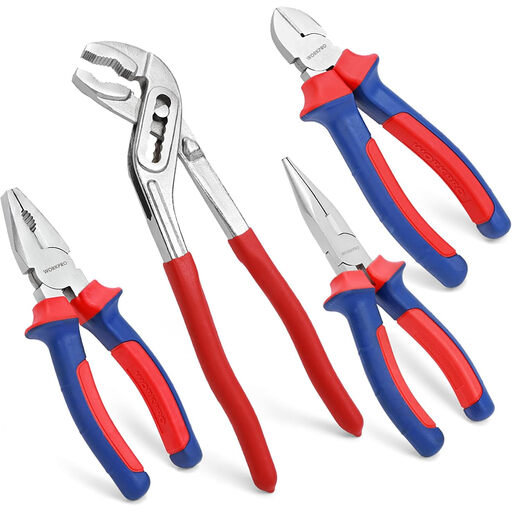
Why This Fits Their Persona: A useful starting combination for home repairs, small DIY jobs, basic electrical tasks and light plumbing work around a UK household or garage.
The four clearly identified tools avoid paying for a high piece count made up of rarely used accessories.
Includes combination, long nose, side-cutting and 244 mm water pump pliers, with PP and TPR non-slip handles.
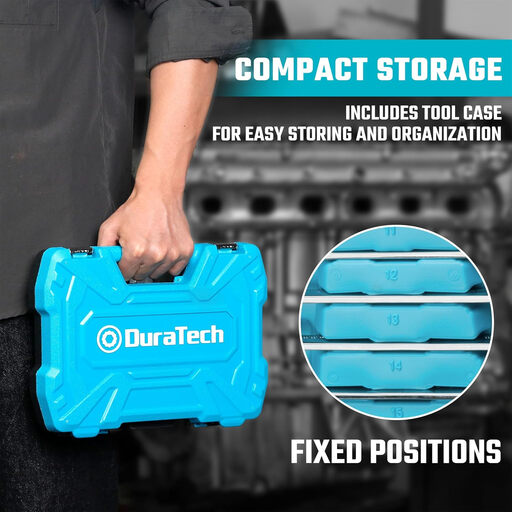
Why This Fits Their Persona: Suitable for users who want a coordinated metric ratcheting spanner set for workshop maintenance, vehicle repairs and repeated fastening jobs.
The listed sizes, 72-tooth mechanism and 180-degree flex head make the design easier to assess than vague access claims.
Covers 8–19 mm, uses chrome vanadium steel and includes a storage case with size identification.
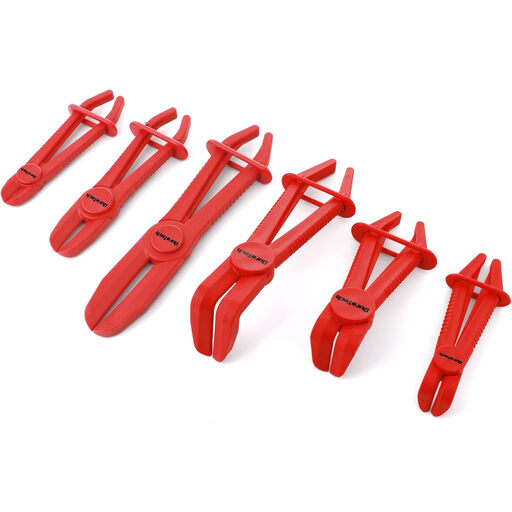
Why This Fits Their Persona: Designed for automotive repair users handling flexible fuel, coolant, brake or radiator hoses where clamp positioning and access are central concerns.
The set specifies six jaw sizes and clearly states it is not for hard, reinforced or high-pressure lines.
Includes straight and 90-degree angled tools, heat-resistant reinforced nylon construction and locking buckles.
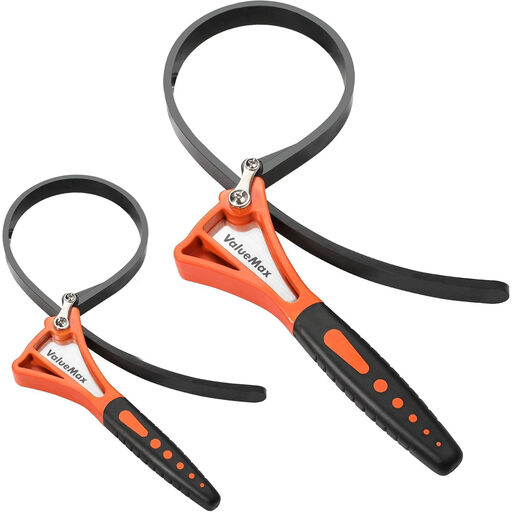
Why This Fits Their Persona: A practical option for smooth, rounded or finished items such as oil filters, sink fittings, shower heads and household containers.
Rubber contact helps address the surface-damage problem, while the product specifies separate torque limits for each wrench.
The 460 mm and 630 mm tools cover stated rotation diameters of 100–150 mm and weigh 110 g and 300 g respectively.
Use the application as the starting point:
Inspect tools before each job, wear eye protection when cutting or applying force and isolate electrical circuits before working near wiring. Keep tools clean and dry, particularly after contact with water, oils or cleaning chemicals. A roll-up pouch or case also reduces lost tools and helps prevent metal-to-metal damage in storage.
We have compiled a complete, real-time list of products that fully satisfy these strict selection criteria and UK safety regulations.
For many household, furniture, bicycle and vehicle tasks, metric sizes are the practical starting point. Check the fasteners on your equipment before buying; imported vehicles or machinery may also require SAE sizes.
Not completely. Ratcheting spanners can save time and work well where the swing arc is limited, but standard combination spanners are often simpler for high-resistance fasteners and general-purpose use. Keeping both types may be useful for a workshop.
Service life depends on workload, correct sizing, storage and exposure to moisture or chemicals. Chrome vanadium construction and protective finishes can support regular use, but no tool should be overloaded or used after its jaws, ratchet or handles show damage.