
24/7 Customer Support

Free returns

Same-day & Next-day Delivery

Quality Guaranteed

Unlock Your Welcome Offers: FREE Delivery | Up to 80% OFF | Free 30-day JoyPlus trial
Download the APP
A handheld fan can be useful on a crowded train, at a summer festival, in a warm office or beside your bed. However, compact cooling products vary considerably in battery capacity, airflow control, charging convenience and safety design.
The main problem is that attractive packaging and phrases such as “strong wind” do not always tell you how a fan will perform in daily use. Before buying, look beyond appearance and check the features that affect comfort, portability and practical running time.
A high RPM figure can sound impressive, but it does not automatically mean that the fan will feel more effective. Airflow also depends on blade design, outlet size, motor efficiency and how close you hold the device.
For personal cooling, a fan with several speed settings is often more useful than one with a single high-speed mode. A lower setting may be preferable in an office, while a stronger setting can be useful outdoors.
Advertised running times usually vary by speed level. A rechargeable handheld fan may last much longer on its lowest setting than on maximum power. Check whether the listing provides separate runtimes for low, medium and high modes.
Battery capacity is another useful comparison. A 5,000mAh battery generally stores more charge than a 2,000mAh or 3,000mAh battery, but the actual runtime still depends on the motor and selected speed.
A fan that is comfortable to hold may not be suitable for a desk. Similarly, a model designed for a handbag may not provide the battery capacity needed for a full day outdoors.
Consider whether you need:
Three speed settings cover most everyday needs, while five settings provide more precise control. Product descriptions may list airflow in metres per second, RPM or simply describe the motor as powerful. These figures should be treated as specification points rather than guarantees of personal comfort.
For a personal cooling fan, adjustable airflow is particularly useful because indoor spaces, public transport and outdoor areas require different levels of breeze.
A USB rechargeable fan can be powered from a laptop, power bank, car charger or USB adapter, making it practical for travel and commuting. USB-C is convenient when it matches the cables already used for your phone and other devices.
Check the listed charging time and whether the cable is included. For longer days away from a socket, compare the battery capacity and stated runtime at different speeds rather than relying only on the phrase “long-lasting”.
Weight and dimensions matter when carrying a fan for several hours. A lightweight mini handheld fan is convenient for a handbag or pocket, while a larger battery can add weight but provide longer use.
A built-in stand turns a portable fan into a small desk fan. A wrist strap or lanyard can also reduce the chance of dropping it while walking, travelling or watching a concert.
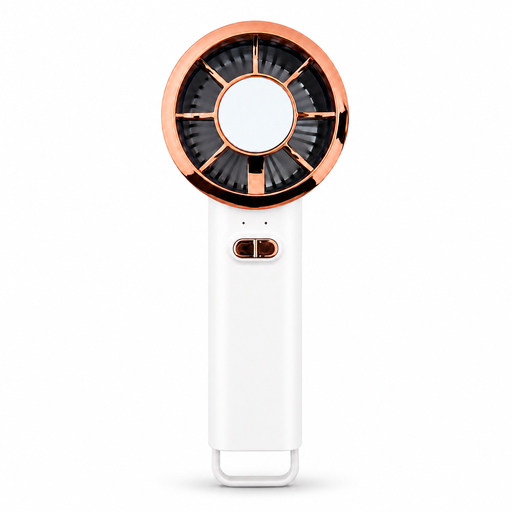
Why This Fits Their Persona: Three speed settings and an integrated phone stand make this a practical choice for first-time buyers who want one device for commuting, office use and watching content at home.
The adjustable settings avoid relying on one fixed airflow level, while USB charging is easier to replenish from a laptop, power bank or adapter.
Three speeds; integrated phone stand; compact handheld format; USB-powered recharging.
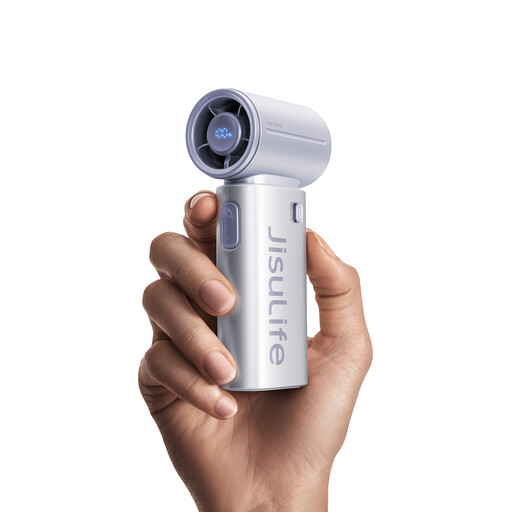
Why This Fits Their Persona: This model suits frequent commuters, travellers and gift buyers who value battery information and more detailed speed control in a compact format.
Its LED display provides speed and battery information, helping you judge remaining charge instead of guessing how long the fan will operate.
5,000mAh battery; five speed levels; LED battery and speed display; listed runtime of 3–22 hours depending on setting.
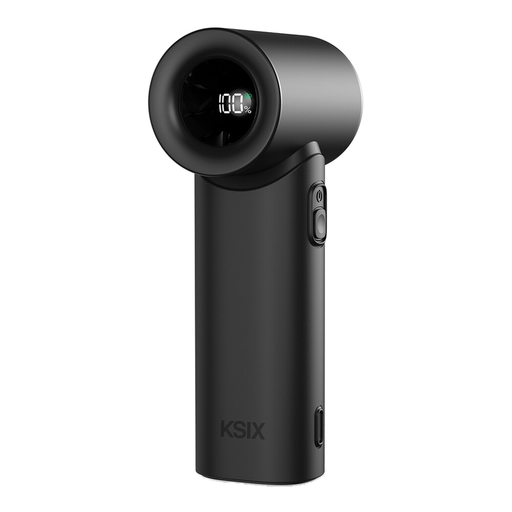
Why This Fits Their Persona: With handheld and desktop use, five speeds and a 3,000mAh rechargeable battery, this suits people who need a flexible fan for the office, travel and outdoor activities.
The stand reduces the need to hold the fan continuously, while USB-C charging and the stated approximately three-hour charging time support regular use.
9.0m/s listed maximum air speed; 17,400 RPM motor speed; 3,000mAh battery; 128g weight; handheld and desktop modes.
A rechargeable handheld fan is convenient if you regularly carry a power bank, laptop or USB charger. It avoids buying replacement batteries, but it needs charging before use and its internal battery will gradually lose capacity over time.
A battery-operated fan using AA batteries can be useful for immediate use, holidays or situations where USB charging is inconvenient. For example, the Misty Blue Handheld Fan with tilting head and safety blades uses two included AA batteries, has a tilting head and includes a neck cord. Soft foam blades may be preferable for some family or festival settings, but check the product guidance and supervise children.
We have compiled a complete, real-time list of products that fully satisfy these strict selection criteria and UK safety regulations.
Runtime depends on battery capacity, motor design and speed. Lower settings usually use less power. Compare the manufacturer’s stated runtime for each mode, rather than relying on a single maximum figure.
Do not assume this is safe or supported. Check the product instructions. If simultaneous use is not specifically permitted, allow the fan to charge before operating it.
A USB rechargeable fan typically uses a small amount of electricity compared with larger room fans, but the exact cost depends on battery capacity, charging frequency and your electricity tariff. Using a lower speed where comfortable can reduce energy use and extend the time between charges.