Occasional frosting makers
If you make frosting for cakes or cupcakes now and then, focus on controlled mixing, paired beaters and a mixer you can store between uses.


For an occasional bowl of vanilla frosting, choose a hand mixer with paired beaters and several speeds so you can start gently and increase the speed as the ingredients combine. If you make larger or repeated batches, compare a handheld model with a bowl-assisted mixer or stand mixer, since you would otherwise hold and guide the mixer throughout. Check the exact accessories and cleaning instructions rather than treating motor wattage as a measure of frosting performance.
If you make frosting for cakes or cupcakes now and then, focus on controlled mixing, paired beaters and a mixer you can store between uses.
If you also make cake batter, whip cream or mix light dough, compare the tools supplied with each model. A whisk or dough hooks may matter for those other jobs, but check the exact bundle.
If you prepare larger or repeated frosting batches, consider how long you want to hold a mixer. A hand-mixer-and-bowl combination or stand mixer offers a different way to support the bowl work.
Start with speed control and beaters for the frosting itself. Then decide whether your usual batch size makes handheld mixing practical, and check how the mixer and its attachments will fit into your storage and clean-up routine.
| Concern | What to check | Who this matters to |
|---|---|---|
| Controlled mixing | Look for paired beaters, selectable speeds and a control you can adjust while mixing. Check how the lowest setting operates. | If I start butter and sugar too quickly, I risk scattering ingredients before they combine; around 45% of consumers put a controlled start first. |
| Batch handling | Consider your usual frosting quantity and the number of consecutive batches. Compare the handling of a handheld mixer with a bowl-assisted option. | Making several batches in one session means holding and guiding a handheld mixer each time; around 33% of consumers put batch handling first. |
| Storage and cleaning | Check the appliance footprint, the tools supplied and the exact model's attachment-cleaning instructions. | A crowded cupboard and washing up after frosting make storage and clean-up my main concerns; for around 22% of consumers, those needs come first. |
KitchenAid lists an 85 W DC motor for its 5KHM5110, Bosch lists 400 W for the MFQ2420BGB, and Kenwood lists 450 W for the HMP30.A0WH. Those manufacturer ratings describe different models; they do not establish which produces better frosting.
Compare speed controls, supplied beaters, handling and cleaning instructions alongside any motor rating.
Cleaning guidance varies by model. Russell Hobbs states that parts of its Desire 24672 are not dishwasher-safe.
Read the instructions for the exact mixer and attachments before washing off frosting residue.
A compact hand mixer still needs to be held and guided for each batch. Kenwood also offers a Chefette format with a rotating bowl for buyers considering bowl support.
Think about your largest bowl and how many batches you make in one session before choosing between a standalone hand mixer and a bowl-assisted model.
GOV.UK states that the Electrical Equipment (Safety) Regulations 2016 set requirements for electrical equipment placed on the Great Britain market. That GB scope should not be applied unchanged to Northern Ireland.
Check that an appliance is supplied for the place where you will use it, and retain its accompanying safety information and instructions.
These model examples show differences worth checking within relevant hand-mixer ranges; a brand name alone does not establish what comes with a particular mixer.
Bosch's CleverMixx MFQ2420BGB is a compact hand-mixer example with four speeds plus turbo.
KitchenAid describes its five-speed 5KHM5110 as suitable for small everyday jobs including icing.
Kenwood offers handheld QuickMix models as well as Chefette hand-mixer-and-bowl combinations.
The Desire 24672 is a hand-mixer example for general mixing, beating and whisking.
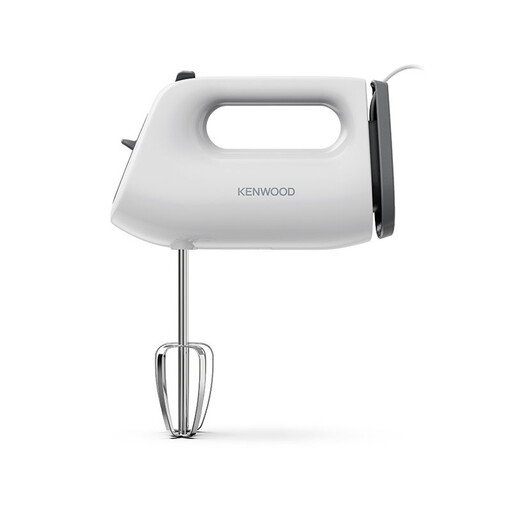
This compact handheld option is relevant if you usually mix an occasional bowl of frosting and want to guide the beaters yourself. Check that a handheld format suits your usual batch size.
 No image available
A handheld choice for an occasional bowl of vanilla frosting when you want to move the beaters around the bowl yourself.
The listed configuration has three speeds and twin beaters. Check the cleaning instructions for the exact appliance and attachments before washing them; do not immerse the motor body.
Choose a mixer that lets you begin gently and increase speed as the ingredients combine; there is no universal minimum number of settings. KitchenAid describes gentle stirring at speed 1 and mixing butter and sugar at speed 5 for its 5KHM5110, while Bosch lists four speeds plus turbo for the MFQ2420BGB.
Paired beaters are the attachment to check for ordinary vanilla frosting; a separate whisk matters more if you also plan to whip cream or egg whites. KitchenAid lists both turbo beaters and a 16-wire whisk with its 5KHM5110, but check the bundle for any model you choose.
Put attachments in the dishwasher only when the exact model's instructions allow it. Russell Hobbs states that parts of its Desire 24672 are not dishwasher-safe, so detachable tools should not be assumed to have the same cleaning requirements across models.
A handheld mixer may suit you if you are comfortable holding and guiding it through every batch. For larger or repeated batches, compare a bowl-assisted or stand-mixer format; Kenwood lists a Chefette option with a 3.5 L rotating bowl.