
24/7 Customer Support

Free returns

Same-day & Next-day Delivery

Quality Guaranteed

Unlock Your Welcome Offers: FREE Delivery | Up to 80% OFF | Free 30-day JoyPlus trial
Download the APP
Drying hair can be awkward when you are helping a child, managing long or thick hair or trying to avoid wrist strain. A hands-free stand hair dryer offers a practical alternative: position the unit, select the setting and let the airflow work while your hands remain available.
However, not every freestanding hair dryer delivers the same level of convenience. Some products use impressive-sounding motor or ion figures without explaining how the airflow is distributed. Others provide a stand but lack useful height adjustment, remote control or low-temperature settings. The right choice depends on how the dryer will be used, where it will be positioned and which controls matter most to your household.
A high RPM figure can indicate a fast motor, but it does not automatically mean faster drying in real use. Airflow design, outlet size, temperature control and the distance between the dryer and your head also matter.
Look for practical specifications such as airflow speed, dual air outlets, oscillation and adjustable positioning. A product with a 110,000 RPM motor may still be less convenient than a slower model if it concentrates air into one uncomfortable spot.
Ionic or plasma technology may help reduce static and make hair feel smoother, but ion-count figures are not a substitute for sensible heat control. Hair can still become dry or uncomfortable if the air is too hot or the dryer is held too close.
For regular use, prioritise an adjustable temperature hair dryer with cool air or hot-and-cold circulation. Children and users with sensitive or damaged hair generally benefit from gentler settings rather than maximum heat.
A stand hair dryer needs a stable, level surface and sufficient clearance around its air intake and outlets. It should not be used beside a bath, shower, sink or other water container. In a UK bathroom, unplug the appliance after use, even when it is switched off.
Check that the product is suitable for the UK’s 220–240V mains supply, inspect the cable before every use and keep hot vents away from skin, towels and furniture. Automatic overheat shut-off is useful, but it should not be treated as permission to block the vents or leave the appliance unattended.
A dual air outlet hair dryer can distribute air from two directions, which may reduce the need to reposition your head. Automatic oscillation is another useful feature: the PINSSLE C4DS, for example, lists a 30-degree wide-angle swing and dual outlets designed to cover more of the head.
Coverage is especially relevant for children, people with limited mobility and anyone who finds holding a conventional dryer tiring. Check whether the stand has adjustable height and whether the airflow direction can be changed without physically moving the base.
A useful hands-free hair dryer should offer more than an on/off switch. Compare the number of heat and speed settings, the presence of cool air and whether the control panel is reachable while seated.
A hair dryer with remote control can be convenient when the unit is positioned behind or beside you. Magnetic remotes are easier to store, but check that the remote controls the functions you actually need rather than only starting and stopping the dryer.
Noise ratings are normally given in decibels, although the perceived sound can vary with distance and room acoustics. Models listed around 56–59dB may be more suitable for early mornings, shared homes or children who dislike loud appliances.
Regularly clean the removable filter and keep hair, lint and dust away from the air intake. A clogged filter can restrict airflow and trigger overheat protection. Also check the included instructions for age guidance: several products specify that children aged eight and above may use them only with adult supervision.
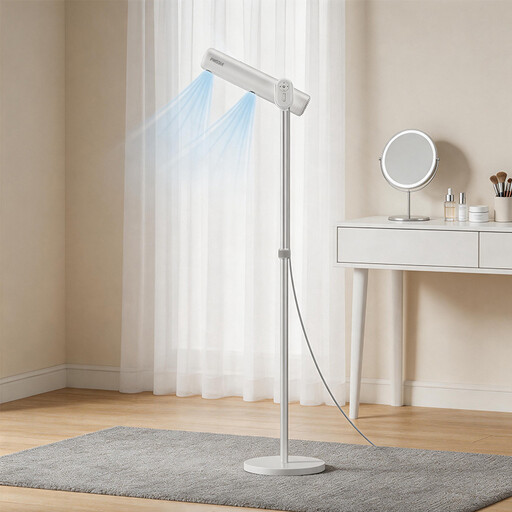
Why This Fits Their Persona: A straightforward option for households wanting hands-free drying without moving to a more complex high-speed system. Its stand format is suited to seated drying and shared family routines.
It lists five speed settings, hot and cold operation, dual air outlets and a wireless remote rather than relying only on an ion feature.
Hands-free design, dual outlets, magnetic remote control and a listed 1,500–1,700W power range.
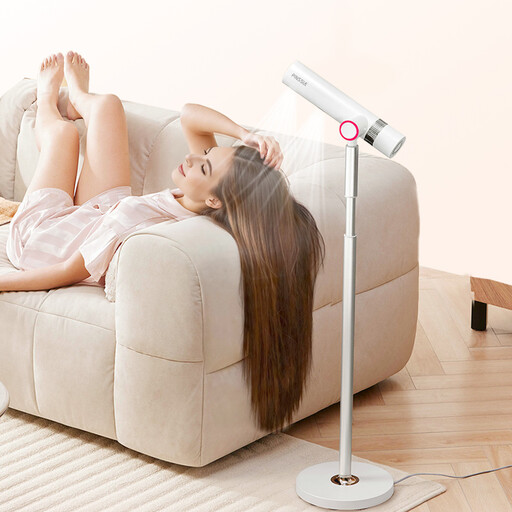
Why This Fits Their Persona: Suits users who want more control over coverage, noise and temperature while keeping both hands free during drying.
Its specifications include automatic swing, five temperature settings, three fan speeds and a dedicated child mode, not just a headline motor figure.
Dual-channel airflow, automatic oscillation, remote operation and a listed noise level of approximately 57dB.
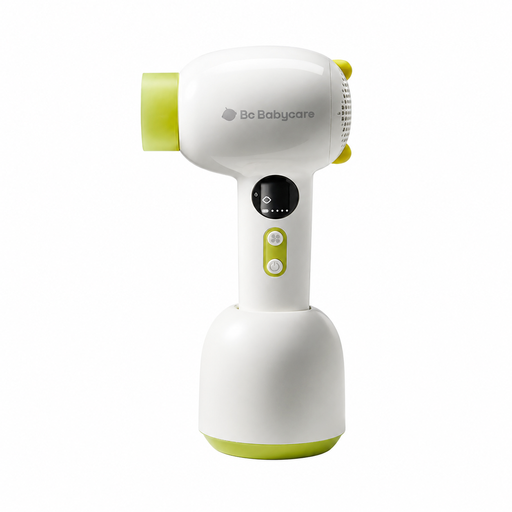
Why This Fits Their Persona: Designed for parents seeking a low-noise, portable option for children and family use, with adult supervision required.
It focuses on a constant 100°F airflow, child lock mode, automatic shut-off and cordless operation rather than maximum heat or speed.
Listed noise level below 60dB, rechargeable design, child lock and a specialised nozzle for focused airflow.
We have compiled a complete, real-time list of products that fully satisfy these strict selection criteria and UK safety regulations.
It can be useful for supervised family routines, particularly when it includes a child mode, low-temperature setting or low-noise operation. Children should not play with the appliance, and the manufacturer’s age guidance must be followed. Keep the hot air outlet away from the face, neck and scalp, and remain present throughout use.
Use a stable, dry, level surface with clear space around the air intake and outlets. Keep it away from baths, showers, sinks and splashing water. Do not place it on a soft surface that could cover the vents, and unplug it after use.
Running cost depends mainly on power rating, usage time and your electricity tariff. A 1,600W dryer used for 10 minutes consumes approximately 0.267kWh, while a 2,000W model used for the same time consumes approximately 0.333kWh. Shorter drying times may reduce total consumption, but actual results vary with hair length, moisture and selected settings.