
24/7 Customer Support

Free returns

Same-day & Next-day Delivery

Quality Guaranteed

Unlock Your Welcome Offers: FREE Delivery | Up to 80% OFF | Free 30-day JoyPlus trial
Download the APP
Choosing between handsaws can be more complicated than it first appears. A large panel saw may cut quickly but feel awkward in a small workspace, while a fine handsaw can produce a cleaner edge yet take longer through thick timber. The right choice depends on the material, finish, blade length and how often you expect to use it.
This guide explains the specifications that matter and highlights suitable options for general construction, joinery, sheet materials, furniture making and portable toolbox work.
A high tooth count is not automatically suitable for every cut. Fine teeth, such as 11/12 TPI or 12 TPI, are designed for controlled cutting and smoother finishes. They are useful for plywood, MDF, chipboard, laminates and detailed woodworking, but may remove material more slowly from thick softwood.
An 8 TPI handsaw generally has more widely spaced teeth. This can make it more suitable for faster general-purpose cuts in timber and sheet materials. Buying a fine handsaw for heavy construction work can lead to unnecessary effort, while using a coarse saw for visible joinery may leave a rougher edge.
A 550mm (22in) blade provides a longer stroke and useful reach for larger panels, framing and general site work. However, it requires more clearance and may be inconvenient inside cupboards, loft spaces or smaller workshops.
A 335mm (13in) junior handsaw or 350mm (14in) toolbox saw is easier to carry between jobs and manoeuvre in confined areas. A shorter blade does not make the saw unsuitable; it simply matches a different working environment.
Marketing often emphasises cutting speed, coatings or tooth geometry. These features matter, but an uncomfortable handle or flexible blade can make accurate work difficult. Check for a rigid blade, a secure grip and useful marking guides before paying extra for performance claims.
A hardpoint handsaw is also worth considering where frequent use is expected. Its teeth are designed to retain a cutting edge for a period of use, although any saw will eventually require replacement when cutting efficiency declines.
TPI means teeth per inch, and it provides a practical indication of the saw’s cutting character:
Tooth count alone does not determine performance. Tooth shape, blade quality, stroke direction and the material being cut also affect the result.
For large boards and open-site work, a 550mm panel saw gives a longer cutting stroke and broad working reach. For smaller components, a 250mm or 300mm tenon saw offers greater control and is easier to use with a mitre box.
A compact toolbox saw is practical for installers, maintenance workers and tradespeople who carry tools between properties. It can also be more convenient for home users who have limited storage.
C75 steel is specified on several IRWIN Jack universal models, providing a rigid blade construction for controlled cutting. Coatings can reduce friction or help protect against corrosion, but they do not remove the need to store tools dry and inspect them regularly.
Look for a handle that gives a secure grip without forcing the wrist into an awkward position. Integrated 90° and 45° guides can also help with quick marking out during carpentry and installation work.
The following options match different working patterns rather than one universal definition of suitability.
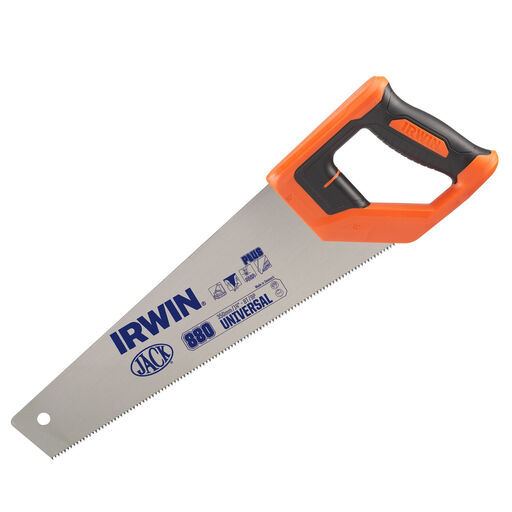
Why This Fits Their Persona: A practical option for DIY users, apprentices and installers who need one portable saw for everyday timber and sheet-material tasks around a UK home or job site.
Its 350mm blade avoids the inconvenience of carrying a full-size panel saw, while the 8 TPI layout is less specialised than fine-toothed alternatives.
C75 steel blade, Triple Ground tooth design, water-based lacquer coating and integrated 90°/45° guides.
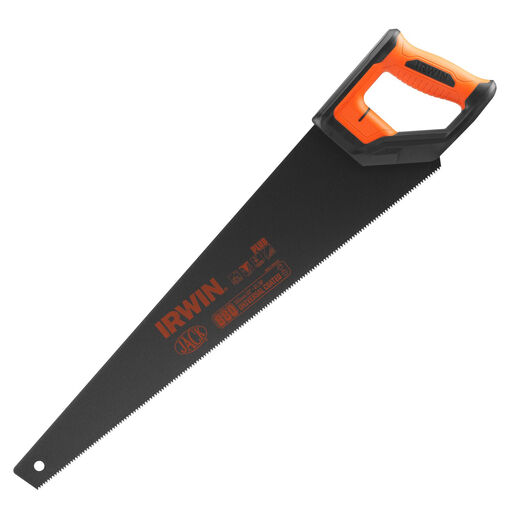
Why This Fits Their Persona: Suits carpenters, builders and regular workshop users who value a full-length blade for repeated general cutting and site work.
The 550mm length is selected for reach and stroke efficiency rather than compactness, making its intended use clear before purchase.
C75 steel blade, coated surface, 8 TPI tooth pattern and soft-grip handle with 90°/45° marking guides.
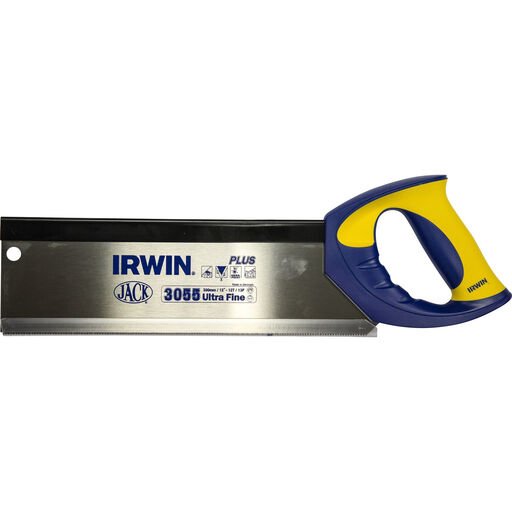
Why This Fits Their Persona: The compact blade and fine tooth configuration suit joinery, furniture components, mouldings and detailed woodworking where line control matters.
It is clearly positioned as a tenon saw rather than a general-purpose panel saw, so buyers can match its 250mm reach and 12 TPI teeth to precision work.
Hardpoint blade, Triple Ground tooth design, push-and-pull cutting action and compatibility with mitre boxes.
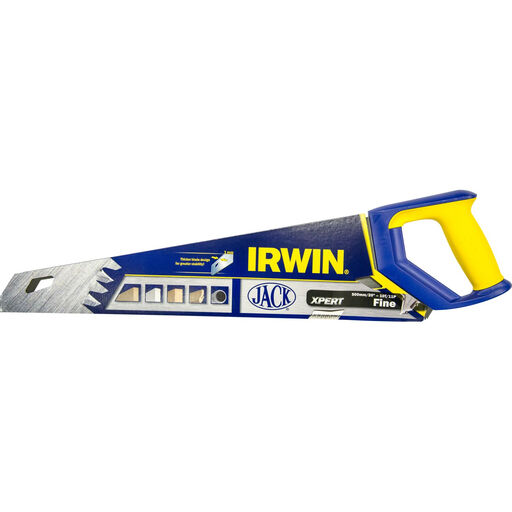
Why This Fits Their Persona: A full-length fine handsaw for carpenters, furniture makers and DIY users cutting plywood, MDF, chipboard and other man-made boards where the edge will remain visible.
Its stated 11/12 TPI specification identifies it as a finish-focused saw, reducing the risk of buying a coarse general-purpose blade for detailed board work.
550mm blade, fine 11/12 TPI teeth, soft-grip ergonomic handle and suitability for engineered sheet materials.
If a full-size saw is impractical, the IRWIN Jack 990UHP Fine Junior/Toolbox Handsaw has a 335mm (13in) blade and 12 TPI teeth. It is designed for tighter spaces, smaller components and portable storage in a toolbox or tool bag. This format can be useful for installers, maintenance work and occasional home projects where control is more important than cutting across large boards.
For metal-cutting tasks, a junior hacksaw is a different tool category. The C.K. Junior Hacksaw includes a tensioned steel frame, a fitted 150mm 32 TPI blade and one spare blade. Do not substitute a wood-cutting handsaw for metal work; the blade pitch and frame design serve different purposes.
To extend usable life:
We have compiled a complete, real-time list of products that fully satisfy these strict selection criteria and UK safety regulations.
Neither tooth count is suitable for every job. An 8 TPI handsaw is generally more appropriate when quicker cutting and material removal are priorities. A 12 TPI handsaw is more suitable for controlled cuts and a smoother finish in plywood, MDF, chipboard and joinery components.
Lifespan depends on frequency of use, materials, storage and cutting technique. A hardpoint handsaw can be a practical choice for regular work, but abrasive boards, nails, dirt and sideways pressure can shorten tooth life. Keeping the blade clean and storing it safely helps preserve its cutting performance.
They serve different purposes. A panel saw with a longer blade is useful for larger boards and general cutting, while a tenon saw has a shorter, reinforced blade suited to joinery, mitre boxes and accurate detail work. Users who regularly switch between construction and fine woodworking may benefit from keeping both formats available.