
24/7 Customer Support

Free returns

Same-day & Next-day Delivery

Quality Guaranteed

Unlock Your Welcome Offers: FREE Delivery | Up to 80% OFF | Free 30-day JoyPlus trial
Download the APP
Struggling with dim, yellowing halogen headlights on dark British roads? You're not alone. Standard halogen bulbs can make night-time driving feel less secure, and they lack the crisp, modern look of newer vehicles. Upgrading to HB3 LED headlight bulbs is a popular choice for improving visibility, enhancing safety and giving your car a contemporary aesthetic.
However, the market is filled with technical jargon and bold claims, making it difficult to choose the right product. As the Joybuy Product Recommendation Officer, my role is to help you navigate the options. This guide offers practical advice and highlights some solid choices for a straightforward car headlight replacement, focusing on what truly matters: performance, compatibility and value.
The HB3 fitment is also commonly known as a 9005 LED bulb, so these terms can be used interchangeably when searching for the correct replacement for your vehicle.
Before you buy, understanding a few key specifications will ensure you get a bulb that meets your needs and fits your car without issue.
When looking at bright car light bulbs, you'll see two main figures: lumens (lm) and Kelvin (K). Lumens measure the total light output, or brightness. More lumens generally mean a brighter light. Kelvin measures the colour temperature.
The easiest upgrades are plug and play headlights. Look for bulbs advertised with a "1:1 mini size" design. This means the LED bulb has the same dimensions as the original halogen bulb it's replacing, allowing it to fit directly into the headlight housing and connect to the factory socket without any modifications or extra adapters.
Another critical factor for modern vehicles is the CANBUS (Controller Area Network Bus) system. This onboard computer monitors your car's electrical systems. Because LEDs use less power than halogens, the system can mistakenly think a bulb has failed, triggering a dashboard warning light or causing the light to flicker. To prevent this, many kits are sold as CANBUS LED bulbs, meaning they have circuitry built-in to work with these systems. For some sensitive vehicles, particularly from European manufacturers, an additional decoder may still be required.
LEDs generate heat, and managing that heat is crucial for performance and longevity. There are two primary cooling methods:
A good cooling system directly contributes to a longer lifespan, often exceeding 50,000 hours, which means you won't be worrying about another car headlight replacement for years to come.
Here are a few recommendations that stand out for their design, features and user-friendliness.
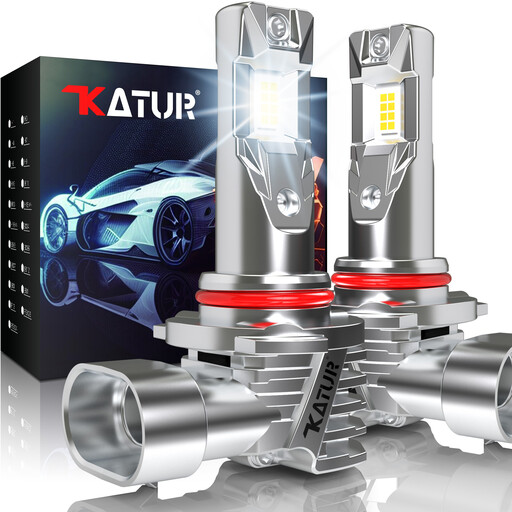

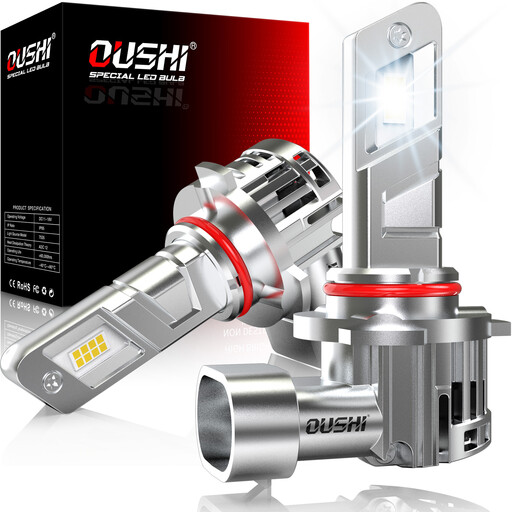
If our recommendations don't quite match what you're looking for, or if you'd like to compare more models with different specifications, we have a wider selection available.
Explore our full range of 9005 headlight bulb options to find the perfect fit for your vehicle.
Are HB3 and 9005 bulbs the same? Yes, HB3 and 9005 refer to the same single-filament bulb fitment and are completely interchangeable. HB3 is the ECE designation common in Europe, while 9005 is the SAE designation used in the US and other regions. Always double-check your vehicle's owner's manual to confirm the correct fitment for your high or low beams.
Will I need a CANBUS decoder for my car? It depends on your vehicle's make, model and year. Many modern cars, particularly from brands like Volkswagen, BMW, Audi and Mercedes-Benz, use a sensitive CANBUS system. While many CANBUS LED bulbs have built-in compatibility, some vehicles may still require an additional external decoder to prevent dashboard error messages or flickering.
Is it difficult to perform a car headlight replacement from halogen to LED? For most cars, upgrading to plug and play headlights is a simple DIY task. Bulbs with a 1:1 design can be swapped just like a standard halogen bulb, often without any tools. The main challenge can be accessing the back of the headlight housing, which varies in difficulty from car to car. A quick search for a tutorial specific to your vehicle model can be very helpful.