Home photo archivists
If family photos, videos and laptop folders keep growing, focus on enough room for a separate copy that you can restore. The National Cyber Security Centre advises storing backups in a separate safe location.


Choose a portable hard disk drive (HDD) when room for periodic local backups matters more than transfer speed; a portable solid-state drive (SSD) suits frequent large photo or video transfers. A USB flash drive is useful for carrying selected files, but do not rely on it as the only copy of irreplaceable photos. Whichever device you choose, check its connection and format against your devices and keep another copy in a separate safe location.
If family photos, videos and laptop folders keep growing, focus on enough room for a separate copy that you can restore. The National Cyber Security Centre advises storing backups in a separate safe location.
If you regularly copy large photo, video or project files, an SSD may make more sense than an HDD. Which? distinguishes faster SSD transfers from HDDs suited to longer-term backup; the speed available to you also depends on your connection.
If the same files need to move between Windows and Mac computers, or possibly a phone or tablet, check the port, cable, device support and drive format before choosing a capacity. A matching USB connector alone does not settle every compatibility question.
Start with what the drive must hold and how often you will move files: an HDD suits capacity-led local backup, an SSD suits frequent large transfers, and a flash drive suits selected files. Then check device compatibility and decide where a second safe copy will live.
| Concern | What to check | Who this matters to |
|---|---|---|
| Backup space and routine | Check the size of the folders you intend to copy, allow for additions and decide how you will repeat the backup. | When my laptop and photo library keep growing, I need room for a separate copy that I will update. Around 26% of consumers put backup space and routine first. |
| Device compatibility | Check each device’s port and external-storage support, the required cable or adapter, and the file format it can use. | If I move files between computers or onto a mobile device, I need the drive to work with each one. Compatibility comes first for around 26% of consumers. |
| Transfer speed and durability | Compare specifications for the exact drive with your host port and cable; read the conditions behind drop or water-resistance claims. | Large photo or video transfers could take up too much of my day, especially when I carry the drive between places. Around 21% of consumers prioritise speed and portable durability. |
| Separate-copy protection | Plan another safe location for important files, and check that you can restore a few of them. | My irreplaceable photos need protection even if one drive is lost or affected while connected. Keeping a separate recoverable copy is the primary need for around 16% of consumers. |
| Compact file transfers | Check that a flash drive’s connector and capacity suit the selected folders you want to carry. | I mainly want to take a few folders between compatible devices, not carry my whole archive. Around 11% of consumers put compact transfers first. |
Moving files off a laptop without retaining another copy leaves them dependent on that drive. The National Cyber Security Centre advises keeping important data in a separate safe location and warns that connected USB backups can be affected by ransomware.
Keep another copy elsewhere, disconnect removable backup storage when appropriate, and try restoring a sample of important files.
Changing a drive’s format erases files already on it; choosing a format for Windows-and-Mac use is not a reason to skip that precaution.
Copy the files you need to another location first, check that the copy opens, and confirm the format required by every device that must use the drive.
A faster-rated drive cannot deliver its stated maximum through every host connection. Samsung says the T7 Shield’s published maximum requires a compatible USB 3.2 Gen 2 host and cable with UASP enabled; Kingston also qualifies its flash-drive speeds by host hardware, software and usage.
Check your laptop’s port and the cable for the exact drive before making transfer speed the deciding factor.
Samsung says its T7 Shield water, dust and drop claims come from controlled tests, while liquid, dust and drop damage are excluded from its warranty coverage.
Treat the rating as a feature with stated limits, protect the drive in use and read the warranty terms for the exact model.
These examples cover different storage needs; features and conditions belong to the named product lines, not every drive from each brand.
The T7 Shield is a portable SSD line to consider for frequent large-file transfers and a travel-ready enclosure.
The Extreme Portable SSD line is relevant when moving large files and carrying the drive are priorities.
The My Passport portable HDD line is relevant to capacity-led local backups and a planned copying routine.
Expansion Portable is a portable HDD line to consider for straightforward local file storage and backup.
The DataTraveler Max USB-C line is an option for carrying selected files between compatible devices.
These HDDs suit capacity-led local copies of laptop files and photos; the SSDs offer alternatives when you also expect to move large files frequently. Choose a capacity for the files you intend to retain, then check the exact connection and format for your devices.
 No image available
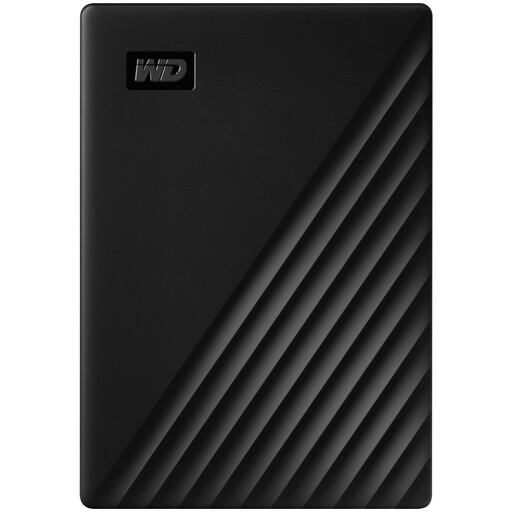
Consider this portable HDD if your photo and laptop-file collection calls for a 4TB local copy. Check the cable, your laptop’s port and the file-sharing requirements of any Mac you intend to use.
 No image available
This 2TB portable HDD is an option for a smaller local collection of photos and laptop files. Before setting up recurring copies, check its connection and the format your computers need.
 No image available
Consider this 4 TB portable SSD if you want one local drive for a substantial file collection and frequent large transfers. Its title specifies USB 3.2 Gen 2; check that your host, cable and file format suit the way you will use it.
 No image available
This 4TB portable HDD is another capacity-led choice for a local photo and file copy. Its title specifies USB 3.0; check the cable and whether the drive’s format works with each computer you plan to use.
 No image available
Consider this 2TB portable SSD for a local file copy that you also expect to carry. Confirm the connector, cable and file format for your devices, and check the exact model’s performance and handling claims before choosing it for travel.
ExFAT is a format to consider for Windows-and-Mac file exchange: Apple Support identifies it as Windows-compatible and specifies it for Windows-use volumes over 32 GB. Check every device that must use the drive, and copy existing files elsewhere before reformatting because formatting erases them.
Not necessarily: a USB-C socket alone does not establish that a phone or tablet can power, read and write to a particular drive and format. Check the device maker’s external-storage guidance, the drive’s requirements and whether an adapter or powered hub is needed.
Do not make it the only copy of irreplaceable photos. The National Cyber Security Centre advises keeping backups in a separate safe location and notes that ransomware can affect connected USB storage; retain another copy and test that important files can be restored.
For UK online, mail and telephone purchases, GOV.UK says customers can cancel within 14 days of receiving an item and then have another 14 days to return it. Remedies for faulty or misdescribed goods are separate from a change-of-mind cancellation; keep your order details and check which situation applies.