Archive-first project keepers
If the drive will mainly hold completed exports, source clips and project folders after assessment, investigate a portable HDD with enough capacity for the whole archive. Keep another copy on separate storage.


A portable HDD is worth considering when the main task is keeping completed footage and project folders; a portable SSD makes more sense if you will move large files often or work from the drive on compatible computers. Measure the full project, check the computers and file format you need, and keep a separate second copy rather than relying on either drive alone.
If the drive will mainly hold completed exports, source clips and project folders after assessment, investigate a portable HDD with enough capacity for the whole archive. Keep another copy on separate storage.
If you regularly move large video folders between school and home, or plan to work from the drive, investigate a portable SSD. Check that the computers and cable can support the connection you intend to use.
If the same drive must work with Mac and Windows computers, plan its file format before copying anything. For footage identifying classmates, staff or interview subjects, follow the school's storage policy and consider appropriate encryption and access controls.
Choose it when: Your priority is space for completed footage and project folders, rather than frequent large-file transfers.
Bear in mind: A USB connection label alone does not establish SSD-like transfer performance, and one HDD is not a complete archive.
Choose it when: You expect to move large files repeatedly or work from the drive on a compatible computer.
Bear in mind: Rated speeds depend on the model, host and cable; you still need enough capacity and a separate copy.
| Concern | What to check when buying | Who this matters to |
|---|---|---|
| Archive space and a second copy | Measure source footage, project files and exports, allowing for revisions. Arrange another copy on different storage media in a separate location. | I need the complete project to fit and remain available if one drive is lost or fails; around 45% of consumers put archive space and a separate copy first. |
| Repeated transfers | Check the ports on the school and home computers and the cable needed for the drive's stated connection. | Moving large folders back and forth makes transfer time important to me; around 33% of consumers prioritise frequent file movement. |
| Cross-device access and footage protection | Confirm the required Mac and Windows read-and-write access. For identifiable footage, check the school's storage and encryption policy. | I need to open the archive on both computers or protect footage of other people if the drive goes missing; about 22% of consumers place compatibility or protection first. |
A drive can fail or be misplaced. The Library of Congress advises keeping copies on at least two different storage media in separate locations.
Arrange an independent second copy before deleting footage or project files from their original location.
Formatting erases existing files. Apple documents ExFAT for disks used with both Mac and Windows computers, but changing format is not a harmless compatibility fix.
Copy the archive elsewhere first, then confirm whether both computers actually need to write to the drive before choosing a format.
Samsung's maximum ratings for the 2TB T7 Shield depend on a USB 3.2 Gen 2 host and cable with UASP support; those ratings do not describe every school computer.
Check the ports on each computer you will use and choose enough storage for the project, even if a faster connection is available.
If a portable drive is lost, people other than its owner may gain access to its files. The Information Commissioner's Office identifies encryption of personal information on removable and backup media as a protection against unauthorised access.
Follow the school's policy for storing and sharing footage, including any encryption and password-management requirements.
Its Elements Portable HDD line is relevant when capacity for a completed archive is the priority.
The researched 2TB T7 Shield MU-PE2T0S/EU is a portable SSD to consider for frequent file movement.
Its One Touch range includes HDD options for larger archives and SSD options for a different transfer workflow.
Its X10 Pro portable SSD support resources may be useful when checking drive-management options for a specific model.
These portable SSDs and HDDs offer different starting points for storing a school video project. Match the listed capacity and connection to your files and computers, then plan a separate archive copy.
 No image available
Consider this portable SSD if you expect to move project files often and its capacity fits the complete archive.
Listed configuration: 4 TB, USB Type-C and USB 3.2 Gen 2. Check the computers' ports and the file format needed before copying files.
 No image available
Consider this portable SSD for an archive that will be moved regularly, provided 4 TB meets your measured storage need.
Listed configuration: USB Type-C and USB 3.2 Gen 2x2. Check whether your computers have a compatible port before relying on that connection, and confirm the file format required at school and home.
 No image available
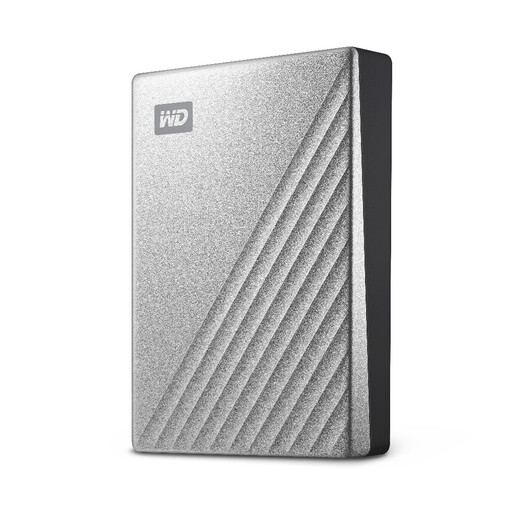
Consider this HDD for keeping completed project files when 4TB covers the full archive.
If both Mac and Windows computers need to write to it, confirm the required file format or driver with the school before transferring files.
 No image available
Consider this portable SSD for repeated file movement if the complete project will fit within its 2TB capacity.
The listing names USB 3.2 Gen 2 and rates transfers at up to 1,050 MB/s read and 1,000 MB/s write. Check the host connection and choose the required file format before copying files.
 No image available
Consider this portable HDD when the main job is holding completed footage and project folders.
Listed configuration: 4TB and USB 3.0. Check the format required for a Mac or other computers before transferring files, and keep a second copy elsewhere.
No: treat it as one copy, not the whole preservation plan. The Library of Congress recommends copies on at least two different storage media in separate locations.
For a drive that both computers need to use, Apple documents ExFAT as a cross-platform option and recommends it for disks over 32 GB. Confirm the school's requirements and copy existing files elsewhere before formatting, which erases the drive.
No. Samsung's ratings of up to 1,050 MB/s read and 1,000 MB/s write for the 2TB T7 Shield require a USB 3.2 Gen 2-capable host and cable with UASP enabled. Check the actual computers before choosing that model primarily for its rated speed.
Follow the school's rules for storing and sharing identifiable footage. The Information Commissioner's Office identifies encryption of personal information on removable or backup media as a protection against unauthorised access, particularly if the device is lost; manage passwords and access permissions as well.